


Unlock the Editor’s Digest for free
Roula Khalaf, Editor of the FT, selects her favourite stories in this weekly newsletter.
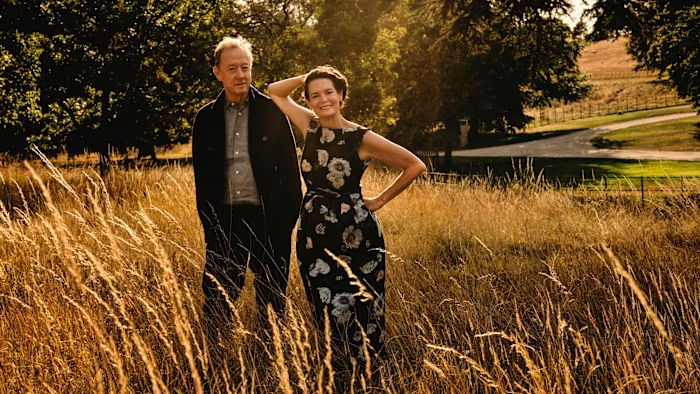
It is all my wife’s fault. Never for a minute did I imagine I would end up with a spa and wellness retreat in an 18th-century, Strawberry Hill Gothic old rectory in the foothills of Glastonbury, in glorious Somerset.
It started as a somewhat mad real-estate venture, the equivalent of Escape to the Chateau, only in the heart of the West Country. And it has taken eight long years repairing buildings and grounds that were at risk of decay and/or falling down. Now fully restored and reconfigured, the hay barns are, somewhat to my surprise, a house of balm.
Perhaps I should have read the runes back in 1993 when my Texan wife Kathryn, then my girlfriend, booked us into an eco-hotel in Mexico on our first holiday together. The bed was a slab of concrete suspended by ropes, and the food was vegan before the word had entered common usage. Even though “bed” acquires at least seven seductive syllables in a Texan drawl, the Flintstones-style berth was still deeply uncomfortable. And even then she mentioned this rather mystifying word “wellbeing”.


At the time I was The Sunday Times’s US correspondent, covering revolution in Haiti, floods on the Mississippi, riots in Los Angeles and the scandals and triumphs of the Clinton years. My own wafer-thin connection to “wellbeing” came at the Hotel Oloffson in Port-au-Prince, immortalised by Graham Greene in The Comedians, where a corpse famously appears in the swimming pool. By that same pool I encountered a voodoo-practising masseur who claimed to have massaged Elizabeth Taylor when she was filming here with Richard Burton. With gunfire crackling outside and revolution unfolding in the streets, I booked a massage. It remains the closest I ever came to Elizabeth Taylor.
Life has since pivoted rather unexpectedly towards what one might whimsically call our North Spa! My thoughts now occasionally drift towards reiki, sound baths, meditation, thermal effect therapy and even kick-boxing.
When we bought the former rectory eight years ago, pre-Covid, no one appeared to want it. It had been on the market for two years: an echoing house with crumbling cottages. One had no ceiling or electricity. Its price tumbled and we fell for its Blue Lias stone, monumental yew hedge and castellated roof-line. In the years since, the main house has been transformed, its gothic windows now no longer emitting whistling draughts and its sweeping stone staircase secure. The three cottages have been repaired, transformed and readied for the next century. Outside is a scent-filled garden. It is all quite a leap from my first rented digs as a cub reporter and days spent covering murders in Deptford, south-east London, and hanging out with gangland bosses Charlie Richardson and “Mad” Frankie Fraser.


Almost surreptitiously, Kathryn has transformed our home from Trollopian rectory into an oasis of wellbeing. She moves effortlessly from bidding for obscure Victorian ceramic dairy bowls to hang on walls to finding Indian campaign furniture, Robert Kime textiles and fabrics sourced in Uzbekistan. Upstairs Downstairs Interiors, who created countless lampshades and chair covers, almost became part of the furniture. There is a contemporary 13m bronze light sculpture by artist Jess Wheeler cast from our lime-tree leaves to hang between oak beams in the wellbeing barn.
Beyond the garden stands a 13th-century church of honey-coloured stone, where services have been held for eight centuries. Looking up towards it each morning feels like living inside a Constable painting. I once imagined a life of gentle Arcadian decay, time slipping by without much interruption. Kathryn had other ideas.
She was the only teenage girl in east Texas with a subscription to Country Life, even then enamoured with English architecture, gardens and decoration. She was never going to sit still. This has always been Kathryn’s vision rather than mine. But this is not a Spartan spa. It is deep Southern comfort – Nancy Lancaster meets Martha Stewart with a touch of Joe Wicks. Not a concrete slab in sight. It even has a Japanese onsen, ice baths and a large Thermo aspen sauna with a HUUM heater.


There was, admittedly, a touch of The White Lotus about our early journey into spa life. Five years ago Kathryn went to a boot camp outside Shrewsbury: 5am starts, boxing, burpees, starvation rations and shouted instructions. It was run by trainer Ashley Evans and marketing executive Hayley Bright, both of whom wanted something more ambitious. Kathryn spoke about her vision; they spoke about theirs. Unlike The White Lotus, everyone survived. Better still, they joined forces: Ashley and Hayley now run our wellbeing retreat.
The retreat’s name, At Winterbourne, comes from the word for a stream that only runs in winter – here from November to May, switched on and off by nature itself. Like every paradise, it has had its serpents – or, in our case, bats. A colony in the barn rafters forced us to build a bat house the size of two double-decker buses, complete with electric blankets, trapezes and carefully engineered roosting zones – the same dizzyingly expensive bat regulations that led to the £100mn HS2 bat tunnel.
But once the bats were dealt with, At Winterbourne settled into something more coherent: a modern wellness retreat with ice baths and sauna within an
18th-century landscape. The old barn is a gym with cathedral dimensions. An ancient cedar of Lebanon from the reign of Charles II spreads its branches across the lawn, unchanged and indifferent to all of it. And being near Glastonbury has brought unexpected opportunities. We have partnered with Camp Kerala, pioneers of luxury glamping, and its Shift wellbeing arm. During last year’s Festival we rented the house to a group of 11 American-Asian tech entrepreneurs.


Yet the greatest luxury remains the West Country. Stourhead is a short distance away, as is Longleat. Our fields are dotted with Dorset Horn sheep, descended from Spanish merino herds smuggled into southern England in the 16th century. Buffalo mozzarella comes from a nearby herd; venison from the local gamekeeper, Bejay; honey is made in hives in the surrounding fields. Curated walks lead through cliffs, beaches and landscapes that inspired Trollope’s Barsetshire, while the rare Large Blue butterfly has quietly returned.
Somerset has a restorative quality that resists explanation. We have had open days with 300 locals and different families renting the cottages for a single night or a week. I have seen 35 people on the lawn doing Pilates.
We are genuinely pleased to open up much of our home. Eight years ago I thought we were buying an old house where home life might finally slow down. Instead, Kathryn quietly built an entirely new life around it. Seeing guests in white towelling dressing gowns drifting by on their way to a cold-water swim still feels faintly unreal, but every day I understand a little more clearly why she saw something here long before I did.
