

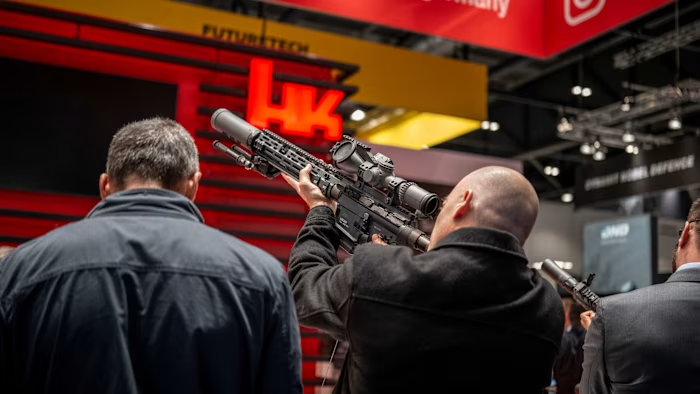
A German gunmaker owned by a descendant of Napoleon is jostling to supply the British Army with its next standard-issue rifle.
Heckler & Koch, a 77-year-old small arms maker with a colourful past, is one of several global gunmakers positioning themselves for Project Grayburn, a programme to replace the SA80 service rifle that industry insiders expect to be worth around €500mn.
H&K has a Nottingham-based facility that has performed several upgrades on the SA80 and this year bought a British gun components manufacturer to enable it to offer UK-based manufacturing.
“Our weapons are deeply embedded in British history,” chief executive Jens Bodo Koch told the FT. “There are pictures with Margaret Thatcher and the SAS with the MP5 [H&K’s submachine gun]. There are photographs of Lady Di with our weapons.”
H&K will offer as many as three different options to the British army as it performs its first wholesale rifle replacement in four decades, buying somewhere between 150,000 and 180,000 new guns.
One is a fresh upgrade of the SA80 and another is the HK416, which has been chosen by the German Bundeswehr as its own standard-issue rifle in a deal worth €800mn to the company.
The offer will depend partly on the precise British specifications, yet to be announced, which must decide on trade-offs between the rifle’s accuracy, weight and its performance over different ranges, as well as the speed and power of the bullet.
Rivals are expected to include Belgian state-owned gunmaker FN Browning Group, which in May bought a UK sniper maker, as well as Italy’s Beretta and Sig Sauer of the US.
Koch, who is not related to the company founder of the same name, said it was “no secret” that H&K weapons were often more expensive than their peers. He said the company’s pitch would focus on their “high level of robustness, precision, quality and endurance”.
The company’s assault rifles are used by special forces across Nato, playing a role in high-profile operations — from the ending of London’s Iranian Embassy siege in 1980 to the killing of Osama bin Laden by US Navy Seals in 2011.
H&K was founded in 1949 in the south-west German town of Oberndorf am Neckar by a trio of German engineers: Edmund Heckler, Theodor Koch and Alexius Seidel. All three had previously worked together at the gunmaker Mauser, which supplied Adolf Hitler’s Wehrmacht. Heckler later moved to HASAG, where he became a senior manager in what would become one of the largest munitions companies in the Third Reich.
After the war, Heckler, Koch and Seidel salvaged what they could from the Mauser factory in Oberndorf, which had been dismantled by occupying French forces. Initially hampered by a ban on weapons production in Germany, they started out making machine tools and industrial equipment. But they went on to become a leading supplier of rifles to the Bundeswehr and other militaries and police forces.
The company also has a complex ownership history.

In 1991, it was bought by the British state-owned Royal Ordnance, the maker of the Lee-Enfield rifle. It became part of BAE Systems in 1999 but was put up for sale three years later and bought by a consortium of private German investors.
That marked the start of a rocky period for the company. It struggled with debt and a scandal involving exports to conflict-riven parts of Mexico that led to a €3.7mn fine and forced the company to adopt a stricter policy on foreign sales.
Koch said that he sought to run the company “to the highest compliance standards”.
In 2015, the financier Nicolas Walewski — who is descended from Napoleon Bonaparte through an affair he had with the Polish Countess Marie Walewska — took a stake in the company via his Luxembourg investment vehicle CDE. Walewski became the majority shareholder in 2020, and in 2025 won a legal victory in a long-running battle with one of the previous owners.
Koch said Walewski was a “financially very strong and highly supportive anchor investor” who had backed the company with a shareholder loan in 2018 when it needed to invest in machinery.
Around 5 per cent of H&K’s shares are listed on France’s Euronext Access, a lightly regulated market for smaller companies. The share price is less than half what it was before the war in Ukraine, making it one of the only European defence companies to have seen a decline in its market capitalisation over the past four years.
Koch said that there was “effectively no trading” of the company’s stock. At other times, he said, the stock had been so overvalued that it was “like owning a collectible”.
The war in Ukraine has helped improve public attitudes towards arms makers such as H&K in Germany. In 2023, Boris Pistorius became the first German defence minister to visit the company’s Oberndorf site in 14 years.
It has also proved a boon to its order book, up from €219mn in 2021 to €700mn at the end of last year.
Revenues hit a record €393mn in 2025, driven by strong growth in European sales, including supplies to Ukraine that are paid for by the German government. Net profit was €40mn.
Koch said the company was “constantly” asking itself about the future of handheld weapons at a time when unmanned warfare and AI-powered weapons are taking centre stage.
It has been experimenting with drone defence.
But H&K remains convinced, Koch said, that infantry combat will always exist and that soldiers will always need a personal weapon. “Perhaps the weapon will look different, but there will certainly still be a weapon,” he said. “So we are firmly convinced that we have a long future ahead.”
