


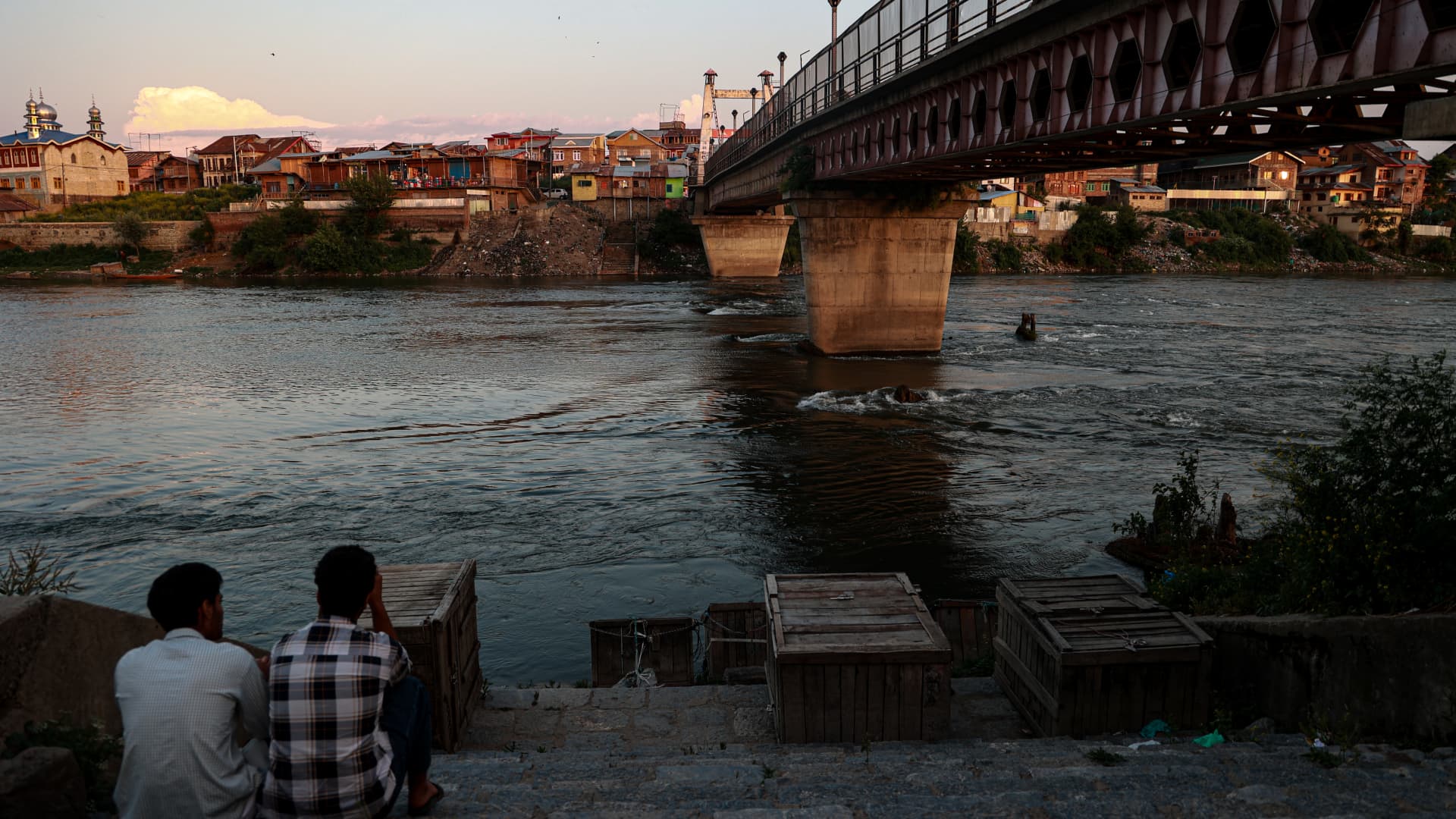
Two boys sit on the banks of the River Jhelum in Sopore, Jammu and Kashmir, India, on May 7, 2026. The Jhelum River flows through India and Pakistan under the framework of the Indus Water Treaty, with recent tensions and border conflicts bringing renewed attention to its water-sharing provisions.
Nurphoto | Nurphoto | Getty Images
The Indian government has categorically rejected an arbitration ruling which said the country must uphold a decades-old water-sharing treaty with Pakistan and limit construction on a hydroelectric project in the disputed Kashmir region.
The Permanent Court of Arbitration (PCA) in the Hague on Monday ruled in Pakistan’s favor over the 1960 Indus Water Treaty, saying the historic pact remains fully binding and that India had no valid grounds for ending or suspending it.
India, which moved to put the agreement “in abeyance” last year, said its decision remains in force.
“This so-called Court of Arbitration has no jurisdiction whatsoever to pronounce on India’s sovereign decisions,” India’s Ministry of External Affairs said in a statement on Monday.
“Its pronouncements, now or in the future, will have no effect on India’s actions in connection with the projects being undertaken by India,” it added.
The PCA also ordered India to limit construction on the Ratle hydroelectric plant in Kashmir, prohibiting work on the dam wall and power intake structure above certain levels. This ruling is set to remain in place until 90 days after a World Bank-appointed neutral expert delivers a final decision, which is expected before July 2027.
The arbitration ruling adds a new layer of stress to a long-simmering water dispute between two nuclear-armed neighbors.
The Indus Water Treaty, brokered by the World Bank, governs the use of the rivers in the Indus basin, which spans India, Pakistan, Afghanistan and China. Under the agreement, India has unrestricted access to the basin’s eastern rivers while Pakistan receives rights to the western rivers.
The treaty has endured three wars and prolonged periods of diplomatic tensions but has come under increasing strain in recent years.
Water security
India moved to put the treaty in abeyance in April last year following a militant attack in Kashmir, for which Delhi blamed Pakistan but Islamabad denied involvement.
Pakistan’s Foreign Minister Ishaq Dar said via social media that Islamabad welcomed the PCA’s court ruling.
“The Award vindicates Pakistan’s consistent position that a binding international treaty cannot be unilaterally suspended or set aside. India must fully comply with its obligations under the Treaty and with the binding decisions of its dispute settlement mechanism,” Dar said Monday.
A view of Baglihar Dam, also known as Baglihar Hydroelectric Power Project, on the Chenab river which flows from Indian Kashmir into Pakistan, at Chanderkote in Jammu region May 6, 2025.
Stringer | Reuters
As the downstream country, Pakistan depends heavily on the Indus Water Treaty, with tens of millions of people relying on the rivers’ waters for their livelihoods and survival.
The Indus basin supplies about 80% of the country’s irrigated agriculture, a sector that employs 65% of the labor force and represents roughly 25% of Pakistan’s gross domestic product, according to data compiled by Chatham House.
