


Ukraine has agreed to speed up Polish requests to exhume the remains of Poles killed during the second world war, a breakthrough that could ease one of the most sensitive disputes between the two allies.
Paweł Kowal, the Polish prime minister’s top adviser on Ukraine, told the FT that Kyiv and Warsaw had struck a deal in August to approve exhumation requests more quickly. Officials in Kyiv confirmed a readiness to accelerate procedures, though they stopped short of saying all permits would be automatic.
Kowal described the agreement as “a big change” after years of reluctance by Ukraine to allow the work.
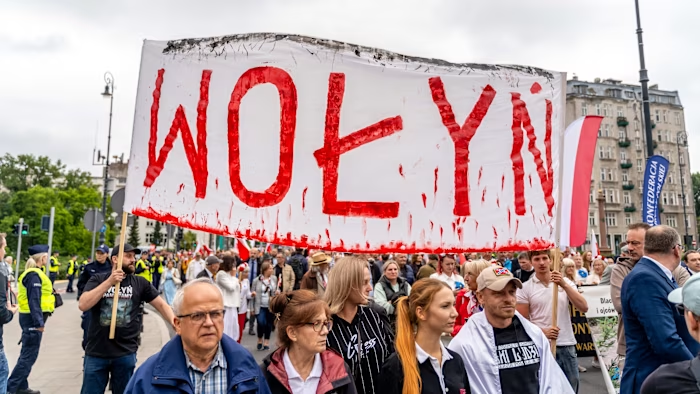
The move marks a shift in Kyiv’s approach to one of the most painful chapters in Polish-Ukrainian history: the legacy of Ukrainian nationalist fighters in what is now western Ukraine, whom Poles hold responsible for the massacre of about 100,000 ethnic Poles.
The exhumations could help soothe resentment in Poland over the spillover from Ukraine’s war with Russia, now in its fifth year. Almost 1mn Ukrainian refugees have settled in Poland, where farmers have been hit by large-scale imports of Ukrainian crops.
On Sunday, 55 Polish victims of the second world war massacre were reburied in Ostrovky, a former Polish village now in western Ukraine, just weeks after their remains were exhumed.
On Sunday, 55 Polish victims were reburied in Ostrówki, a former Polish village now in western Ukraine, just weeks after their remains were exhumed.
But Polish search teams would soon start digging for remains “in two or three places at the same time”, with more planned for next year, said Kowal, who also chairs the Polish parliament’s foreign affairs committee.

Heorhii Tykhyi, spokesperson for Ukraine’s foreign ministry, said Kyiv was “ready to look into dozens of new requests from the Polish side, when they are submitted”, but rejected suggestions that Ukraine was responsible for the slow pace of exhumations.
Oleksandr Alfiorov, head of Ukraine’s national memory institute, the government agency overseeing the process, told the FT it was “determined to consider requests for search and exhumation works as promptly as possible”.
He said he expected Poland soon to submit a new list of digging locations, adding that permits would be granted “as soon as possible”, though “this does not mean that all permits will be automatically issued”.
Tensions over the wartime legacy flared in May when President Volodymyr Zelenskyy renamed one of Ukraine’s special forces units in honour of the “heroes” of the Ukrainian Insurgent Army, or UPA. The force is celebrated in Ukraine for fighting both Nazi Germany and the Soviet Union during the second world war.
In Poland, however, the UPA is remembered for the massacre of ethnic Poles in Volhynia and eastern Galicia. Estimates vary, but historians hold the partisan force responsible for killing tens of thousands of Polish civilians.
The dispute escalated into a diplomatic crisis after Polish President Karol Nawrocki stripped Zelenskyy of the Order of the White Eagle, Poland’s highest state honour. Zelenskyy returned his decoration in June and, in protest, skipped a Polish conference on Ukraine’s postwar reconstruction.
The exhumation deal could now help defuse those tensions.

“We have passed the peak in Polish-Ukrainian tensions,” Kowal said. Ukrainian officials had recognised that “historical and political discussions should be separated from the humanitarian question” of allowing Polish families to honour their dead by reburying their remains, he added.
He also pointed to signs of an economic thaw, including a recent agreement by PZU, Poland’s state-controlled insurer, to buy MetLife Ukraine, which controls about half of the country’s life insurance market.
“The economic data are very positive and I think that some more flagship corporate deals will help explain better to our society that we are getting real economic benefit from Ukraine,” he said.
Warsaw spearheaded military and humanitarian aid after Russia’s full-scale invasion of Ukraine in 2022, but tensions soon rose as the previous rightwing government imposed import bans to shield Polish farmers from cheaper Ukrainian produce.
Kowal said Russian propaganda had sought to exploit historical grievances between Poland and Ukraine to distract from “how real the threat of Russian aggression is”.
The debate comes as Polish Prime Minister Donald Tusk and Baltic leaders have warned that Russia is preparing a major hybrid attack to test the resolve and security of Nato’s eastern flank. Kowal described that threat as a challenge for “a Polish society that has lived for almost four decades in peace”.
Opinion polls ahead of parliamentary elections next year show public sentiment towards Ukraine remains lukewarm. Law and Justice, the main rightwing opposition party, has vowed to block Ukraine’s prospective EU membership.
“I see some efforts from both governments to cool things down, but the political circumstances are not favourable,” said Małgorzata Bonikowska, head of the Centre for International Relations, a Warsaw think-tank.
“In Poland, we are already entering an election campaign in which the Ukraine card will definitely be played.”
