


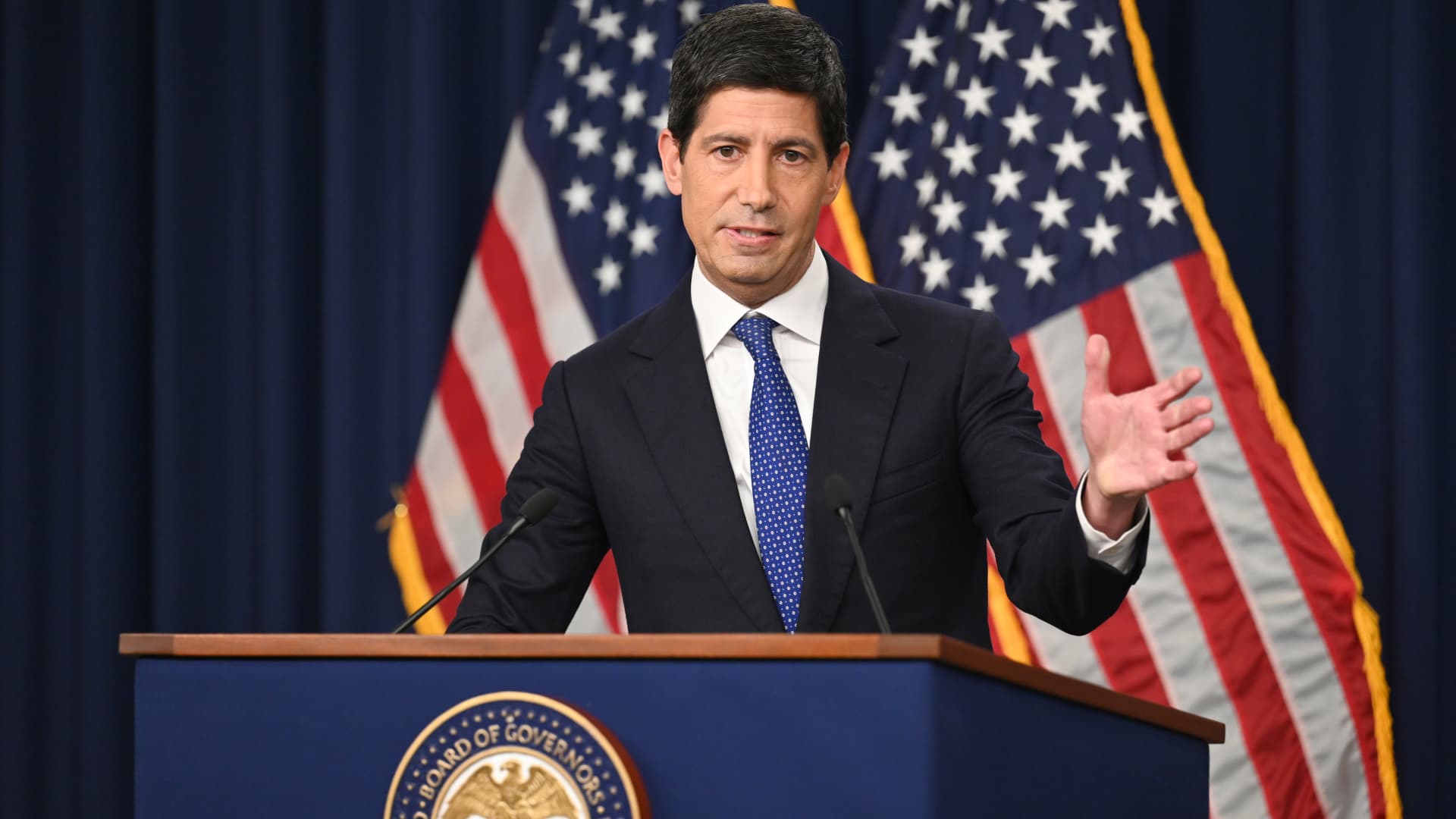
US Federal Reserve Chair Kevin Warsh speaks during a news conference at Federal Reserve Headquarters on September 16, 2026 in Washington, DC. Kevin Warsh discussed the central bank’s decision to raise interest rates for the first time since 2023 at a press conference following its latest policy meeting.
China News Service | China News Service | Getty Images
With a few carefully chosen words, Federal Reserve Chairman Kevin Warsh both explained this week’s decision to hike interest rates and raised vexing questions about what comes next.
Warsh described Wednesday’s decision to lift the central bank’s benchmark rate by a quarter percentage point not specifically as a tightening of policy but rather as removing “a dose of accommodation.” Further, he explained that the move was possible because of a U.S. economy that appears to have “strengthened” and financial conditions that have become less restrictive.
While the language may sound like central bank semantics, it gets to the heart of what markets are debating now: How far will the Warsh Fed go if it has only removed a “dose” of help, and what are the guidelines it will be using to formulate policy?
The phrase was “the one stand-out hawkish element” of Warsh’s post-meeting commentary to the press, Krishna Guha, head of economics and central bank strategy at Evercore ISI, said in a client note.
“This was not a mistake; it was a phrase he repeated several times and looked very much a deliberate choice to frame policy in this way,” Guha added, noting that “the framing is substantively different to that used by the Fed in recent years, and raises the possibility of a more open-ended approach to the number of hikes that might be required.”
That framework has included a calibration of where policy should sit relative to the so-called neutral rate, one that neither boosts nor holds back growth. By extension, benchmark rates that sit well above the neutral rate are considered restrictive, while those closer to or below neutral are regarded as accommodative.
What about neutral?
Warsh’s framing of the hike as removing “a dose” of accommodation could be seen as the first of multiple steps toward withdrawing support the Fed no longer feels is necessary. The Fed is looking to return inflation to 2%, and policymakers generally consider raising rates as a way to tamp down demand and control price pressures.
“Warsh’s framing, if taken literally, raises the possibility that rates might have to keep going up until financial conditions facing the private sector are no longer ‘accommodative’ – however that is defined,” Guha said. “This is a relatively open-ended prospect.”
Warsh had the chance to clarify what benchmark he was using to determine how much accommodation remains in policy.
Asked by CNBC’s Steve Liesman to explain how far he sees the current rate — in a target range of 3.75%-4% — sitting above neutral, Warsh essentially rejected the framing, in a statement that runs counter to how central bank policy has operated for more than a decade.
Warsh said measuring the benchmark rate relative to neutral is “useful academically. It’s a discussion to help us think about policy. Do I think it has any operational effect of decisions that we make today? No, I don’t.”
The answer helped add a layer of mystery to a Fed chairman already developing a reputation for being cryptic when it comes to how he views the wheels of policy needing to be tuned.
Markets wonder what’s next
A round of post-meeting speculation on Wall Street about what’s to come has ensued.
One of the initial reactions was pricing in higher odds for another hike when the Fed next meets in October. Goldman Sachs added an October increase to its forecast, as does Bank of America, which also expects another move in December. The market-implied odds of an October increase were near 58% Friday morning, according to the CME Group’s FedWatch gauge. A week ago, the probability was 42%.
“The word ‘accommodation’ means ‘stimulus” at the Fed; this comment implies that the current monetary policy stance is meaningfully stimulative,” wrote James Egelhof, chief U.S. economist at BNP Paribas Securities.
“With policy starting at a stimulative stance, a strong cyclical impulse, and persistent inflation, we think significant rate increases, perhaps more than the three we expect, may be necessary to stabilize the unemployment rate from below and prevent overheating next year,” he added.
Egelhof agreed that the “dose of accommodation” remark was “the most striking feature” of Warsh’s abbreviated news conference.
Markets are pricing in the likelihood that the Warsh Fed removes a few more “doses” before it is finished. Futures are implying a fed funds rate of 4.635% near the end of 2027, which would argue for three or four more hikes ahead.
If that’s the case, the Fed at the very least will undo many of the FOMC rate cuts approved under Warsh’s predecessor, Jerome Powell, who now sits on the committee as a governor.
The “dose of accommodation” remarks “seemingly helped to underscore this hawkish tone, implying that [the] committee no longer views policy as modestly restrictive,” said Jack Janasiewicz, portfolio manager and lead portfolio strategist at Natixis Investment Managers Solutions.
“We remain unconvinced that this is the start of an aggressive new tightening cycle,” he added. “Rather, we see this as a removal of the insurance cuts the Fed delivered in the fall of 2025.”

