


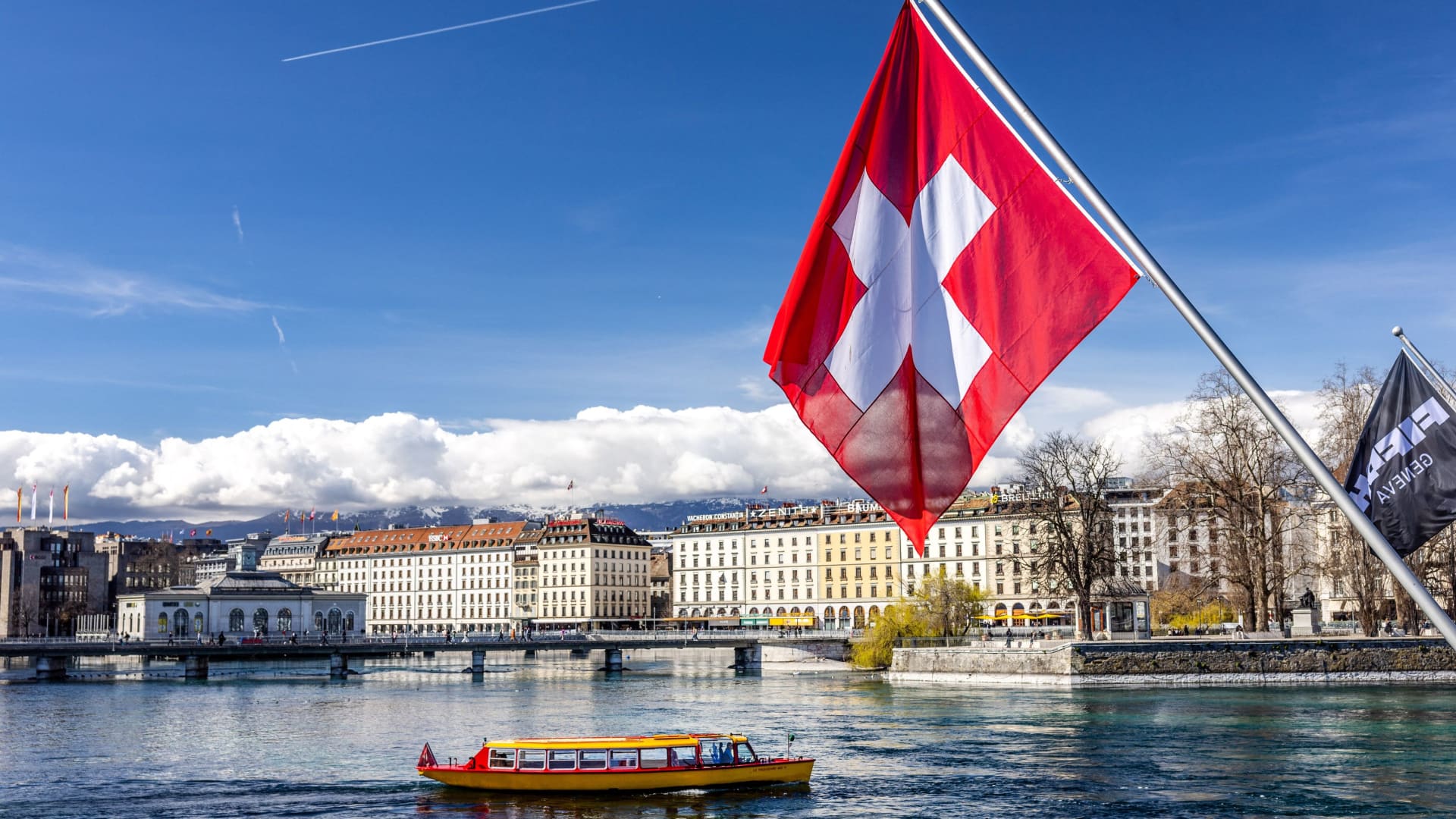
Swiss flag is pictured at the Harbor in Geneva, Switzerland, March 13, 2024.
Denis Balibouse | Reuters
Switzerland’s central bank kept its key interest rate at 0% on Thursday, defying the tightening cycle that has begun among many of its major peers.
But market watchers say it’s only a matter of time before it’s forced into raising rates.
Thursday’s decision marked a divergence from policy decisions by the banks of Switzerland’s major trading partners: the European Central Bank, the U.S. Federal Reserve and the Bank of Japan, which have all begun raising interest rates to ward off rising inflation.
The central banks of Canada and the U.K., also major trading partners, are expected to follow suit later this year.
The unique Swiss economy has kept it somewhat insulated from the inflationary surge seen in neighboring nations and economic peers. In August, Switzerland’s annual inflation rate ticked up to 0.8%, pushed higher due to rising gasoline, diesel and heating oil costs — but it’s a far cry from levels seen in the U.S., U.K. and euro zone.
Their respective central banks have inflation targets of 2%, while the SNB’s objective is to keep inflation between 0% and 2%.
The SNB is widely expected to eventually embark on its own hiking cycle. Traders are pricing odds of a hike versus a hold at close to 50-50 in December — and more than a 90% chance the SNB will begin hiking by early 2027.
LSEG’s data shows traders are betting on the SNB’s key rate rising to at least 0.75% by next September.
One of the factors that helps keep inflation low is the Swiss franc’s safe-haven status. The currency’s strength puts deflationary pressure on the country. As the currency appreciates, imports — which play a significant role in the economy — become cheaper.
U.S. dollar/Swiss franc
Because of the franc’s potential to curb inflation and economic activity if it appreciates suddenly or excessively, the SNB also monitors exchange rates in its task of maintaining “appropriate monetary conditions.”
As investors sought protection from widespread market volatility in 2025, the Swiss franc rose more than 12% against the dollar — but the greenback has clawed back around 4% against the franc so far this year.
The SNB has a history of ‘surprising markets’
Swiss lender UBS had been expecting a preliminary hike from the SNB in June 2027.
But in a note earlier this month, its economists said the falling value of the franc — as well as elevated oil prices and resilient U.S. and euro zone economies — raised the likelihood of the SNB enacting a hike earlier than expected.
“Swiss franc depreciation of more than 2% against the euro and more than 1% against the US dollar since the last SNB meeting in June could increase concerns that inflation will accelerate more than previously anticipated,” they said.
“Although we believe inflation is quite unlikely to exceed 2% over the next 12-18 months, the SNB has a history of surprising markets.”
‘Safe haven dividend’
Gedeon Tumong, head of finance specialization at Switzerland’s HIM Business School, told CNBC the Swiss economy also enjoyed what some economists call a “safe haven dividend.”
“Unlike the U.S., the U.K. and the euro zone, Switzerland imports credibility as much as it imports goods,” he added. “Consequently, foreign capital inflows support the Swiss franc, the strong Swiss Franc by extension curbs imported inflation and low inflation provides enough arguments for the central bank to maintain lower rates than the Fed, the Bank of England or the European central Bank.”
The SNB has previously intervened in foreign exchange markets to stabilize its currency, and has signaled a willingness to do so again in recent years.
The SNB “maintains a highly flexible monetary policy that actively boosts the Swiss Franc,” Tumong said. “When global energy and commodity prices spike the natural appreciation of the franc absorbs the shock, thereby rendering imported goods significantly cheaper for the Swiss consumer.”
He added that energy only accounts for about 3.5% of the Swiss inflation basket compared to about 7% in the euro zone, with Switzerland also helped by alternative energy sources like hydropower and nuclear power, “keeping it somewhat insulated from regional shockwaves.”
Tumong added that Switzerland’s strict fiscal debt brake, which requires balanced budgets, means “the country does not force higher yields to attract bond investors. This would also account for lower rates.”
Antonio Fatás, a professor of economics at INSEAD business school in France and an external consultant for the IMF, told CNBC that Switzerland has a history of low inflation, which keeps inflation expectations low.
“When a shock hits, a central bank that can rely on low inflation expectations will have an easier time managing inflation and keeping it low — that’s the case [for the likes of] Switzerland or Japan,” he said.
However, Fatás added that when considering Switzerland’s real interest rate — its nominal rate adjusted for inflation — the country is not an outlier.
” [An] interest rate at 0% and inflation around 0.8% means a real interest rate of -0.8%,” he said. “In the Euro area, an interest rate of 2.5% and inflation of around 3.2% means a real interest rate of -0.7%, so very similar. The U.K. and U.S. numbers are also similar even if slightly higher.”
“So overall this is a story of low inflation that persists through the years and anchors the expectations of all economic players,” he added.
