


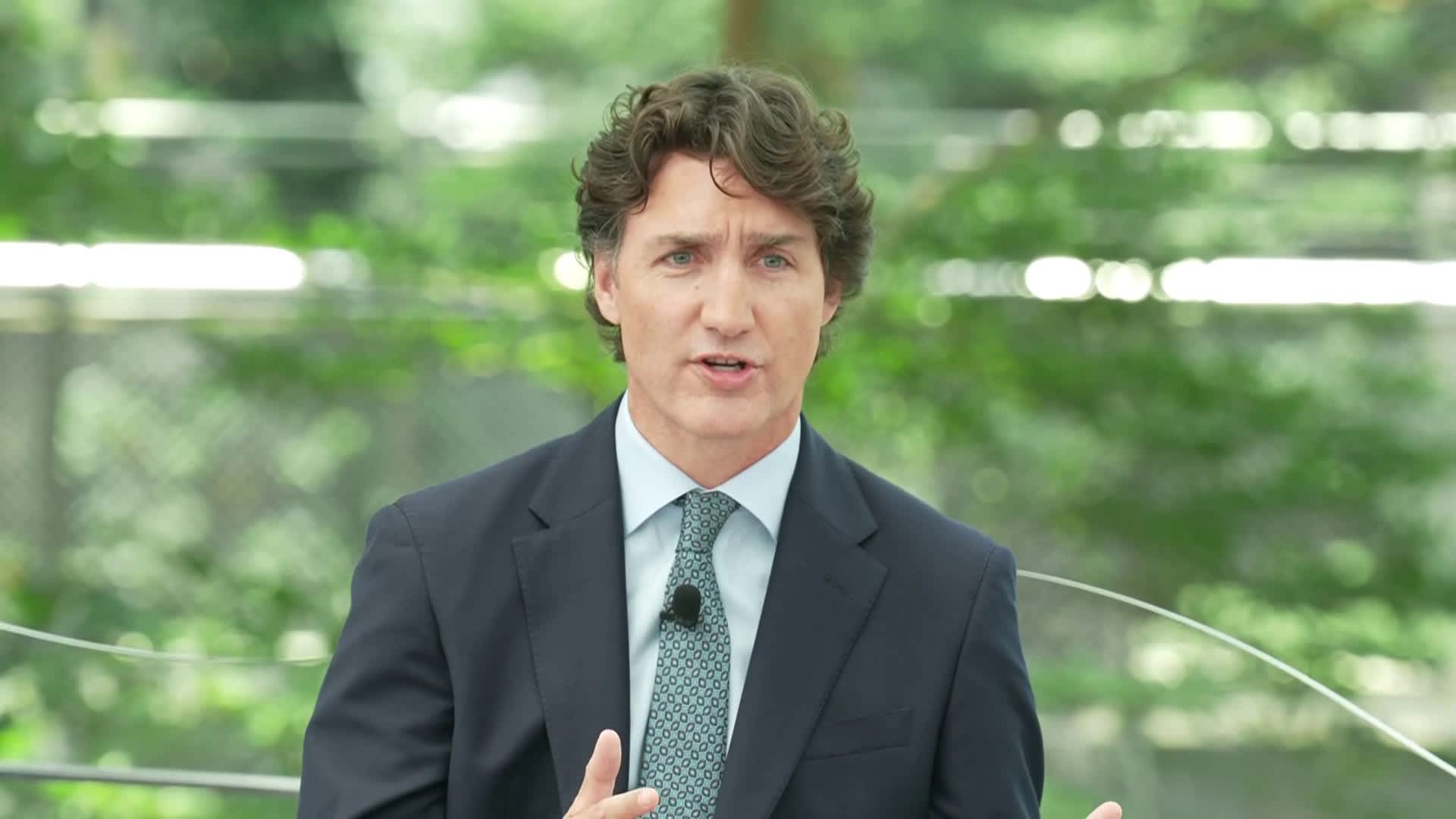
Canada’s former Prime Minister Justin Trudeau said at CNBC’s CONVERGE LIVE that international institutions were “spectacularly ill-adjusted” to respond to modern-day issues, while advocating that middle powers form new alliances as they face pressure from large powers.
“You can look to different places around the world to realize that those institutions, whether it was the WTO or the IMF or what have you, aren’t necessarily fit for purpose in our decades now,” Trudeau told CNBC’s Mandy Drury in Singapore on Thursday.
Trudeau called out “great powers,” naming the U.S., China, Russia, and India, saying they had decided they can “opt in or opt out of pieces of the rules-based order.”
“The question of what do the rest of us do if we don’t have them on board, driving a renewed world-based order is, I think, at the heart of the conversations people are having now,” he said.
Canada has sought to recalibrate its diplomatic relationships amid the geopolitical shifts triggered by U.S. President Donald Trump’s trade and foreign policies, with Prime Minister Mark Carney declaring a “rupture” in the American-led world order, calling on middle powers to band together and chart their own course.
Microlateralism
Trudeau reiterated Ottawa’s call for world leaders to unite and adopt “microlateralism” where a small group of countries identify shared interests as opposed to multilateralism evident in large organization such as the United Nations, WTO and IMF.
His comments come against the backdrop of the U.S.-Israeli war against Iran, and the American operation in January that captured Venezuela’s President Nicolas Maduro and his wife, with Washington seizing control of the country’s oil industry.
Responding to the Middle East conflict for the first time, Trudeau cautioned that the warring powers remained far apart on terms for ending the war. “I think the parties involved all want to see a path through this. I don’t think they’re yet at the place where they can share a path through this. I think, unfortunately, this instability is going to last a while.”
Carney had issued a statement at the start of the war that appeared largely supportive of U.S. military action in Iran, before adding more nuances to that stance in March, saying that Canada’s backing came “with regret,” calling the current conflict another example of the failure of the international order.
In a widely watched speech at the World Economic Forum in Davos in January, Carney urged middle powers to forge new alliances and build collective resilience against coercion by larger powers. “If you’re not at the table, you’re on the menu,” he said.
Diversifying away from the U.S.
Canada has faced mounting pressure to reassess its economic and security dependence on Washington, accelerate its efforts to diversify its trade and diplomatic ties with countries such as China and India, as the Trump administration pushes an increasingly transactional approach to trade and foreign policy.
Trudeau put it bluntly, saying that “we’re now having to look at working with China because the American industry doesn’t want to work with us anymore.” Canada has sought to reset its ties with China after eight years of a frosty relationship.
“That uncertainty of ‘are you going to throw tariffs on us again?’ means that we found better partners … and that’s a way of getting around some of that economic coercion,” Trudeau said.
Canada was among the first countries to be targeted by Trump’s tariffs, prompting retaliatory duties by Ottawa on U.S. steel, aluminum, auto imports. Trump also warned of 100% duties on Canada if Ottawa struck a deal with China.
Trump has kept in place a 50% duty on commodity imports, including aluminum and steel from Canada, causing U.S. aluminum imports from Canada to drop 27% since tariffs doubled from 25% last year, according to S&P Global, with Ottawa diversifying shipments to Europe.
“We’d much prefer to sell our aluminum a few hundred kilometers away rather than a few thousand kilometers across the ocean — but that’s not a big enough impediment for us to sit back and not act to diversify,” Trudeau said, stressing that “building reliable relationships is the way to stay safe.”
The U.S.-Mexico-Canada free trade agreement, under which Canada has averted a raft of Trump’s global tariffs, is due for a formal review by July 1. Concerns have mounted over the slow pace of negotiations between Washington and Ottawa, with Canada’s chief trade negotiator Janice Carette saying Tuesday that it was unlikely to address all issues by that deadline.
AI warnings
Trudeau said that the rapid development of artificial intelligence could create enormous wealth but warned that if it benefits a narrow elite while leaving ordinary workers behind, then it will sow disaffection among people.
“If we have 1,000 trillionaires, something will be fundamentally wrong with the world — and everyone will be right in saying this system doesn’t work.”
The resistance to trade sweeping democracies, he argued, was a preview of what awaited if AI’s gains were not more broadly shared.
“The anti-trade backlash we’re experiencing politically is actually an anti-prosperity backlash,” he said. The stakes this time, Trudeau cautioned, were far higher, suggesting if AI leads to concentration of wealth in a few hands it would make the inequalities of the trade-led globalization era look modest by comparison.
