

Close Menu

    Subscribe to Updates

    Get the latest creative news from FooBar about art, design and business.

    What's Hot

    Trump’s lack of focus on economy spooks Republicans in 2026 election

    April 23, 2026

    LVMH CEO Arnault warns of ‘world catastrophe’ if Middle East conflict is not resolved

    April 23, 2026

    American Airlines (AAL) Q1 2026 earnings

    April 23, 2026
    Facebook X (Twitter) Instagram
    Addison Markets
    • Home
    • USA
    • Europe
    • Business
    • Investing
    • Tech
    • Politics
    • Contact Us
    Addison Markets
    Home»Tech»You want your Moon landings in HD? So does NASA—here’s how it’s happening.
    Tech

    You want your Moon landings in HD? So does NASA—here’s how it’s happening.

    franperez66q@protonmail.comBy franperez66q@protonmail.comApril 23, 2026No Comments2 Mins Read
    Facebook Twitter Pinterest Telegram LinkedIn Tumblr WhatsApp Email
    Share
    Facebook Twitter LinkedIn Pinterest Telegram Email


    Low-cost optical terminals

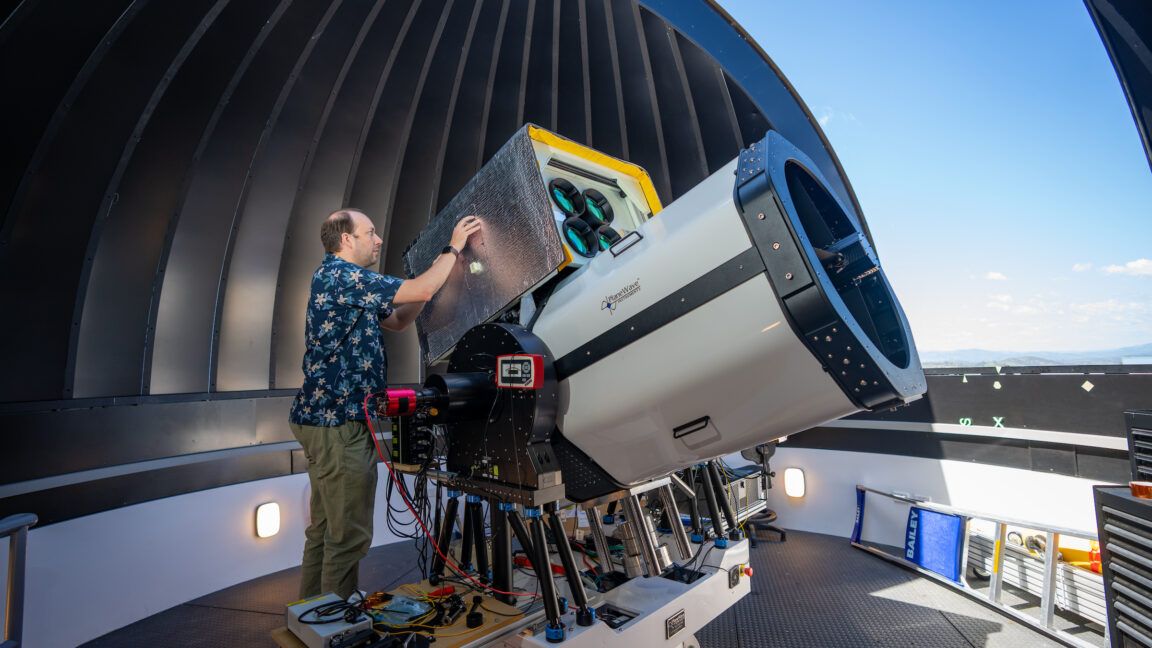
    NASA’s primary ground stations for optical communications on Artemis II were telescopes at the White Sands Complex in Las Cruces, New Mexico, and the Table Mountain Facility in California. However, the space agency also decided to test whether it would be feasible to deploy a lower-cost optical terminal on the ground to receive lasers from space.

    Engineers from NASA field centers in Ohio and Maryland purchased an off-the-shelf 70 cm telescope from Observable Space and a backend to process the lasers from Quantum Opus. Within months, the telescope and detector were deployed at Mount Stromlo in southeastern Australia, near Canberra.

    During Artemis II, the off-the-shelf optical terminal reached the system-designed maximum rate of 260MB per second, downloading much of the data NASA received during the mission.

    “Advancing US leadership in space- and ground-based optics is core to our mission, and turn-key laser communication ground stations are a critical component of that future,” Dan Roelker, co-founder and CEO of Observable Space, said in a statement.

    The technology for receiving and processing laser signals from the Moon, Mars, or beyond is not simple. The “Opus One” detection system, for example, uses superconducting nanowire single-photon detectors. That’s why reducing the cost of building and deploying these systems is critical for widespread adoption of space-to-ground laser communications.

    Quantum Opus was co-founded by physicist Josh Cassada, who became a NASA astronaut in 2013 and then retired more than a decade later to rejoin Quantum Opus. He led the fabrication of the company’s photon-detection products.

    In an interview, Cassada said the technology is important not just for getting massive amounts of data down from space, but also for applications such as quantum computing. “If you want to detect photons at the single photon level, and you don’t know anything about cryogenics, that’s fine,” he said. “You just push this button, and in three hours, you’re counting photons.”


    Source link

    Share. Facebook Twitter Pinterest LinkedIn Tumblr Email
    franperez66q@protonmail.com
    • Website

    Related Posts

    Jim Cramer’s strategy to avoid missing out on big winners

    April 23, 2026

    Microsoft expands AI footprint in Australia with $18 billion investment

    April 23, 2026

    RFK Jr. won’t back CDC director on vaccines as agency scraps positive data

    April 23, 2026

    CEO: AI will boost workers so ServiceNow won’t have to backfill jobs

    April 23, 2026

    Lawsuit: Nintendo is getting tariff refunds—its customers should get them instead

    April 23, 2026

    Microsoft looked at buying Cursor before SpaceX deal, sources say

    April 23, 2026
    Leave A Reply Cancel Reply

    Top Reviews
    Editors Picks

    Trump’s lack of focus on economy spooks Republicans in 2026 election

    April 23, 2026

    LVMH CEO Arnault warns of ‘world catastrophe’ if Middle East conflict is not resolved

    April 23, 2026

    American Airlines (AAL) Q1 2026 earnings

    April 23, 2026

    P&G’s under-pressure gross margin in focus as Iran war lifts costs

    April 23, 2026
    © 2026 All right reserved
    • About Us
    • Privacy Policy
    • Terms & Conditions
    • Disclaimer

    Type above and press Enter to search. Press Esc to cancel.