


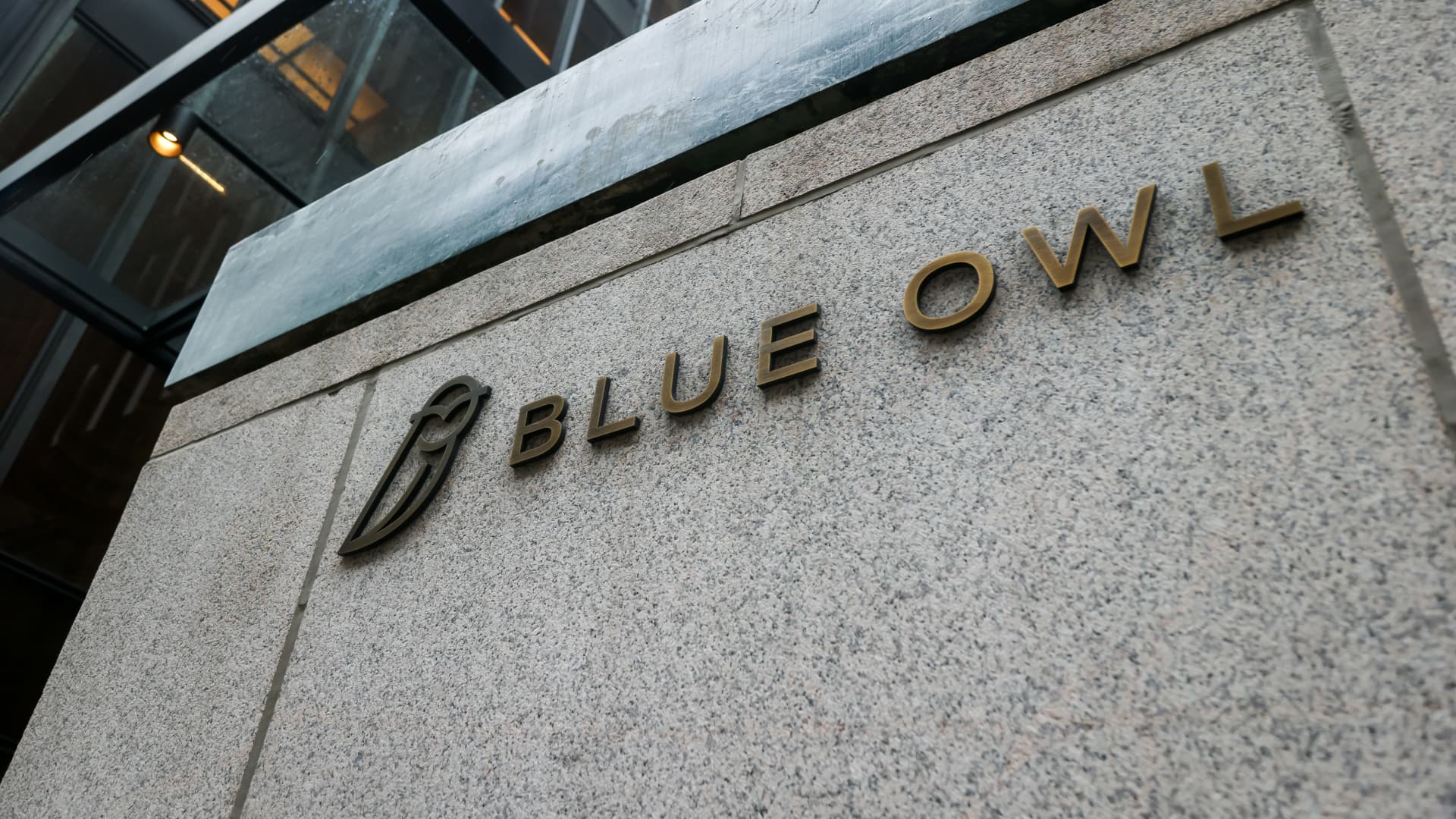
Blue Owl signage outside the Seagram Building at 375 Park Avenue in New York, US, on Thursday, March 12, 2026.
Michael Nagle | Bloomberg | Getty Images
Saba Capital Management said that the tender offers for shares in non-traded business development companies managed by Blue Owl Capital and Starwood Capital came in “below initial expectations.”
In early March, the hedge fund Saba offered liquidity to locked-up investors in Blue Owl Capital Corporation II (OBDC II), a non-traded private-credit fund, at a 35% discount. It launched a similar program at Starwood Real Estate Income Trust (SREIT) at a 24% or 29% discount, depending on the share class.
On Monday, Saba said that through the tenders, it was able to acquire about $10 million in aggregate face value across 190 separate trades, “substantially all” from SREIT. The tender for Blue Owl shares reportedly failed to garner more than 1% of what was offered.
The disinterest by investors in garnering liquidity at a steep discount comes amid a quarter that saw elevated redemptions across most private-credit, non-traded BDCs. Blue Owl was among the poster children of this phenomenon, halting quarterly redemptions in OBDC II in mid-February, and opting instead to return capital periodically through portfolio asset sales. In early April, investors sought to redeem $5.4 billion from two of its other private-credit funds during the first quarter. Like many of its peers, the fund manager opted to cap these requests at 5%.
In the wake of the OBDC II decision, Saba Capital’s Boaz Weinstein told CNBC that they were “hearing from investors in these funds that they wanted their money back,” which is why the firm saw a market opportunity. As such, Saba announced on Monday that it was “considering providing bids on a number of additional products, including the Cliffwater interval fund and Blue Owl’s OCIC.”
“Saba’s goal is straightforward: retail investors in these products deserve access to liquidity, just as investors in public BDCs have long enjoyed,” Saba said in a statement. “We intend to be a consistent, credible bid in this market.”
The hedge fund said that following its public activity in SREIT, Starwood Chairman and CEO Barry Sternlicht announced a commitment to inject equity capital to fund investor redemptions. Saba said it “commends” Sternlicht for that decision.
“We believe our entry into this market was a catalyst for that outcome and that all SREIT investors have benefitted as a result,” the firm said.
Saba said that in terms of OBDC II, the “pool of illiquid capital available to tender was naturally limited” due to only $332 million remaining in the fund. However, the firm said it sees credit risk accumulating into 2027 and 2028 and believes the “opportunity set for providing liquidity at scale will grow considerably.”
“Saba believes the question is not whether this space will experience significant stress, but when,” the firm said in Monday’s statement. “Hundreds of billions of dollars of private credit are currently held by retail investors in products that offer limited or no secondary liquidity. Saba intends to be a consistent source of that liquidity – and to have the capital deployed and ready when the need intensifies.”
