

This article is an on-site version of our Europe Express newsletter. Premium subscribers can sign up here to get the newsletter delivered every weekday and fortnightly on Saturday morning. Standard subscribers can upgrade to Premium here, or explore all FT newsletters
Good morning. While you were sleeping, EU negotiators failed to seal a deal on legislation to implement the bloc’s trade deal with the US, risking the ire of Donald Trump, our economy correspondent reports below.
Also, we reveal upcoming proposals to finally make buying European train tickets simple, and new research into how to wean the continent off US defence reliance.
Deferred decision
Negotiations on implementing the EU-US trade deal broke down in the early hours of this morning without white smoke, writes Paola Tamma.
Context: The European parliament and EU countries are negotiating additional safeguard clauses that MEPs added to the deal struck last August, such as the EU lowering trade barriers only when the US brings down tariffs to 15 per cent across the board, and retiring the trade deal if the US administration imposes new tariffs.
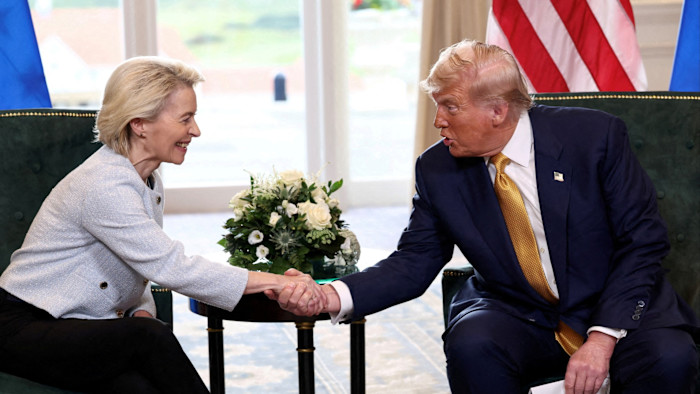
The European Commission and some EU countries are pushing for a quick agreement to avoid giving US President Donald Trump a reason to follow through on his threats to increase tariffs on European cars as punishment for not implementing the deal. But others, including France and a majority of political groups in the parliament, don’t want to rush through without clarity on US commitments.
Negotiators “made good progress on the issue of the safeguard mechanism . . . but there is still some way to go,” said Bernd Lange, chair of the parliament’s trade committee and chief negotiator. He added the parliament seeks to implement the US trade deal “expeditiously” but is keen to “provide additional guarantees that will benefit citizens and companies in both the EU and the US”.
Michael Damianos, industry minister of Cyprus, who is chairing the talks on behalf of EU capitals, said they were “committed to moving swiftly”. Technical talks will continue, with another attempt to find a deal on May 19. If an agreement is found, final approval in the parliament would be sought in June, said one official familiar with the negotiations.
On track
European rail passengers will be able to book tickets from multiple providers on the same platform, in rules that will shake up travel across the EU, write Ian Johnston and Barbara Moens.
Context: Rail passengers across Europe currently have to navigate multiple booking systems when travelling across borders, an issue Brussels is seeking to rectify in a rail provision package due next week.
Booking long-distance rail trips with multiple providers was currently a “nightmare”, EU transport commissioner Apostolos Tzitzikostas told the FT. YouGov polling has shown that booking challenges have dissuaded 61 per cent of passengers at least once from booking trains.
Under new proposals, “all companies will be forced to publicise and make public the lines of all other companies” in a “game-changer” for travel, Tzitzikostas said in an interview where he also rejected claims of current jet fuel shortages in Europe.
The measures, due to be unveiled next Wednesday, would also ensure that passengers booking journeys with multiple legs were covered by the same rights throughout the trip.
The shake-up means national rail platforms would have to offer tickets from rival private or national operators.
France has already acted to make SNCF Connect do so through a national law. Tzitzikostas dismissed concerns about opposition to the plans from national rail operators.
Chart du jour: Orbán fatigue
Hungarians backed Tisza primarily to end Viktor Orbán’s rule rather than to support party leader Péter Magyar or his policies, according to new research by the European Council on Foreign Relations.
Spending smart
Europe could achieve “far-reaching autonomy” from the US in most military areas within five to 10 years at the cost of just €500bn — if it adopts the right mindset, according to new research seen by Laura Pitel.
Context: European leaders are fretting about their reliance on Washington for a host of essential military technologies at a time when Trump appears increasingly unwilling to underpin the continent’s security.
But Europe should not be daunted by the challenge, five German high-profile figures, including Airbus chair René Obermann and venture capitalist Jeannette zu Fürstenberg, argue in a paper published today.
By tearing up procurement rules and pursuing more cross-border projects, Europe could make rapid progress in areas where they currently lack sovereign solutions, they say.
The paper identifies 10 priority areas for investment, including long-range precision weapons such as the Tomahawk missiles that were due to be deployed with a US battalion to Germany this year but were last week cancelled by Trump.
It also points to satellite technology and strategic airlift, the ability to transport large numbers of troops and equipment into a combat zone, as essential.
The paper argues that the cost of making Europe independent from the US in these areas would be about €500bn over the next decade, roughly 10 per cent of total European defence expenditure in that timeframe.
“The decisive bottleneck is . . . neither money nor technology,” they write. Instead, the Germans argue, the main obstacles are a lack of political prioritisation and leadership, poor industrial co-operation and the fragmentation of European defence.
What to watch today
-
US secretary of state Marco Rubio meets Pope Leo XIV in the Vatican.
-
German President Frank-Walter Steinmeier meets Finnish President Alexander Stubb in Helsinki.
Now read these
Are you enjoying Europe Express? Sign up here to have it delivered straight to your inbox every workday at 7am CET and on Saturdays at noon CET. Do tell us what you think, we love to hear from you: [email protected]. Keep up with the latest European stories @FT Europe
