


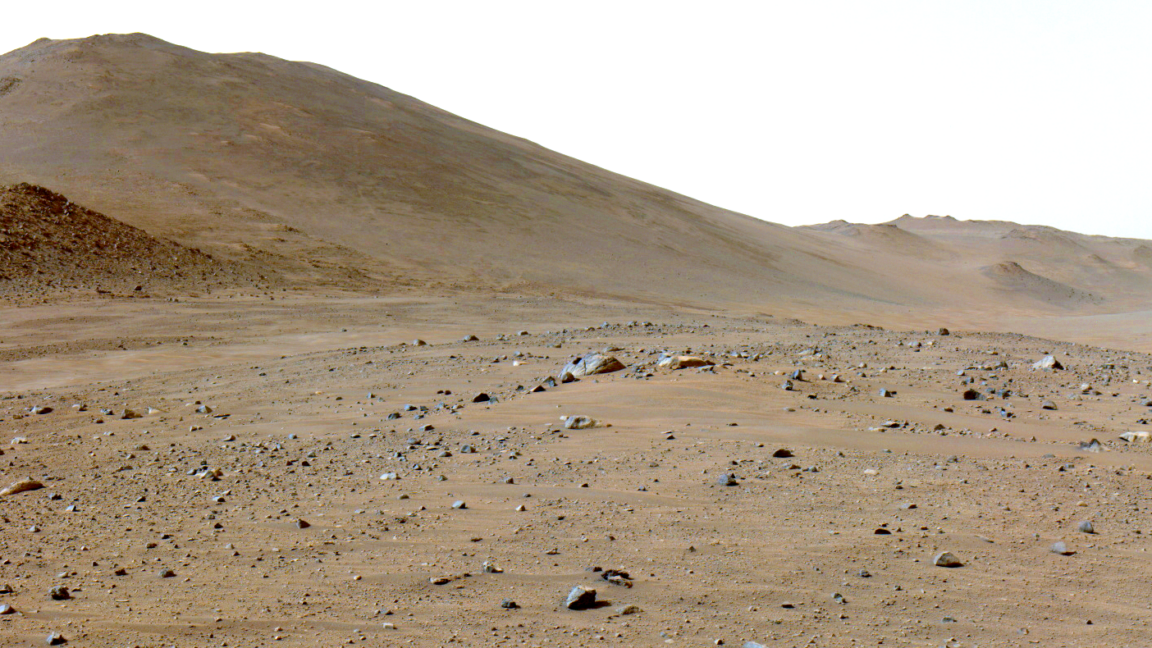
NASA’s Perseverance rover has spent five years traversing Jezero Crater looking for the chemical leftovers of whatever processes were at work on Mars billions of years ago. The rover has found organic carbon, but it has mostly been inside rocks that had to be drilled or abraded to expose it. But now, at an outcrop on the edge of an ancient river channel named Neretva Vallis, Perseverance detected complex macromolecular carbon sitting right on the rock’s surface.
“To our knowledge, that’s the shallowest detection of organic matter on Martian surface to date,” said Ashley E. Murphy, a researcher at the Planetary Institute in Tucson, Arizona, and lead author of the study of the rock, which was found at a site called Bright Angel. On Earth, this much macromolecular carbon usually suggests a biological origin. But to learn what this Bright Angel carbon is and where it came from, we might need to bring samples back to Earth.
Carbon on the rocks
The detection of Bright Angel carbon came from SHERLOC (Scanning Habitable Environments with Raman and Luminescence for Organics and Chemicals), a UV Raman spectrometer fitted on Perseverance’s robotic arm. SHERLOC fires a deep-ultraviolet laser at a target and reads the light that bounces back at shifted energies, a signal that enables scientists to identify specific molecular bonds.
Between sols 1180 and 1218, the rover pointed this UV laser at four targets at Bright Angel. One, called Steamboat Mountain, was an ordinary rock the team used as a control. The remaining three (called Cheyava Falls, Apollo Temple, and Walhalla Glades) returned a spectroscopic signature of macromolecular carbon. This signal, called the graphitic band (G-band), indicates the presence of a tangled, cross-linked network of mostly reduced carbon atoms that is resistant to chemical and thermal breakdown.
At least within the precision limits of the Perseverance’s instruments, the material roughly matches terrestrial kerogen. Using the word “kerogen,” though, was a no-go, the researchers decided. On Earth, kerogen is made almost exclusively of biological matter, mainly fossilized microbes that were buried millions of years ago. “The term kerogen implies biogenic source,” Murphy explained. “Macromolecular carbon implies we don’t know whether its origin is biotic or abiotic.”
