
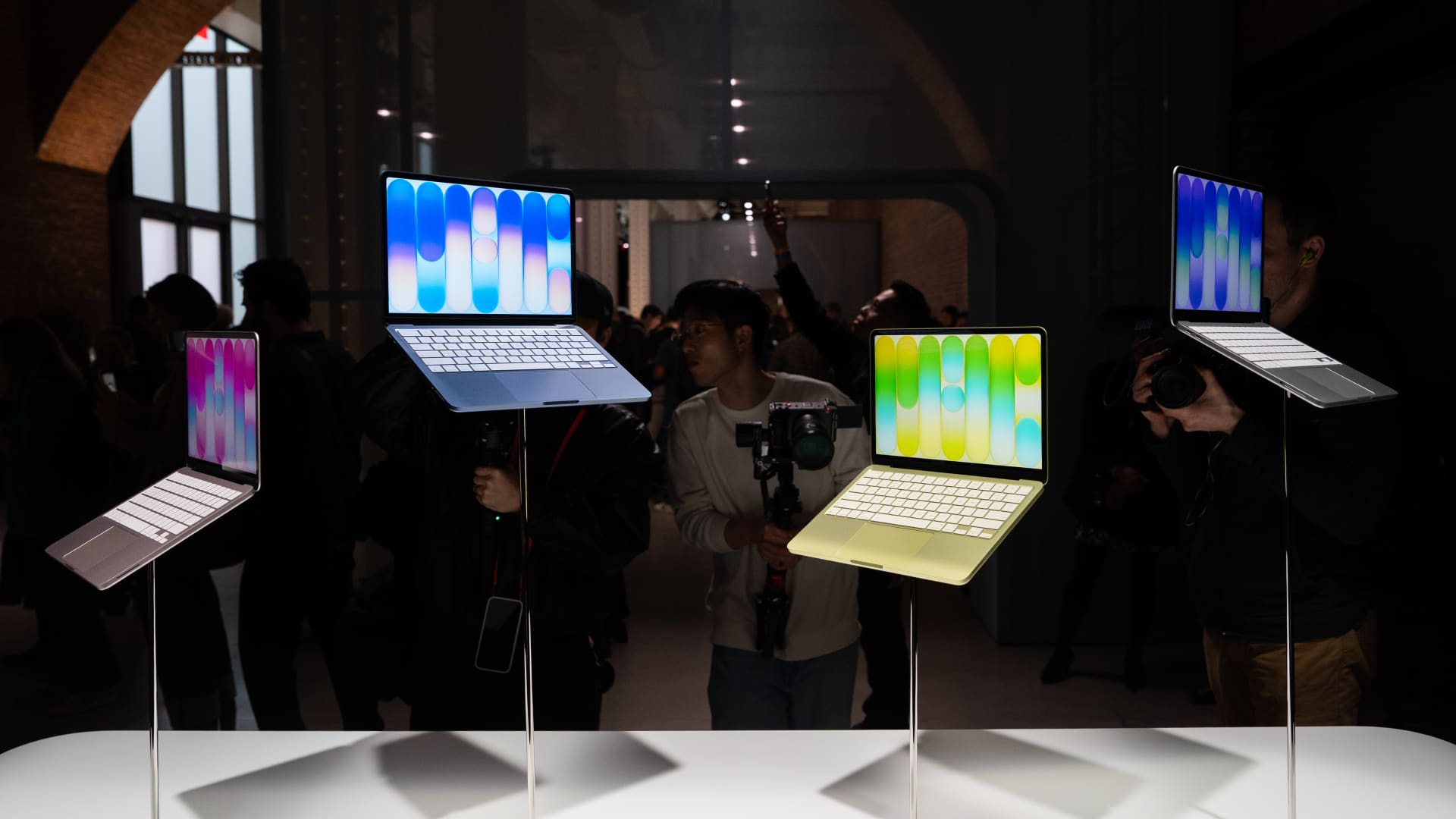
Apple on Thursday announced price hikes on MacBook and iPad, its first formal move to pass higher memory and storage costs on to consumers after CEO Tim Cook said increases had become unavoidable.
Shares sank around 5% on Thursday after the price change, its worst fall since February.
Here are the latest changes from Apple:
- MacBook Neo entry $599 increasing to $699
- MacBook Air 512GB $1099 increasing to $1299
- MacBook Pro 1T $1699 increasing to $1999
- iPad Air 128GB $599 increasing to $749
- iPad Pro Wifi 256GB $999 increasing to $1199
Apple’s online store briefly went down Thursday morning and updated with the price changes.
“The consumer electronics industry is facing an unprecedented challenge,” the company said in a statement. “The rapid expansion of AI data centers has created an extraordinary surge in demand for memory and storage. We have never seen a component price increase this much, this quickly.”
Apple added that it has “reached a point where we need to begin raising prices on a number of products,” leaving the door open to more increases down the line.
“We know this is not welcome news, and we are working tirelessly to find solutions,” the company said.
Cook told The Wall Street Journal last week that Apple could no longer fully shield customers from a spike in component costs tied to the artificial intelligence boom.
“This is a hundred-year flood,” Cook told the Journal. “I’ve never seen anything like it in any area in over 40 years.”

Apple stock chart.
Memory and storage prices have quadrupled in the past three quarters, according to Counterpoint Research, as suppliers steer more production toward the high-bandwidth memory used in AI servers.
The memory crisis has been a major boon for suppliers like Micron, which just reported a quadrupling in revenue and said its gross margin jumped from 39% a year ago to 84.9% in the most recent quarter, surpassing Nvidia and Meta.
Apple’s pricing playbook has historically involved removing the lowest-cost option, making higher storage or memory the new starting point, or steering buyers toward Pro models and higher-capacity versions.
The Mac mini offered an early sign of that approach. In May, Apple stopped selling the lowest-priced configuration, removing the $599, 256GB option from its lineup. The remaining entry model started at $799. Apple has also long used storage upgrades to lift the price consumers pay for its devices.
Tarun Pathak, research director at Counterpoint Research, estimates the higher cost of components could add roughly $200 per iPhone for Apple. He expects price increases of about $150 to $200 across the lineup, weighed more heavily toward higher-memory configurations than base models.
The AI push gives Apple another reason to emphasize higher-memory configurations.
IDC expects all new iPhone models to move to 12GB of RAM, as Apple looks to avoid selling new devices without access to the full suite of Apple Intelligence features.
More advanced on-device AI features require more memory, and Apple’s new Siri experience will only work on newer hardware. IDC estimates roughly 54% of iPhones shipped since 2022 will not support the full new Siri experience.
That gives Apple a potential way to frame higher prices around more capable hardware, rather than simply passing along component inflation. IDC sees Apple’s average selling price rising 12% this year, helped by a richer product mix and the expected launch of a foldable iPhone.
WATCH: Apple to pass memory cost increases on to consumers

