

Close Menu

    Subscribe to Updates

    Get the latest creative news from FooBar about art, design and business.

    What's Hot

    Bentley launches Torcal as luxury rivals pull back on electric cars

    September 24, 2026

    No Kings But King Dollar

    September 24, 2026

    Ukraine: Russia welcomes U.S. invite for possible Trump-Putin meeting

    September 24, 2026
    Facebook X (Twitter) Instagram
    Addison Markets Addison Markets
    • Home
    • USA
    • Europe
    • Business
    • Investing
    • Tech
    • Politics
    • Contact Us
    Addison Markets Addison Markets
    Home»Tech»Artificial cell manages a few rounds of cell division
    Tech

    Artificial cell manages a few rounds of cell division

    franperez66q@protonmail.comBy franperez66q@protonmail.comJuly 3, 2026No Comments2 Mins Read
    Facebook Twitter Pinterest Telegram LinkedIn Tumblr WhatsApp Email
    Share
    Facebook Twitter LinkedIn Pinterest Telegram Email


    But the complex of proteins needed to make more proteins is far too large to go through a small pore. So the researchers encased these proteins and other large materials in a different membrane and then fed those to the SpudCells. To get the two membranes—one from the SpudCell, one from its food—to interact, the researchers added a tag to the pore protein that they had already been using. They then added something that would interact with that tag to the food membrane. This allowed the two to interact long enough to fuse, spilling the food into the interior of the SpudCell and adding additional membrane material to it.

    This “feeding” process allows the SpudCells to continue making new proteins even after they would have exhausted their initial supply of raw materials. The added membrane material also increased the SpudCell’s size, literally causing it to grow.

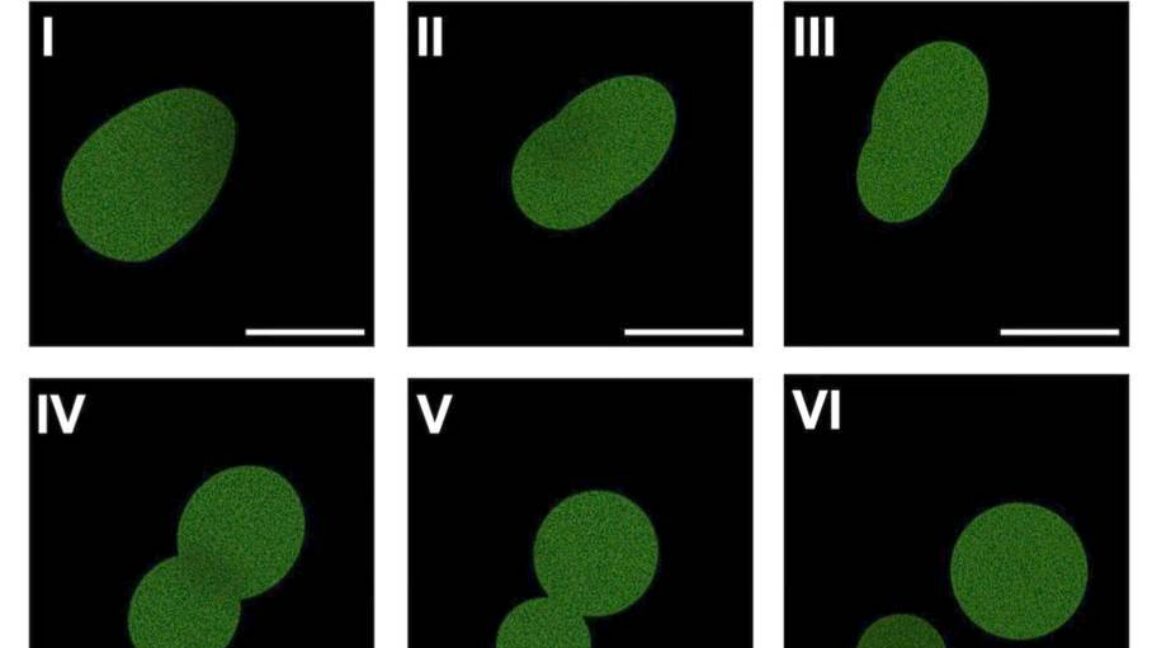
    Normally, cell growth eventually results in cell division, splitting the membranes and their context between two new cells. But the SpudCells had no mechanism for achieving this. Initially, the researchers simply passed them through a wire grid and applied physical force to cause the membranes to split. But they eventually developed a system that could cause the pore proteins to clump by adding certain chemicals to the solution. That altered the membrane’s shape and eventually led to parts of it budding off. While this is a far more random process, it approximates cell division.

    So in a limited, carefully engineered sense, these “cells” could feed, grow, and divide, driven by proteins encoded by their own genome. As noted above, though, that genome was only distributed into the next generation of cells at random, and pieces of it were progressively lost over each generation. As a result, no SpudCells were taken past five generations in this work.


    Source link

    Share. Facebook Twitter Pinterest LinkedIn Tumblr Email
    franperez66q@protonmail.com
    • Website

    Related Posts

    Ukrainian drones overwhelm Russian tanks’ new active protection system—for now

    August 19, 2026

    Jim Cramer says the market is too negative — and that’s creating buying opportunities

    August 19, 2026

    “Sabotage”: Experts, lawmakers blast RFK Jr. for destroying healthcare research

    August 18, 2026

    OpenAI rolls out ChatGPT for Teens with more safety protections

    August 18, 2026

    Against all odds, SpaceX finally tugs Starship into port after 24 days at sea

    August 18, 2026

    Economists warn AI-driven market rally is due a sharp correction

    August 18, 2026
    Leave A Reply Cancel Reply

    Top Reviews
    Editors Picks

    Bentley launches Torcal as luxury rivals pull back on electric cars

    September 24, 2026

    No Kings But King Dollar

    September 24, 2026

    Ukraine: Russia welcomes U.S. invite for possible Trump-Putin meeting

    September 24, 2026

    Swiss National Bank holds rates at 0% as inflation stays low

    September 24, 2026
    © 2026 All right reserved
    • Privacy Policy
    • Terms & Conditions

    Type above and press Enter to search. Press Esc to cancel.