


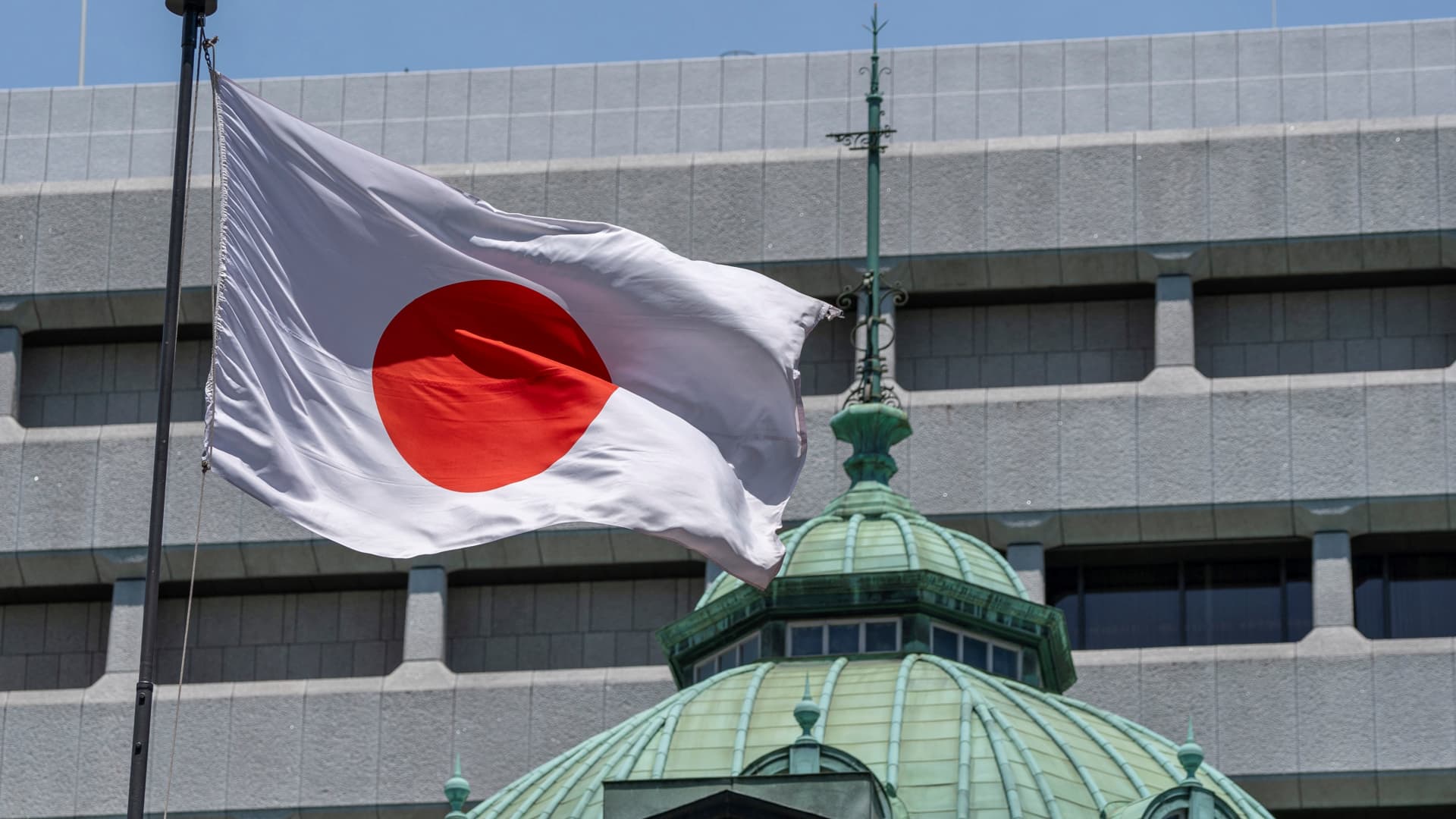
The Bank of Japan headquarters in Tokyo on May 30, 2024.
Kazuhiro Nogi | Afp | Getty Images
Japan’s central bank on Tuesday raised its policy rate to the highest in over 30 years at 1%, in line with expectations of economists polled by Reuters, accelerating policy normalization started in 2024.
This is the Bank of Japan’s first hike since December, when it raised rates to 0.75%, and the first time since 1995 that rates have been raised to 1%.
The BOJ said the decision was split 7-1, with board member Toichiro Asada dissenting and advocating for a hold at 0.75%.
The policy tightening comes at a time when Japan has been struggling with a weak yen and inflation that has started to creep up, partly due to the Iran war.
The benchmark Nikkei 225 was up 0.46% after the decision, while the yen strengthened marginally to 160.22 against the dollar. Yields on the 10-year Japanese Government Bonds climbed 3 basis points to 2.615%.
The central bank said that it will continue reducing its government bond purchases by 200 billion yen per calendar quarter before halting the taper and maintaining monthly JGB purchases of 2 trillion yen from April 2027.
The BOJ said Japan’s consumer inflation has been below 2% due to government’s measures to reduce the household burden of higher energy prices.
“However, the price pass-through stemming from the rise in crude oil prices has been progressing at a relatively fast pace in business-to-business transactions, which could spread to an increase in consumer prices across a wide range of items,” the central bank said.
That can be seen in Japan’s producer price index, which rose 6.3% in May, marking its fastest pace in over three years and mainly fueled by increased energy costs.
Weakness in the Japanese yen had also supported the case for a rate hike. After reportedly splashing out 11.7 trillion yen ($73.5 billion) on intervention operations in May, the yen weakened again, touching the 160 level against the dollar and languishing at that level for most of June.
“Intervention without changing domestic monetary policy is like tapping the brake while keeping your right foot firmly on the accelerator — at best, your passengers have a little fun, at worst, you’re burning through your brake pads,” Jesper Koll, expert director at Tokyo-based financial services firm Monex Group told CNBC.
A weak yen, despite boosting the competitiveness of Japan’s exports, will increase imported inflation and pressure government finances as it seeks to cushion the impact of rising prices via subsides.
Prime Minister Sanae Takaichi’s administration had enacted a supplementary budget of 3 trillion yen to shield households from rising energy costs, months after passing the yearly budget.
Japan’s core inflation eased more than expected in April to 1.4%, its lowest level since March 2022, with headline inflation also at 1.4%, the fourth straight month below the central bank’s 2% target.
However, analysts told CNBC that the low inflation figures is largely the result of various policy measures that have suppressed inflation, including the removal of Japan’s gasoline tax and making high school free for all students.
