
President Donald Trump speaks about Trump Accounts at the Andrew W. Mellon Auditorium in Washington, D.C., Jan. 28, 2026.
Brendan Smialowski | AFP | Getty Images
Soon-to-launch Trump Accounts are a new vehicle for long-term savings and investing geared toward children, but they are not the first of their kind.
In 2007, thousands of families in Oklahoma were randomly selected to participate in a statewide college savings initiative. In many ways, Saving for Education, Entrepreneurship, and Downpayment for Oklahoma Kids, also known as SEED OK, offers a bird’s-eye view of so-called child development accounts, or CDAs, and their potential.
About half of the newborns in the program received a $1,000 grant deposited in an Oklahoma 529 college savings account. The other half did not receive an account or the initial deposit.
A 2021 analysis of the experiment by the Center for Social Development at Washington University in St. Louis, which designed and implemented the project in partnership with the Oklahoma State Treasurer’s Office, found that families with accounts experienced positive outcomes, ranging from asset accumulation to behavioral changes. For example, children with CDAs were more engaged in their education, and both children and their parents had higher educational expectations, the study found.
Lower-income children specifically benefited, according to a 2021 research summary by the center. The CDA increased the likelihood that financially vulnerable households saved for future college expenses, the study found.
“SEED OK is the experiment behind these kinds of early wealth-building ideas, including Trump Accounts,” said Jin Huang, co-director of the Center for Social Development. For three decades, “our center has been testing early wealth building across different projects,” he said. “I think SEED OK does provide very strong positive evidence about the potential outcomes we can achieve.”
SEED OK’s first cohort is graduating
Now many of the original cohort are graduating from high school and deciding what comes next.
“In the treatment group, after 18 years, 100% of the treatment children still hold assets,” Huang said. “The total amount of wealth building is also much, much higher.”
In addition to larger account balances compared with those who got no seed money, more participants are focused on college, he said.
“When we have an institutional setting encouraging all children and families to accumulate wealth, that changes their mindset, that changes their perspective,” Huang said. “The policy intervention increased parents’ educational expectations for their children.”
Typically, about 40% of students in Oklahoma enroll in college directly after high school, Huang said. In this experiment, the share will be closer to 64%, he estimated.
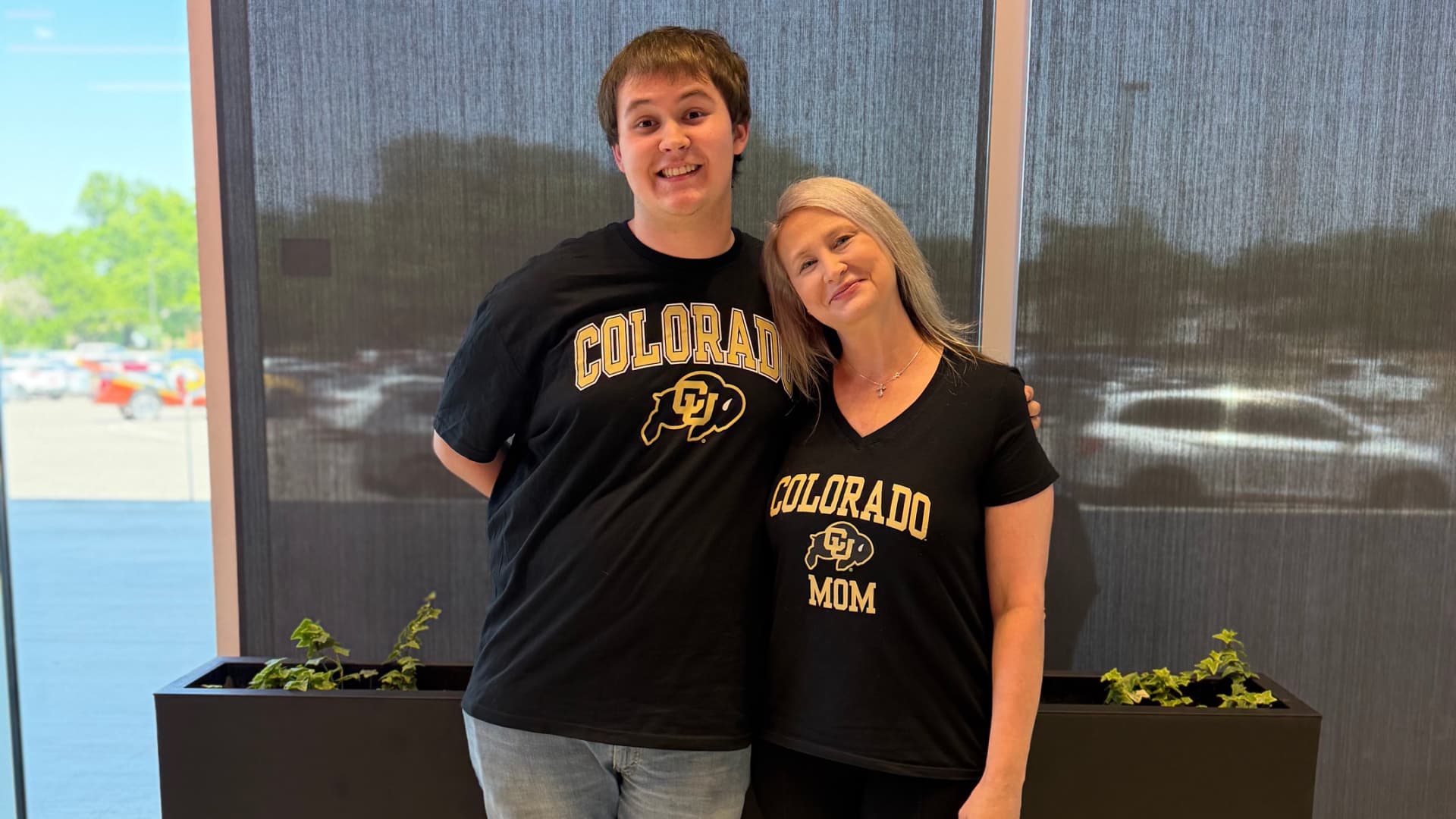
Monica Rachelle and her son, Hayden.
Courtesy: Monica Rachelle
Monica Rachelle and her son, Hayden, were chosen to participate and receive seed funding. “We found out while we were in the hospital” shortly after giving birth, she said. Rachelle said that at the time, she knew nothing about the program, nor did she have educational goals for her newborn in mind.
In the years after, the account served as a constant reminder that college was possible for him, she said.
Rachelle is a single mother and a healthcare worker at a local hospital. “It’s a great job, but I don’t make a doctor’s pay,” she said. She picked up extra shifts and started saving, she said: “It was a door that opened.”
Hayden excelled in school and found meaningful extracurricular activities, she said. He was accepted into several four-year colleges, including one of his top choices: the University of Colorado Boulder.
“No one in our family has ever earned a bachelor’s degree, and now he is on track to become the first,” Rachelle said. “I am incredibly proud of him.”
Maine implemented a similar program over a decade ago in which all Maine resident babies born on or after Jan. 1, 2013, were automatically awarded a $500 grant from the Alfond Scholarship Foundation into a 529 plan to help pay for college, trade school or other postsecondary education.
With the grant money, families were twice as likely to report that they expect their child to go to college, according to the National College Attainment Network. Other states, including Pennsylvania and California, have also experimented with early investment initiatives.
“They serve as good comparisons for what we know works and what doesn’t from the field,” said Madeline Brown, senior policy associate at the Urban Institute, a Washington-based think tank.
For starters, having a dedicated college savings account “changes parents’ outlooks for their kids,” Brown said. And now, “kids are going to college and using these dollars.”
Up next: Trump Accounts
In many ways, these programs paved the way for Trump Accounts, the new tax-deferred investing accounts for children.
“The most important finding we have about wealth building is that the SEED OK policy experiment is sustainable and scalable,” Huang said.
All parents or guardians with babies born between 2025 and 2028 who open a Trump Account, also known as a 530A account, will receive a $1,000 initial deposit from the U.S. Department of the Treasury.
After the official launch on July 4, parents, guardians, grandparents and others can contribute up to $5,000 a year in after-tax dollars until the year before the beneficiary turns 18.
Susan Dell, co-founder and chair of the Michael & Susan Dell Foundation, and Michael Dell, founder and CEO of Dell Technologies and co-chair of the Invest America Giving Committee, celebrate after ringing the opening bell at the New York Stock Exchange on March 25, 2026.
Michael M. Santiago | Getty Images
Advocates of the Trump administration’s new savings initiative say Trump Accounts could have the same long-term benefits as some of the state-based programs that came before.
“What we found is that when a child has even a modest amount like this, they’re way more likely to graduate from high school, go on to college, start a business, start a family, not be incarcerated,” tech CEO Michael Dell said during CNBC’s Invest in America Forum in April. “It improves the mental health of the child, improves the mental health of the parent. And so, we thought, this is going to be fantastic.”
Dell and his wife, Susan, committed $6.25 billion to provide an additional $250 seed deposit for children born between 2016 and 2024 — who wouldn’t qualify for the Treasury’s $1,000 contribution.
When balances fall short
TrumpAccounts.gov projects that accounts could grow to $6,000 by age 18, assuming no further contributions are made beyond the initial $1,000 Treasury deposit. On its own, however, that would not be enough to make a significant dent in future college costs.
After participating in SEED OK, Hayden’s initial deposit and Rachelle’s contributions grew to a few thousand dollars over the years, but his savings fell short of what they would need to cover the tab for college, even at a public institution. For out-of-state students at the University of Colorado Boulder, the tuition bill alone is about $46,000 for the upcoming academic year. After factoring in room and board and books, the cost jumps to $66,500.
Rachelle said they will tap federal student loans to make up the difference and that Hayden is enrolled for the fall semester. “He earned one of only a few spots in his program, and we could not pass up such an amazing opportunity,” she said.
