


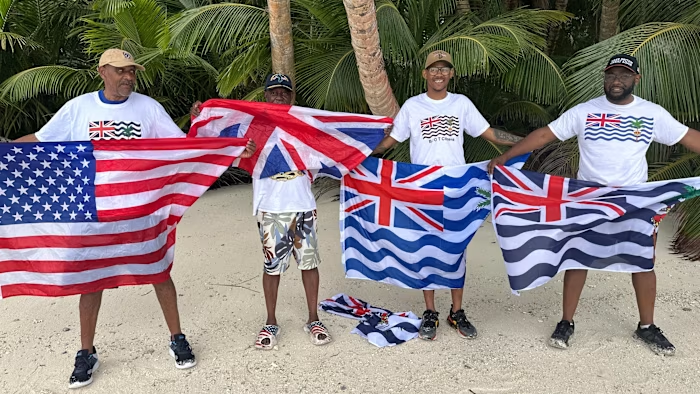
In February, nine people — four British Chagossians, a Reform UK politician, a journalist and a small crew — sailed illegally to an uninhabited atoll in the Indian Ocean, in an expedition they jokingly named “Operation Certain Death”.
Six months later, they are at least alive.
But the logistics of creating a permanent settlement on the Chagos Islands, which also hosts a major US-UK military base, are fraught, according to people involved.
The politician, crew and journalist have left as planned. The Chagossians who remain have limited food, threadbare tents and no boat capable of traversing the surrounding ocean.
“The truth is, we have been winging it. Unfortunately, that’s what we had to do,” said the politician, former Tory MP Adam Holloway, who stayed on the island for 10 days.
“It’s not easy living there,” he added, citing the island’s mosquitoes, rats and tropical heat.
The small expedition was part of a plan to block the contentious deal under which the UK government agreed to give sovereignty over the Chagos to Mauritius. The accord, signed last year, is supported by some Chagossians but opposed by others, especially those within the UK. It is stalled due to the opposition of US President Donald Trump.
The travelling party landed on the island of Île du Coin, part of the atoll of Peros Banhos, which has been uninhabited since the 1970s when the UK evicted the last native Chagossians.
“They never really had a plan beyond sneaking on to the island,” said a person close to the scheme. The person added that the group behind the plan — backed by Reform’s biggest donor, Christopher Harborne — was focused on “publicity stunts”.
“We wanted to change the facts on the ground,” said Holloway. “We’re playing a long game, and we’re determined we’re going to repopulate the Chagos Islands.”
Reform’s leader Nigel Farage said he planned to make Chagos “the greatest marine-tourism area in the world” and to “get high-net-worth individuals going down there”.
Currently, however, the tropical stormy season looms, and basic questions of habitability — and legality — remain.
“The tents are now absolutely frazzled, and water is always a challenge,” Holloway said.

Medical treatment is another serious concern. If the islanders — now six after two more joined — need to evacuate due to a storm or medical emergency, they are reliant on other boats rescuing them.
The small vessel they have was “not sufficient, it’s not safe enough”, said Kareesha Turner, a lawyer for the group, who compares it to the inflatable boats used by migrants crossing the English Channel.
One recent storm took the islanders by surprise, she added: the decades-long lack of habitation on the island meant no one “knew what they were going to be dealing with . . . Luckily there have been no casualties”.
Food is difficult, requiring regular resupply. The British Indian Ocean Territory administration delivered three months’ worth of essential provisions, including rice and sugar, this month.
Misley Mandarin, one of the Chagossians encamped on the island and the self-declared first minister of the government in exile, said in addition: “What we do in the morning is go and fish, [and] whatever we catch, we cook it.”

The idea to land Chagossians on the island first arose last year, and Holloway secured the financial backing of a friend, “a very wealthy philanthropist”, over Christmas. He then raised the issue with Farage, who offered to put him in touch with other backers.
The five-day voyage from Sri Lanka was shrouded in secrecy, as the group lacked the necessary permits. The crew first sailed out with basic supplies, including Starlink internet satellites for communication and GB News interviews, colonial-era maps and Holloway’s red silk pyjamas.
For its part, the UK government has also struggled in its efforts to evict the group.
In March, the BIOT Supreme Court quashed a previous order stripping Chagossians of the right to abode in the territory. The government is appealing against the decision.
The Foreign Office said the administration’s “vital humanitarian resupply” to the Chagossian expedition did not mean it was accepting “wider responsibility for the group who entered and remain on the territory unlawfully”.
Prime Minister Andy Burnham is set to face pressure from Mauritius at the UN General Assembly meeting next month to proceed with the sovereignty handover, The Daily Telegraph reported.
Meanwhile, the UK-based parts of the Chagossian expedition have not all been smooth sailing either.
Mandarin’s exiled Chagossian government initially attempted to use Margaret Thatcher House — Tory-turned-Reform MP Andrew Rosindell’s old Romford constituency office — as its British postal address.
But the Conservative Party blocked this due to its ongoing dispute with the MP over the office, two people familiar with the matter said.
Holloway admitted that the expedition had moved more slowly than some expected, describing the process as a “long slog”. The Chagossians “could be there for 18 months before we land more people there, if the legal [verdict] goes our way”, he said.
But despite the island’s hardships, the six Chagossians — one of whom has not yet met his newborn son, born during the expedition — appear resolute.
“My endgame is: stay on the island for good,” said Mandarin.
