
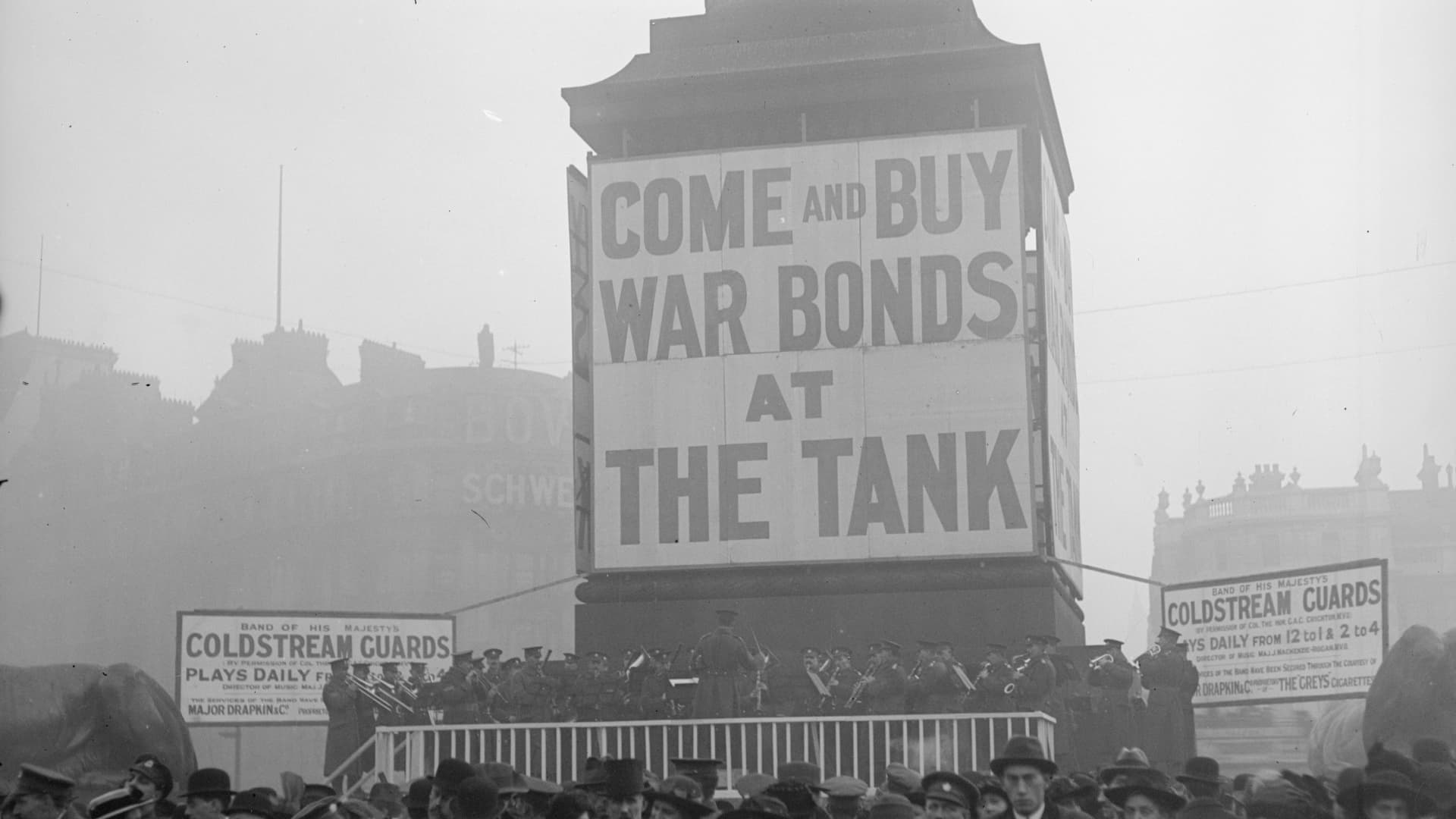
Crowds in Trafalgar Square during a rally to promote war bonds in December, 1917.
Topical Press Agency | Hulton Archive | Getty Images
This report is from this week’s CNBC UK Exchange newsletter. Like what you see? You can subscribe here.
The dispatch
In 1914, the United Kingdom was one of the world’s wealthiest countries, but by the end of the year it still needed to finance the war it had been fighting with Germany and its allies since August.
The solution was to borrow from investors via a so-called “war loan,” offering a coupon of 3.5%, repayable between 1925 and 1928.
Evidence unearthed by Norma Cohen, a former Financial Times journalist and now honorary research fellow at Queen Mary University of London, suggests it failed — with just £91 million ($121 million) raised of the £350 million ministers had targeted.
The Bank of England made up the shortfall and kept the details hidden from the public for decades.
Just over two years later, David Lloyd George, the chancellor (finance minister) responsible, became prime minister and decided to attempt a second issue of war loans.
In a speech at the Guildhall on Jan. 11, 1917, he said: “I want to see cheques hurtling through the air … every well-directed cheque, well loaded, properly primed, is a more formidable weapon of destruction than a 12-inch shell … a big loan helps to ensure victory.”
He added: “A big loan will also shorten the war.”
The issue was supported by a marketing campaign with the slogan: “Unlike the soldier, the investor runs no risk.”
Unfortunately for the three million people who invested £2.5 billion — around £261 billion in today’s money at a conservative estimate — that proved untrue.
In 1932, at the height of the Great Depression, Neville Chamberlain, another chancellor later to become prime minister, decided the 5% coupon on the debt was unsustainable and persuaded investors to swap the bonds into “perpetuals” that would never need to be repaid and with a coupon of just 3.5%. Inflation did the rest.
By 2014, with interest rates close to zero and the government able to borrow more cheaply, another chancellor, George Osborne, finally redeemed the outstanding £1.9 billion — by which time the original £100 invested in 1917 would have been worth little more than £2. Astonishingly, there were still more than 120,000 holders of the debt, which in many cases had remained in the same family.
War Bonds 2.0
Memories of this unedifying episode have been rekindled by suggestions that Andy Burnham, Britain’s new prime minister, could issue “war bonds” to fund extra defense spending.
The notion has been given fresh impetus because, before he dramatically resigned last month as defense secretary in protest at the Treasury’s unwillingness to spend as much as he wanted, John Healey reportedly pushed the idea. He is, of course, the new chancellor.
Healey is not the only supporter of such a scheme.
Andy Haldane, a former Bank of England chief economist who has been advising Burnham informally, suggested in an FT article last month that, with a quarter of the public telling pollsters they would be willing to buy war bonds, “extending tax incentives for investment in war bonds — for example, through a temporarily higher threshold for individual savings accounts, pension relief or inheritance tax — could readily tap” some of the £2 trillion held by Britons in bank deposits.
It’s a beguiling thought. But investors tempted would do well to remember the old adage “don’t let the tax tail wag the investment dog,” employed by generations of financial advisors. In other words, an investment should be all about maximising returns, not minimising tax liabilities.
The main objection, though, was outlined last weekend by Rishi Sunak, Burnham’s predecessor but one, in his Sunday Times column: “War bonds sound good, but are still just borrowing by another name.
“We’d be foolish to test the market’s attitude to lending us even more money.”
Quite.
— Ian King
Need to know
Hedge funds circle UK stocks as new PM Burnham pledges ‘new economic model’
Hedge fund short-sellers have ramped up bets against U.K.-listed stocks this year, with disclosed positions surging fivefold in the first half of 2026.
Andy Burnham says he would be prepared to call out Trump
Asked by BBC journalist Laura Kuenssberg if he would call out Trump if it was the right thing to do, Andy Burnham said: “You have to defend your own national interest before anything else. That’s what you’re required to do if you’re to do this job properly.”
PRO: Defense shares rally after UK government shake-up
The appointment of John Healey — who until recently served as ex-leader Keir Starmer’s defense minister — as chancellor appears to have been received by markets as a boon for security stocks.
— Katrina Bishop
Coming Up
JULY 29: Mortgage approvals (June)
JULY 30: Bank of England rate decision
JULY 31: Nationwide House Prices (July)
AUG 3: S&P Global Manufacturing PMI (July)
