
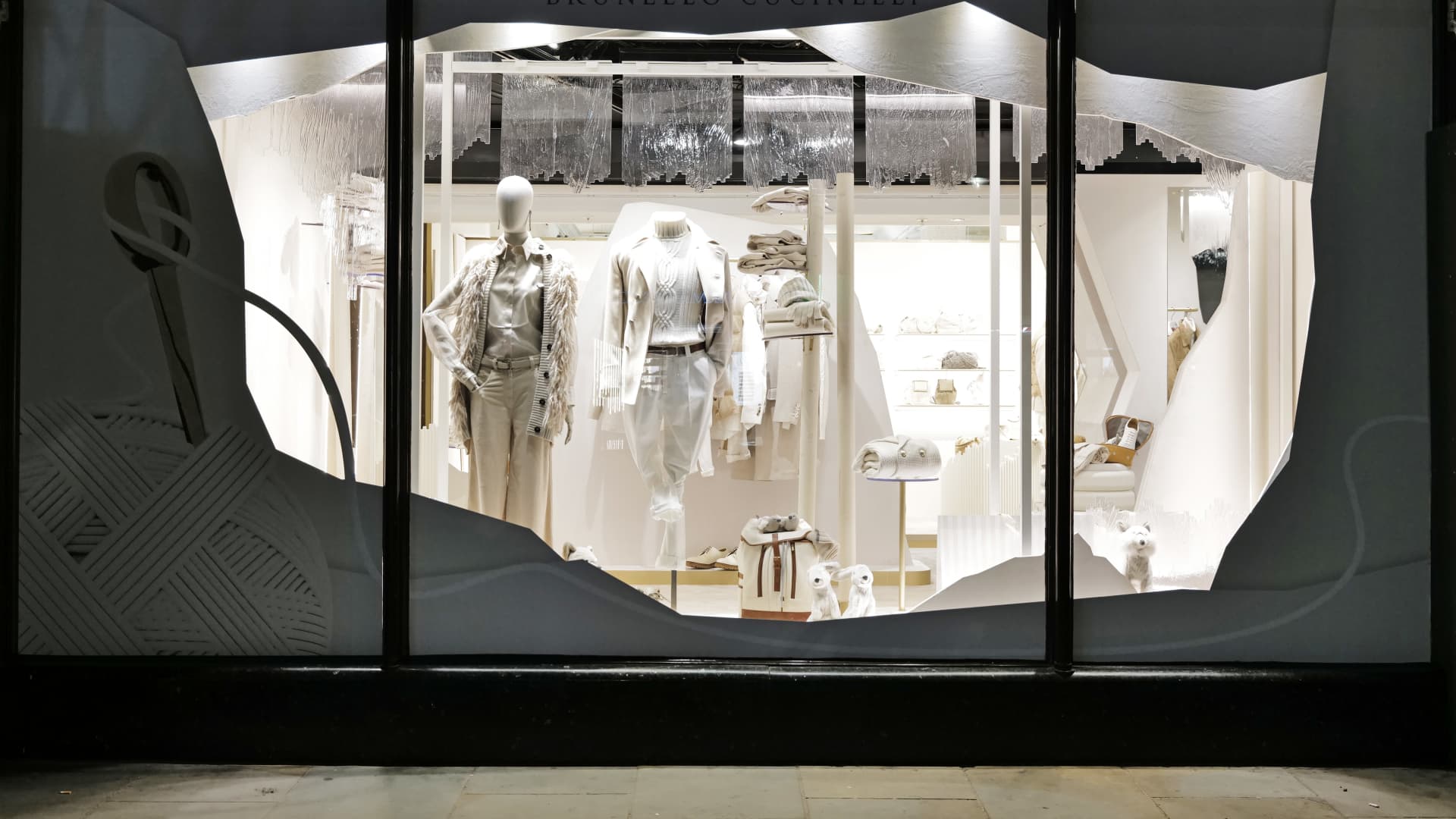
COPENHAGEN, Denmark – On the day of its IPO in 2012, Brunello Cucinelli issued an uncommon ultimatum to investors: if they wanted short-term profits achieved by harming the environment or damaging people, they should not invest.
In stark contrast to an industry filled with flatlining sales, the Italian luxury house known as “the King of Cashmere” is now bucking the trend, reporting a 14% revenue growth in the first three months of the year.
Meanwhile, other major luxury houses like Gucci and Louis Vuitton are weathering a sweeping downturn, barely recording growth at all.
Brunello Cucinelli’s success in making luxury apparel, including knitwear lined with diamonds and $1,000 t-shirts, is tied to its ethos of choosing long-term integrity over short-term margin chasing, Co-CEO Riccardo Stefanelli told CNBC.
“You don’t have to be greedy,” he said on the sidelines of the Global Fashion Summit in Copenhagen. “If you are greedy, it means that you are taking value from the supply chain and you are depleting someone.”
Dressed in white, matching Brunello Cucinelli’s “Solomeo in White” collection, the 45-year-old CEO explained how the company is expanding without losing its soul: it consciously operates at lower margins to preserve a healthy supply chain and what it calls “gracious” growth.
Its focus on ethical operation is rooted in the experience of its founder, Brunello Cucinelli, and has today evolved into what the company calls “humanistic capitalism.”
It’s about how you deliver your profits, how you achieve targets, and how you respect the value chain by trying to give back before pocketing a higher return, Stefanelli said.
Brunello Cucinelli, chairman and chief executive officer of Brunello Cucinelli SpA, center, speaks during a news conference to announce the company’s initial public offering (IPO), inside the Borsa Italiana, Italy’s Stock Exchange in Milan, Italy, on Friday, April 27, 2012. Brunello Cucinelli SpA, an Italian maker of luxury cashmere clothing, rose 37 percent on its debut in Milan trading after investors sought to purchase 17 times the amount of stock available in an initial public offering. Photographer: Michele D’Ottavio/Bloomberg via Getty Images
Bloomberg | Bloomberg | Getty Images
To protect its philosophy, the Cucinelli family retains 51% ownership of the business.
“It makes all the difference. We have control,” Stefanelli, now son-in-law to the founder. “We have to think on a long term instead of the short term imposed by the stock exchange.”
Luxury woes
Brunello Cucinelli has maintained a strict pricing principle, keeping the retail price at 7-8 times the industrial production cost.
This formula separates it from much of the industry’s behavior during the Covid-19 luxury boom, which ended in 2022. Many brands aggressively hiked prices, achieving as much as 30% revenue growth, but without a perceived uptick in quality, it alienated customers.
Gucci-owner Kering’s new CEO, Luca de Meo, recently said that price hikes “went too far.”
“We hope to still keep a perception of between the real value and the retail price,” Stefanelli said. “When you miss that, you have the problem, like the last two years, where the customers understand, or maybe they didn’t understand, why the increase of price was not connected to the increase of real [value].”
“I appreciate also the success of the LVMH, of Kering. I respect them,” Stefanelli said. “We do another job.”
The luxury market is currently experiencing a sharp polarization: generalist conglomerates catering heavily to aspirational consumers are struggling, while hyper-exclusive labels thrive.
A narrowed focus of only having one single brand, and the company’s relatively small size, allows the company to target a steady, controlled annual growth rate of between 10% and 12%, keeping volume growth modest to preserve brand exclusivity.
Brunello Cucinelli has a market capitalization of about 6 billion euros ($7 billion) and recorded 1.4 billion euros in revenue in 2025 – much smaller than many of its peers.
Scaling exclusivity
By avoiding mass-market expansion and focusing strictly on what it calls “absolute luxury,” Brunello Cucinelli appears to have sidestepped the luxury fatigue plaguing many of its peers.
And while Stefanelli recognized that Asia in particular offers significant headroom for growth, the brand refuses to alter its DNA to chase trends, even if it means missing opportunities.
“What we will not change is our domestic recognizability, our domestic attitude, our Italian attitude,” he said. “We do listen to the market, but if the market is asking something that doesn’t belong to you, we should not produce it.”
LONDON, ENGLAND – NOVEMBER 21: A general view of the atmosphere at the opening of the Brunello Cucinelli “Solomeo In White” pop-up at Harrods on November 21, 2023 in London, England. (Photo by Dave Benett/Getty Images for Brunello Cucinelli)
Dave Benett | Dave Benett Collection | Getty Images
Some of its competitors tried to grab a larger, more aspirational customer base to generate higher revenue, but that means “you never come back on the top of the pyramid,” Stefanelli said.
Following the company’s quarterly print in April, Jefferies analysts said it confirmed “the superior staying power of wealthier luxury shoppers.”

Brunello Cucinelli shares over the past 12 months.
However, maintaining this premium image has not come without market turbulence.
In September last year, short-seller Morpheus Research alleged that Brunello Cucinelli was misleading investors regarding its operations in Russia, circumventing international sanctions.
The stock plummeted more than 17% on the allegations, marking its biggest daily drop on record. While the company strongly rejected the claims, the stock has yet to fully recover the losses.
Italian luxury brands have also been rattled by recent investigations into worker exploitation and poor factory conditions which threatened the prestigious “Made in Italy” image.
Stefanelli insisted that the solution is simple: pay workers more.
Higher wages are also vital in encouraging the next generation to enter artisanal trades like tailoring and spinning, where labor shortages loom. Parents are unlikely to steer their children toward these career paths without the promise of dignified compensation, Stefanelli said.
“If you believe that the company must be there for the next 50 years, you plan like we do,” said Stefanelli. “It’s a cost for sure, but it’s a choice.”
