


Unlock the Editor’s Digest for free
Roula Khalaf, Editor of the FT, selects her favourite stories in this weekly newsletter.
Since performance art began, scandal has been part of the script. In 1916, Cabaret Voltaire — the birthplace of the dada movement — hosted a series of outlandish performances organised by German poets Hugo Ball and Emmy Hennings. A reaction to the horrors of the first world war, these deliberately absurdist acts — which included recitals of “nonsense” poetry or music made with typewriters — whipped audiences into a frenzy. On more than one occasion, they reportedly stormed the stage.
The golden age of performance art’s shock value, though, was surely the 1970s — when artists seemed intent on outdoing one another in ever more transgressive works, from Hermann Nitsch’s blood- and-animal-carcass-filled rituals to Marina Abramović inviting audiences to use chains and knives on her naked body. In recent decades, however, you’d be forgiven for thinking artists have lost their nerve. As the art world has turned towards care, healing and community, performers today are as likely to offer audiences a warm beverage as to spit in their faces.
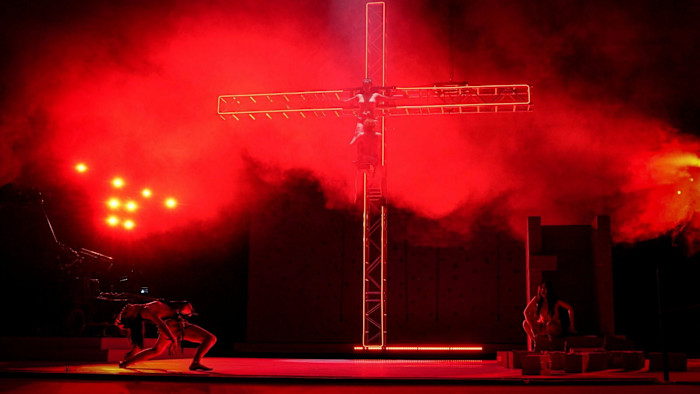
But if there is one artist unafraid of sharing her DNA, it’s choreographer Florentina Holzinger, whose taste for blood, piss and excrement has earned her comparisons to Nitsch and the notorious Viennese Actionists. Already a major figure in the theatre world, Holzinger is now stepping on to her biggest stage yet as she represents Austria at this year’s Venice Biennale. Among performance devotees, expectations are high: after the announcement, German newspaper Die Zeit put her and her all-female cast on its cover under the headline, “She is Europe’s Most Radical Artist”.
Despite her reputation for dangerous stunts, Holzinger bristles at this characterisation. “My work isn’t just spectacle and circus,” she argues. “The things I do are very sincere and attempt to go deeper than that.” And while this might sound a bit rich coming from the director of Sancta — an opera featuring roller-skating nuns in habits and not much else — she has a point: the controversy over the nudity in her work, in particular, feels faintly pearl clutching in an age when “naked” dresses are a red-carpet staple.

“What counts as radical really just depends on someone’s point of view,” says Nora-Swantje Almes, the curator behind Holzinger’s presentation in Venice. She uses body suspension — a practice often described as cathartic, in which a person suspends themselves in the air from hooks inserted through their skin — as an example. “When I first encountered it [in Holzinger’s work], I thought, wow, this is something I’ve never seen before. But there is a whole world out there of people doing it, and to them it’s completely normal.”
In her role as curator of live programme and outreach at Gropius Bau in Berlin, Almes regularly hosts sold-out performances in the museum’s vast atrium. So what does she think it is that draws audiences to such challenging experiences? “Performance has the potential to bring together people who may have different levels of tolerance towards certain topics,” she says. “To have that clash, and to give people space to hold different opinions, is really crucial for our society.”


For Holzinger, it all comes back to the human body. “It’s not a surprise that people are always excited by performance,” she says. “At the end of the day, if there is a painting or a photograph versus a body, audiences will always be drawn to this moving thing.” As to why they keep coming back for more punishment, she believes that impulse is equally straightforward. “What excites people is usually pretty close to what disturbs them.”
Of course, performance doesn’t need to go to physical extremes to push boundaries. Dutch artist Dries Verhoeven, who is representing the Netherlands in Venice, is known for creating taboo-busting performances that confront audiences with moral grey areas, touching on topics such as consumer ethics and sexual subcultures. “I always search for discomfort,” he says. “I use my own feeling of unease as a starting point and then look for ways I can materialise it for an audience so we can examine that unease together.”


His contribution, titled “The Fortress”, marks the first time the Netherlands will be represented by a performance at Venice. A vocal and architectural intervention in the Gerrit Rietveld-designed pavilion, the piece will be experienced by a select number of invited visitors, who will enter a pitch-black, bunker-like space within the otherwise closed building. “It’s a work, I would say, on the reflex for self-preservation — the urge to safeguard our boundaries, our peace of mind, our way of life,” says Verhoeven.
He believes that performance art can counter our tendency to push uncomfortable truths under the carpet and offer a way to switch off the autopilot many of us rely on just to get through the day. “There is this growing sense that the art world should be a safe space, that it should set a good example, and that’s understandable,” he says. “But I’m not interested in utopias. I would like to use art as a space where we can experience our nightmares.”
What nightmares await visitors in Venice remains to be seen, but, as with Holzinger, Verhoeven sees the body as an integral part of any performance piece. “What could be more meaningful than looking at a living body as a point of reflection?” he asks. “In these times, we all feel increasingly vulnerable, and witnessing a human body in all its fragility can create a profoundly intense and valuable experience. When someone is standing in front of you, looking you in the eyes, it is much more difficult to dismiss than a painting.”
Find out about our latest stories first — follow FT Weekend on Instagram, Bluesky and X, and sign up to receive the FT Weekend newsletter every Saturday morning
