


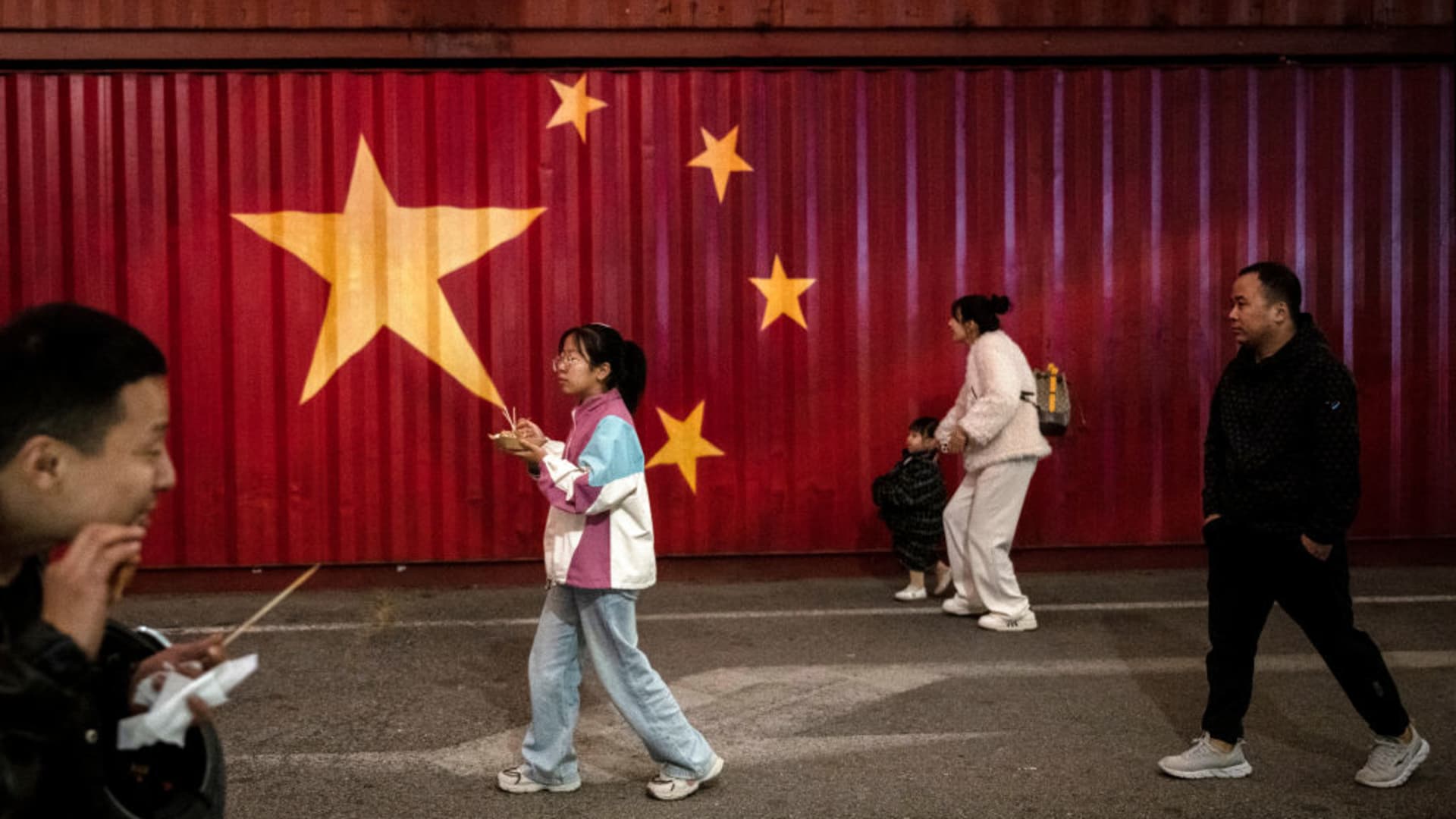
Visitors walk by a large Chinese national flag painted on the side of a container at an outdoor market during the Golden Week holiday in Beijing, China, on Oct. 3, 2024.
Kevin Frayer | Getty Images
China is making it harder for retail investors to steer money to U.S. stocks, ramping up a longer-term shift that steers domestic capital and companies toward Hong Kong.
Beijing’s securities regulator recently tightened scrutiny on offshore brokerages, saying it will “resolutely crack down” on Tiger Brokers, Futu Holdings and Longbridge Securities over what it described as illegal cross-border securities operations. It’s the latest salvo in a years-long effort to close loopholes that allowed mainland investors to access overseas markets outside formal channels.
The change “may potentially reduce funds to ADRs listed in the U.S.,” said Vey-Sern Ling, senior equity advisor at Union Bancaire Privée. “Hong Kong listings may therefore become more attractive if the company is eligible for Stock Connect,” a program which allows mainland Chinese to invest in some Hong Kong-listed stocks via their local brokerages.
The latest move comes as Beijing intensifies a broader cleanup of China’s financial sector under securities regulator Wu Qing, while simultaneously tightening oversight over cross-border capital flows and financial risk.
While the crackdown has revived concerns over foreign access to Chinese markets, analysts broadly downplayed the impact on global investors and liquidity.
“It should not have any material impact on foreign investors at all,” said Theodore Shou, chief investment officer at Skybound Capital. The crackdown is unlikely to materially hurt trading volumes in Chinese ADRs, he added, because affected mainland investors represent only a small portion of these platforms’ client bases and could still find alternative routes into overseas markets.
The bigger implication may instead be the continued migration of Chinese listings and investor activity toward Hong Kong, which analysts say Beijing viewed as a safer and more controllable offshore financial hub.
Still, UBP’s Ling cautioned the incremental boost may be limited because many major Chinese firms have already shifted toward Hong Kong over the past several years amid escalating U.S.-China tensions.
“Among companies with dual U.S. and Hong Kong listings, the majority of trading is already done through HK in most cases,” he said.
Some strategists argued that Beijing’s tightening also coincides with a broader push to channel investor enthusiasm toward China’s domestic technology champions and strategic industries — for instance, a series of initial public offerings expected in coming months.
The pipeline of high-profile listings including memory chipmaker CXMT, robotics firm Unitree and semiconductor company YMTC might benefit from Beijing’s changes, according to Peter Alexander, founder of Shanghai-based consulting firm Z-Ben Advisors.
“The public launch of these companies goes far beyond just the financial headlines,” he said. “China is making real strides in building a roster of companies that are customed built to address the technological gaps currently present with America.”
