
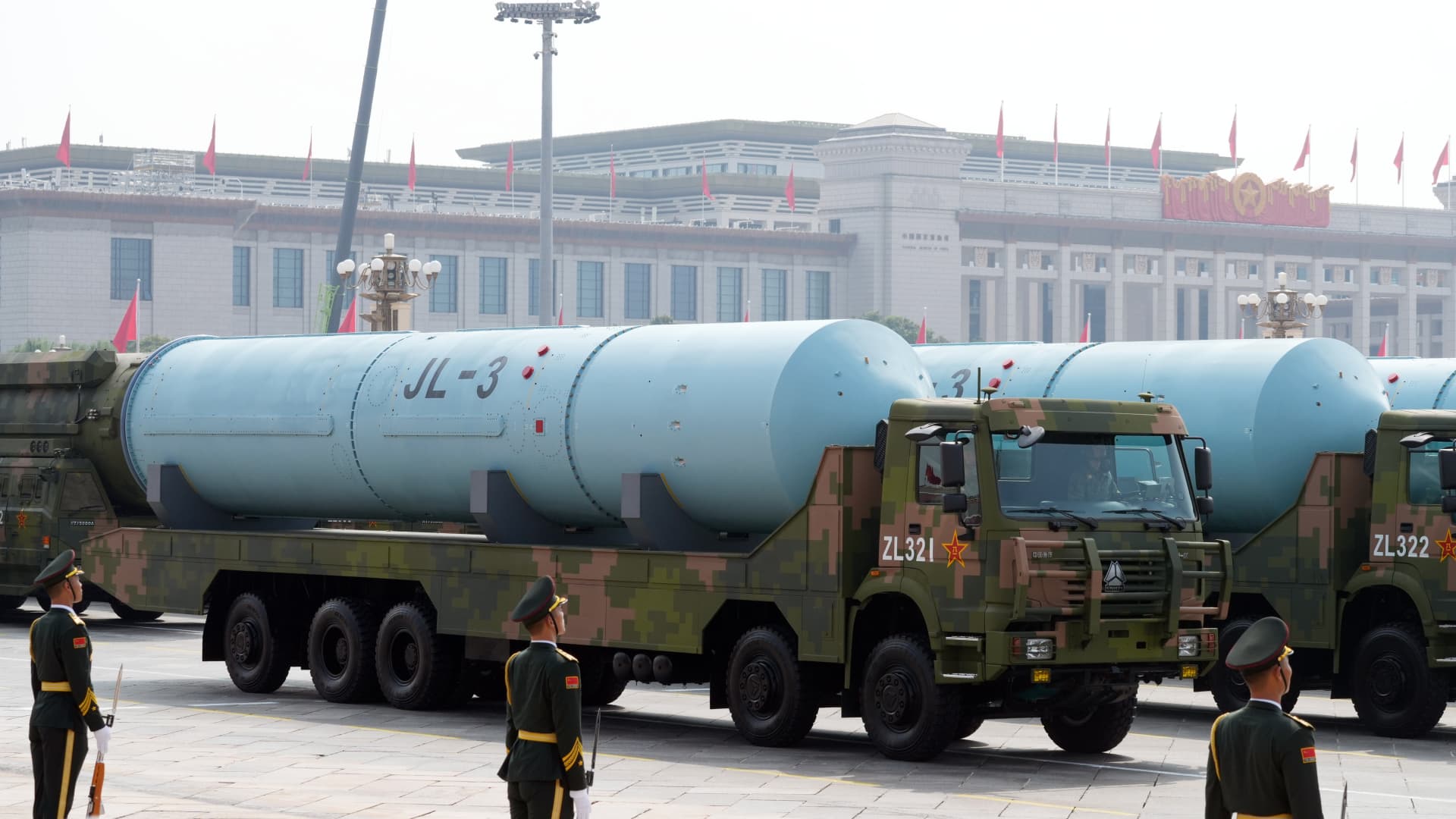
People’s Liberation Army (PLA) JL-3 intercontinental-range submarine-launched ballistic missiles on Chang’an Avenue at Tiananmen Square during a military parade to mark 80 years since Japan’s defeat in World War II held in Beijing, China, on Wednesday, Sept. 3, 2025.
Qilai Shen | Bloomberg | Getty Images
China’s rare launch of a ballistic missile from a nuclear submarine into the Pacific, demonstrating the sea-based leg of its nuclear arsenal, will push countries in the region to wall themselves off from Beijing by tightening defense ties.
A People’s Liberation Army Navy submarine fired the missile, carrying a dummy warhead, toward international waters at 12:01 p.m. Monday, according to the official Xinhua News Agency. The missile “landed precisely within the designated waters,” it said, calling the launch “part of China’s routine military training” that targeted no specific country.
The launch was Beijing’s first strategic missile test into the region since September 2024, when it fired a nuclear-capable intercontinental ballistic missile into waters near French Polynesia — its first known ICBM test there in four decades.
Rather than drawing regional powers into its orbit, the test will likely push them to deepen defense ties with one another to counter China’s growing military might, according to analysts.
“This assertiveness from Beijing should serve to drive U.S. allies in Asia closer together,” said Ely Ratner, former U.S. assistant secretary for defense for Indo-Pacific security affairs. The test underscores the speed and scale of China’s military modernization, including nuclear forces, he added.
Beijing’s military modernization and expanding arsenal had already been driving regional governments toward one another, and “this test launch will likely fuel those concerns,” said Jeremy Chan, senior analyst at Eurasia Group.
“China primarily used this missile launch to test and demonstrate its second-strike nuclear capability,” said Chan, noting the sea-based test followed the 2024 land-based launch. “Presumably the next test will be an air-based missile.”
He expects greater cooperation in joint training, arms sales, and defense spending, among countries such as Australia, New Zealand, Japan and the Philippines.
Beijing has spent years assembling a nuclear triad — the ability to deliver warheads from land, air and sea — an arsenal that would strengthen its position in any regional crisis or conflict with the U.S.
The missile type, location and where it was fired from or landed remains unclear. The state-run media Global Times cited a military expert as saying it was likely the JL-3 — China’s most advanced submarine-launched ballistic missile, capable of reaching the continental U.S. from waters off the Chinese coast, according to the U.S. Department of Defense.
In a statement late Tuesday, Chen Xi, Chinese defense ministry spokesperson, said the test launch “achieved its intended targets” and neighboring countries were notified in advance. “Beijing has kept its nuclear forces at the minimum level required for national security, and will not engage in a nuclear arms race with any country,” Chen added.
Stoking fears
The test also reflected Beijing’s determination to project power over its neighbors, analysts said, despite the scrutiny and alarm from regional powers such exercises almost immediately set off.
Australian Foreign Minister Penny Wong described the launch as “destabilizing to the region” and came “in the context of a rapid military buildup by China.” New Zealand Foreign Minister Winston Peters said China carried out the test “within hours of informing us” while warning that it signaled “a recurring pattern” from Beijing.
The U.S. State Department also condemned the exercise, stating that Beijing’s “rapid and opaque nuclear weapons buildup is of great concern to the region and the world.”
The launch “fits into a continuing aggressive pattern by China of throwing its weight around in the Pacific,” where the U.S. allies are already increasingly wary of the Trump administration’s wavering commitment to their defense, said David Silbey, a military historian and senior lecturer at Cornell University.
But in China’s calculation, proving progress toward a building a full nuclear triad was worth the risk of regional blowback, said Lyle Morris, senior fellow at Asia Society Policy Institute. “The deterrent benefit outweighs the diplomatic and military costs from the region.”
Leaders from Fiji and Australia signed a mutual defense treaty on Monday, that mandates both countries to consult on security threats and “act to meet the common danger” if either is attacked. The pact came as Canberra seeks to curb Beijing’s growing security influence through defense deals with Pacific nations.
Pacific island nation of Vanuatu last week agreed with Australia to bar foreign military bases from its territory in a move viewed as targeting China. The Solomon Islands, one of China’s closest security partners in the region said last month it would review a security agreement with China while negotiating a comprehensive treaty with Canberra.
The show of force could further validate Fiji’s choices, and send a signal to others that “China is prepared to play rough and therefore they should accede further to Australian overtures for security cooperation,” said John Blaxland, a professor at the Australian National University.
