


POWER POINT
What I’m hearing from energy insiders
First and foremost, I hope that everybody had a wonderful 4th of July holiday and celebrated the 250th birthday of this amazing nation.
As the celebrations ended and this week began, we seemed to be on a path to the Iran conflict winding down and the Strait of Hormuz being fully opened. But then Iran shot at a Qatari tanker, the U.S. retaliated and Trump said at the NATO Summit that the ceasefire was off.
Despite this news, oil prices remained relatively muted. WTI crude moved back above $75 per barrel at one point, but that’s only back to levels of a few weeks ago. It is certainly possible oil inches even higher, but as we wrote recently, there is a lot of oil in the world and it’s clear the market wants to push prices lower if it can.
MY TAKE → If you look out further on the futures curve, prices at the CME Group are still just above $70 later in the year. So the outlook for oil is relatively stable.
Still, with the chaos we are seeing inside Iran – the Ayatollah’s son, who is ostensibly ruling the country, didn’t even attend his own fathers funeral and it’s unclear even if he’s alive – where things are with oil in the next 24, 48 or 72 hours is anyone’s guess. Stay nimble. It is likely going to stay very dicey for a while.
Another reason why the outlook for oil is remaining steady is because trading during this conflict has proven the extent of the ample energy supplies from America.
So back to what I wanted to talk about first in this newsletter: American exceptionalism and how our energy abundance contributes to that.
When you travel the world, energy stands out. Billions of people don’t have easy or affordable access to electrical power. Here in America, our electricity costs are close to half that of Europe. Having relatively moderate energy costs is a massive benefit. That benefit isn’t just to economic growth, but how families live.
Some of the reporting I’m most proud of is our early coverage of Europe’s largely self-inflicted energy problems. Back in 2021 we reported from London about the UK’s growing issue of energy poverty. “Energy poverty” is exactly what it sounds like: people not being able to afford all the heat, cooling or electricity they need to stay comfortable or even safe. Paying for high power costs can also often take away a person’s ability to afford other necessities. Choosing between heating or eating is not a decision anyone should have to make in the 21st century. Sadly, many still do.
The issue isn’t limited to the U.K. Across Europe, high energy costs have taken a toll. In a remarkable report last year, the European Commission admitted that:
“Exceptionally high prices had, and continue to have, serious implications for European households, industry, the broader economy and public finances.”
According to GlobalElectricity.org., Europe’s residential electricity prices are about 60% higher than what we have here in the U.S. Europe has massive natural gas resources, but has largely chosen to limit or even close them. The Eurozone is now reliant on imports to meet 90% of its oil and gas needs. The region has also booted nuclear power, closing a number of plants. That’s a move that European Commission President Ursula von der Leyen called a “strategic mistake.”
MY TAKE → Energy has played a role in economic and stock market outcomes. American GDP has soared over the last 20 years, far outpacing the European Union. It’s not all because of poor energy policies, but those are clearly a factor.
The bottom line is that energy policy decisions have consequences. It’s why American Clean Power CEO Jason Grumet smartly acknowledges below that we as a planet are going to need nearly all forms of energy. Read more below in Inside Line.
On the topic of energy, while we assume you probably don’t directly buy barrels of oil, we are guessing you do buy gasoline. We also know you may be frustrated that gasoline prices have not fallen as fast as you would like. One question I’m frequently asked is why gasoline prices tend to go up faster than they go down.
There are two reasons.
First, station owners have to sell through the inventory they bought at higher prices. They don’t want to lose money by selling below cost. Two, station owners – most of whom are simple family operations and not part of ‘big oil’ – will use price spikes to their advantage. Yes, there is what some people may call ‘gouging,’ but selling gasoline is an incredibly low margin business and often owners will have to make up for losses they take elsewhere.
FUN FACT→ Both my father and late grandfather owned gas stations for periods of time. My dad’s station was in La Habra, California and my grandfather’s was located in Stephens City, Virginia. Those were long ago, different times, but the stories and experiences still stick with me.
Here’s the good news: absent some sudden twist, gasoline prices should keep coming down. In fact, I would expect that soon parts of Texas and Louisiana and the south will soon have average prices under $3 per gallon. If so, that would take a bite out of the inflation picture. Let’s hope for peace and prosperity for all, including our friends and allies overseas.
WALL STREET’S TAKE
The oil and gas stocks all popped on that Iran news, but overall most are lower over the past month as crude has fallen. The upshot of that downmove is that many big name stocks are 20% or more below their average Wall Street analyst price target. Here’s the FactSet screen I track.
Let’s move on from oil and gas.
Listen up, all you nuclear energy bulls: small modular reactors may not be the next big thing. So says Bernstein. The research firm – now a part of French investment firm Societe Generale – is out with a bold new note that nukes a part of the nuclear thesis. Sort of.
Small modular reactors (SMR) have been the buzzy talking point the last few years. I won’t go into exactly what they are other than they are small, modular, and yes, nuclear reactors. Joking aside, they are also not new. Nuclear powered submarines have been around for decades. The U.S.S. Nautilus was commissioned in 1954. It was powered by a form of SMR. If you want more info, here’s a good white paper.
SMR has also been an energy theme. The next big thing is, apparently, small. But Bernstein says it’s time to take a pause. The firm lays out 79 different SMR projects, liking some but admitting that not all nuclear ambitions are the same. The research is led by Bob Brackett, Ph.D.
Part of Brackett’s rationale is that SMRs – while important – are mostly “second-wave options for small grids” and are good at replacing coal. He and his team say that the near-term trade is in “existing nuclear” with Constellation Energy (CEG) and Vistra (VST) set up as “early major beneficiaries.” He believes CEG and VST will benefit from large existing “restart” projects, rather than trying to build all new nuclear and SMRs. Cameco (CCJ) is also seen as a big winner for investors. Not just is CCJ a huge uranium supplier – which is a critical nuclear fuel – but also because Cameco owns 49% of nuclear developer Westinghouse.
Speaking of GE Vernova (GEV), it has really become a hot energy stock lately. Shares keep hitting new record highs, though hit a bit of turbulence this week.
Still, the shares are up 25% since we spoke with CEO Scott Strazik back in March. The Binghamton, New York native was bullish … and right. Investors are realizing GEV is a giant of all things energy: nuclear, wind, hydro and natural gas. Wall Street’s mean price target is $1,228 – which, like Bernstein – doesn’t imply a lot of upside. Other analysts are more bullish. Evercore ISI’s has a $1,350 target and Deutsche Bank isn’t too far behind at $1,309. That said, caveat emptor! A few firms have targets below the current price. Mizuho Securities has a $913 target to go with their ‘hold’ rating.
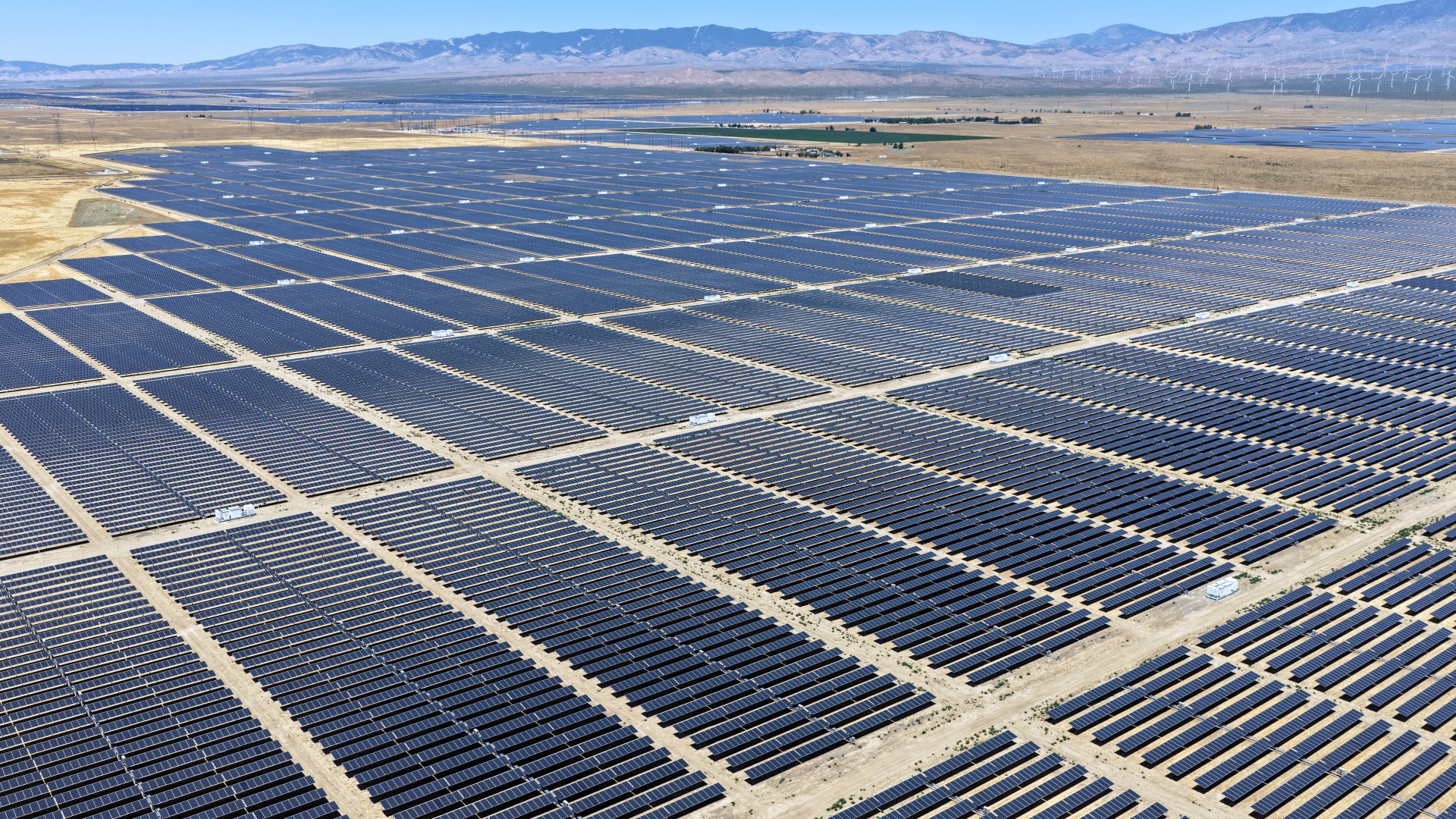
Let’s stay on solar. It’s been a bit cloudy on shares of America’s largest solar company, First Solar (FSLR). Shares have lost 18% in the past month, and are now down 12% for the year. According to FactSet and SEC data, some insiders have also been selling.
That drop, however, could mean sunnier things for investors. Deutsche Bank’s Corinne Blanchard upgraded FSLR on Tuesday. She believes the current valuation is an attractive entry point. Fundamentals matter, but for investors now, they may not matter as much as politics. Much of Wall Street is waiting for an outcome around tariffs. It’s complicated, but has to do with tariffs.
Aside from normal earnings metrics, tariffs and quotas on solar are top of mind. Investors are waiting on a ruling around section 232. That’s a policy issue that allows the President to hit a sector with tariffs or quotas in situations where minerals or materials deemed critical to America are being imported into the county. I’ll call it ‘WBI’ (wonky, but important).
Key Point → Potential Section 232 tariffs on solar polysilicon are a huge issue for First Solar and other players in the space. A positive ruling on the reading of the rule would allow the White House to impose new fees on certain parts of the solar panel supply chain.
You can read more here: Section 232 Tariffs on Steel and Aluminum Frequently Asked Questions | U.S. Customs and Border Protection
Like with any policy calls, the outcome is unclear. The decision will ultimately be made by the Commerce Department and is expected next month. First Solar expects more tariffs but does not want to see new quotas. The company itself is very quiet, but did briefly mention S.232 in its latest earnings presentation. A negative ruling (aka higher tariffs or quotas) could hit FSLR stock. A more positive outcome would benefit investors. If you own solar stocks you have to pay attention to this policy.
For more on her bullish call, we welcomed Corinne Blanchard onto Power Lunch to discuss it. Watch it here.
TAKE A LOOK
We were happy to welcome Exelon (EXC) CEO Calvin Butler on CNBC this week. Butler talked about the grid, electricity demand and pricing, and why obscure decisions by America’s grid operators matter so much to you:
INSIDE LINE
This week’s Inside Line is with American Clean Power CEO Jason Grumet. Grumet is a strong, rational voice for renewable energy.
Brian: Jason thanks for coming on Inside Line. We’ve been so focused on Iran that it’s great to hear more about what you and the team are doing at American Clean Power. The solar power buildout has rather quietly been tremendous the last few years. Any sign of a slowdown?
Jason: Clean power resources are providing roughly 90% of all new electrical capacity being added to the grid, with solar and storage leading the way. We need all forms of power, but renewable resources are available today and will remain the largest fraction of new electric power for the foreseeable future.
Brian: Does offshore wind have a future in America?
Jason: Five commercial offshore wind projects are currently under construction, and three are already delivering electricity to the grid. Offshore wind has the unique advantage of delivering large amounts of power directly into major coastal population centers where demand is highest, and where land-based options are limited. When people see the price tag of alternatives like new nuclear in these regions, I think there will be renewed urgency to deploy offshore wind.
Brian: Do you expect real, meaningful permitting reform to get through Congress at some point?
Jason: We need dramatically more power than the current permitting system can deliver, but the window of opportunity from this Congress is closing. The key to passing legislation is treating all energy equally and making clear that final permits cannot be undone based on political bias on the left or the right. The White House is going to have to demonstrate a real commitment to these principles for legislation to advance this year.
Brian: You come from a bipartisan policy and problem-solving background. What would be one or two easy policy ‘wins’ the industry could use to keep up momentum?
Jason: The clearest near-term win is tax policy supporting domestic manufacturing for critical energy systems — bipartisan momentum here is real and it directly supports American competitiveness and national security. The second opportunity is securing permitting reform that treats all energy equally and provides project certainty. Both policies would increase energy supply, create jobs, and lower prices.
Brian: Finally, Jason, what’s your message to both parties and industry CEOs right now on clean power?
Jason: To both parties: Creating durable policy for competitive energy systems is good politics and good economics. To CEOs: keep building. America needs what we’re delivering, and the economic fundamentals are stronger than ever.
RANDOM, BUT INTERESTING
Bernstein’s graphic about powering the electric grid highlights the highs, lows, fast and slows of what it perceives as paths to power right now. Where do you land on the best option right now? Love to hear from you. Hit me up on X or LinkedIn.
