


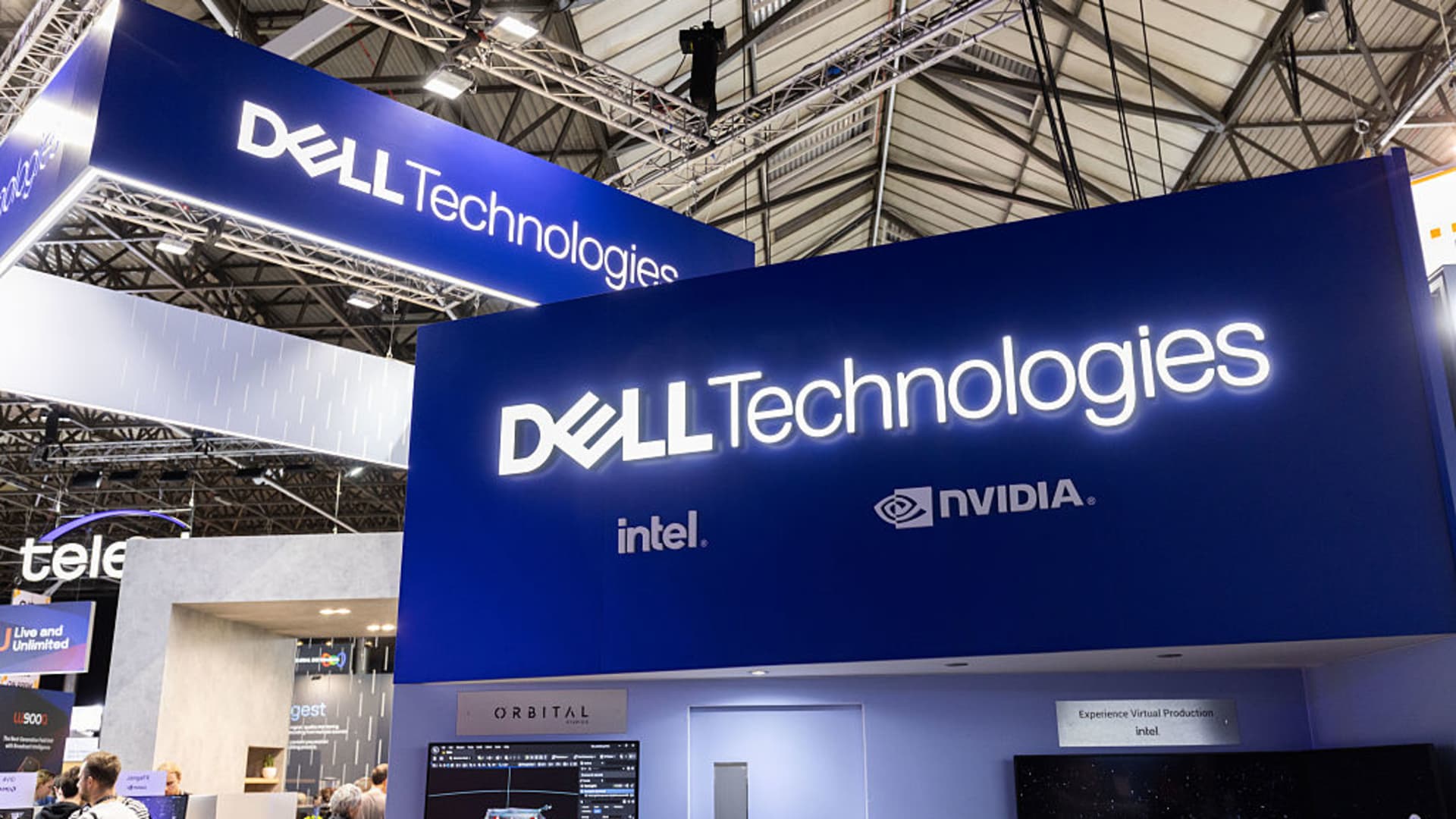
Don’t fight the tape. That’s the message from strategists at Piper Sandler on Friday morning, and you know what, it’s hard to argue with their take. “The market’s price action continues to remind us of a simple mantra from the movie Maverick— ‘Don’t Think, Just Do,'” they wrote. “The primary trends are firmly bullish, rewarding investors who avoid over-analyzing the macro noise and instead follow the tape’s leadership. By sticking with momentum leaders and avoiding laggards, investors are capturing the market’s grind into new highs.” Importantly, in many cases, the winners are winning thanks to earnings, not simply multiple expansion. Take a look at server maker Dell Technologies , the latest company to report a blowout quarter on the back of the artificial intelligence spending boom. If you’re only looking at the price action — shares up over 30% on Friday — you could be forgiven for thinking that we’re starting to see bubble behavior. However, as was the case with Nvidia from the start of its historic run following the launch of ChatGPT in late 2022 , it’s not a bubble if the fundamentals back it. That is certainly the case with Dell. Wall Street has already raised its fiscal 2027 full-year earnings estimate to $16.85 a share, up from $13.12 prior to Thursday night’s report, according to FactSet data. Meanwhile, estimates for next fiscal year have jumped to $20.21 a share from $15.18. That represents a 28.4% increase to FY27 numbers and a 33% increase to FY28 numbers. What that means is that, despite Friday’s surge in the stock, based on a share price of $410, the price-to-earnings ratio on FY27 numbers has only expanded from 24.2 times to 24.3 times. On FY28 numbers, the stock trades at roughly 20.3 times earnings, which is actually down from the 21 times multiple we thought we were looking at Thursday before learning that the estimates have just been way too low. Put simply, the price action will have you thinking this is unsustainable. That’s exactly what folks were saying about Nvidia after that legendary May 2023 earnings report , when Wall Street realized just how offside it was on the earnings tidal wave about to hit. The point is, if you’re looking at these moves and thinking you need to bet against them, think again. The AI spending boom is real. We are simply now seeing Wall Street catch up to what the hyperscale CEO’s have been saying: the AI opportunity is far bigger than most can imagine, and the spending on data centers and computing infrastructure is required. On this note, Dell’s customer count for AI servers has surpassed 5,000, up over 50% in the last six months. Talk about broadening demand, which is something Nvidia preached when it reported last week. Nvidia and Dell are close partners, and Nvidia is a clear winner from this quarter too. We expect that will become even clearer in coming days, when CEO Jense Huang gives his keynote address at Computex in Taipei. At the same time, we’re not advocating chasing a move like this in Dell — no matter how impressed we are by the numbers. The reason to proceed with caution has more to do with market mechanics and less about the fundamentals or valuation. A lot of people just made a lot of money, and when that happens, some profit-taking should be expected. Consider: There may be some fund managers with Dell positions that now exceed an appropriate weighting thanks to these monster gains, forcing them to peel some off. This gets to the idea of why we like to trim stocks after parabolic moves. In this case, we’re saying you should wait for a name like Dell to cool off before initiating a position. That can certainly make this a hard market to get money to work in, but what we can do is keep track of winners and estimate revisions, and use that to build a target list — similar to our Bullpen watchlist — that we can revisit when volatility strikes (as it always does). As for the AI stocks we already own, this is simply another proof point that for all the money made in the AI trade — whether that’s in semiconductors like Nvidia, power, or network infrastructure, there is still plenty of upside left to be had because demand is off the charts. (Jim Cramer’s Charitable Trust is long NVDA. See here for a full list of the stocks.) As a subscriber to the CNBC Investing Club with Jim Cramer, you will receive a trade alert before Jim makes a trade. Jim waits 45 minutes after sending a trade alert before buying or selling a stock in his charitable trust’s portfolio. If Jim has talked about a stock on CNBC TV, he waits 72 hours after issuing the trade alert before executing the trade. THE ABOVE INVESTING CLUB INFORMATION IS SUBJECT TO OUR TERMS AND CONDITIONS AND PRIVACY POLICY , TOGETHER WITH OUR DISCLAIMER . NO FIDUCIARY OBLIGATION OR DUTY EXISTS, OR IS CREATED, BY VIRTUE OF YOUR RECEIPT OF ANY INFORMATION PROVIDED IN CONNECTION WITH THE INVESTING CLUB. NO SPECIFIC OUTCOME OR PROFIT IS GUARANTEED.
