


Unlock the Editor’s Digest for free
Roula Khalaf, Editor of the FT, selects her favourite stories in this weekly newsletter.
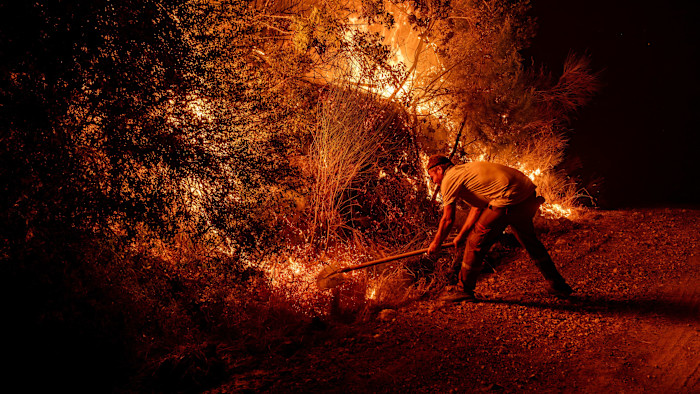
“Dantesque” is how one French fire chief portrayed the wildfires sweeping parts of the Gironde; residents returning to burnt-out homes in mountains west of Madrid used a similar image. Not since 1949 have flames crept so close to Bordeaux. In the UK, blazes have raged in the Scottish Cairngorms and Suffolk’s coastal heathlands. And while some of those fires are dying down, EU officials warn that Greece, Italy and central Europe are all seen as vulnerable in coming weeks.
Europe is not alone; parts of Canada and the US have experienced record or near-record wildfire activity so far in this northern summer. But Europe in particular, the planet’s fastest-warming continent, is having to confront the speed of the change. Scientists warn both temperate forests across France, Germany and Poland and boreal forests of Scandinavia are likely to see increasing extreme fire activity — with warmer growing conditions producing more vegetation that hot, dry summers make liable to ignite. Compared to North America, Europe’s lack of vast, remote wilderness means blazes are rarely far from populated areas. Even if flames do not reach the cities, toxic smoke can.
The 2026 European heatwave is further proof of how ill-advised it is for some countries to be watering down climate change policies. Yet alongside mitigation efforts, this summer has shown that adapting to global warming’s effects — too long a poor relation to mitigation — needs to rise up the agenda, to deal not just with summer wildfires but winter flooding.
That poses tricky decisions for often cash-strapped authorities on how to manage threats that, though more frequent and severe, will remain irregular. The experiences of Australia and California and others that have suffered intense recent wildfires offer some lessons on what works and what to avoid — and technologies that might help.
One is to prevent fires from starting, or spreading so fast. Australia is conducting more controlled burns to reduce dead wood and bark that can fuel wildfires; Finland, Europe’s most forested nation, fragments its commercial timberlands with borders, paths and waterways to act as firebreaks. Portugal is trying to shift from industrial “monoculture” forests such as eucalyptus to more fire-resistant and water-retentive species such as oak and chestnut. There are similar calls in France’s Gironde to diversify the pine forests first planted in the 19th century.
Another step is to improve early warning systems. In California, Silicon Valley has spawned a fire tech sector whose start-ups are coming up with hilltop cameras that can spot heat or smoke plumes, and solar-powered ground sensors sniffing for ignition gases. Others offer drones that can quickly drop fire retardant on to small fires. In Europe, Greece in May became the first country in the world to deploy a constellation of four thermal satellites designed to detect ground hotspots in minutes.
There are better ways to prepare too. Businesses and homeowners in fire-prone areas can be encouraged to clean gutters — where debris can be ignited by falling embers — fireproof perimeters around buildings, and maintain hoses. Fire crews, complemented by voluntary or military reserve firefighters, need proper training in tackling megafires.
Equipment for fighting very big fires, such as Canadair water-bombing planes, is expensive. Pooling resources between regions or countries can cut costs. The EU’s Emergency Response Coordination Centre offers a model, with its shared fleet of firefighting planes and other supplies. But simultaneous blazes in coming weeks could still overwhelm firefighting efforts. Europe’s long, hot summer is far from over.
