
Harvesters pick grapes in vineyards during the 2025 Champagne harvest in Hauvillers, north-eastern France on August 28, 2025.
Francois Nascimbeni | Afp | Getty Images
Sweltering summer temperatures look set to spur the earliest Champagne harvest on record and potentially one of the most challenging. The French region’s winemakers face lower crop yields, weaker consumer demand and a threat to the iconic drink’s famed fresh taste.
The Champagne season officially starts on Aug. 15 this year, with the majority of picking expected between Aug. 20 and 25, around two weeks earlier than usual in recent years. Before the early 2000s, harvesting the grapes of the sparkling wine — which brought in $6.6 billion in sales revenues last year — almost always took place in September or October.
But hotter springs and summers are accelerating the grape-ripening process, creating more sugary fruit and narrowing the optimum picking window for Champagne.
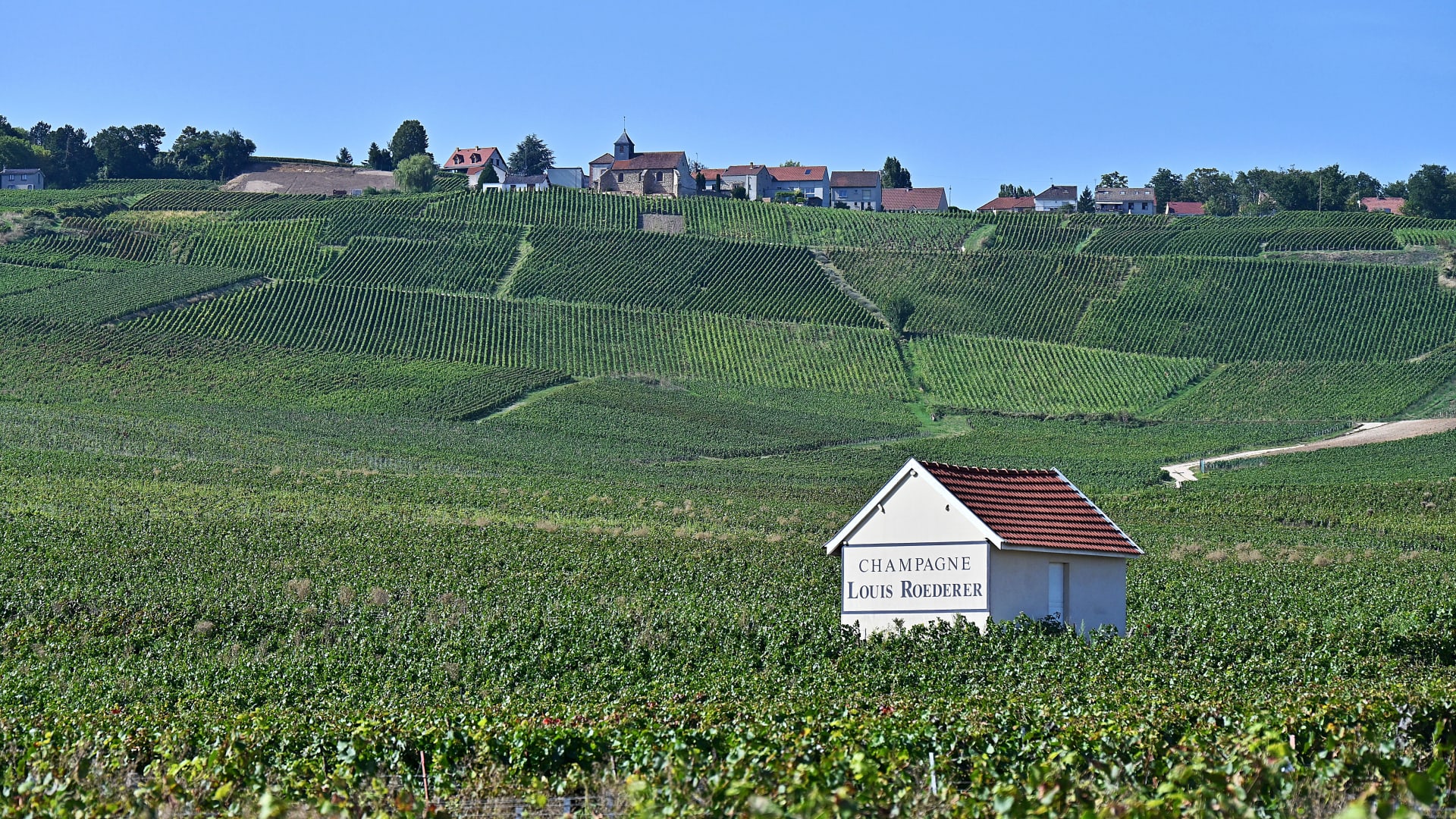
Mutigny, north-eastern France, with vineyards of Champagne.
Andia | Universal Images Group | Getty Images
Winemakers are torn between harvesting early to reduce the amount of sugar in the fruit, but risking the ability to achieve the correct balance of acidity and so-called “phenolic ripeness,” the point when tannins and other compounds have matured enough to deliver the desired flavor and texture.
“With great wine grapes, you want the maturation process to be slow. This is true with most fruit,” said Linda Johnson-Bell, founder of the Wine & Climate Change Institute consultancy.
A short growing window can be more easily disguised in red wines, many of which have increased their alcohol content in recent years due to more sugary grapes. But it is a particular challenge in Champagne, where the drink’s “identity is its tautness, its high acidity, low sugar, its finesse, its elegance,” Johnson-Bell said.
Adapt to survive
Along with a warming trend pushing harvesting seasons earlier, European wine growers are up against drought, freak weather events such as spring hailstorms and frost which wiped out many buds, and wildfires.
In the macro picture they also face waning demand for alcoholic drinks, higher labor and fuel costs, and the complication of tariffs in the U.S., Champagne’s largest export market.
Some winemakers are reacting by pulling out vineyards, changing their grape varieties, moving further north or introducing irrigation systems. But high-end variants such as Champagne are restricted by their appellation, which protects where its grapes can be grown and how, including a ban on the watering of adult vines.
Champagne growers are developing various techniques to protect grape clusters, a representative from trade association Comité Champagne told CNBC. Those include the use of insect-proof greenhouses and experimenting with new grape varieties, along with the creation of an R&D center to explore further solutions.
Producers have also trimmed their quota of yield permitted for sale this year, a decision made to help balance stocks, maintain quality and preserve vineyards amid “challenging” weather conditions and “sluggish” French demand, the Comité Champagne said in a release last month.
The businesses which sell their end product will be little-concerned by this year’s harvest since the “quality seems promising, and the industry could do with lower inventory,” Bernstein’s global head of luxury goods, Luca Solca, said by email.
Jean-Claude Mas, founder of Domaines Paul Mas-Coté Mas, which produces reds, whites and rosés in the southern French region of Languedoc, said his vineyards had so far defied gloomy expectations since he began harvesting earlier this month and were looking “beautiful.”
“In 30 years I’ve never seen a year like this. We’ve had an accumulation of heat since the end of May. I was so stressed, but this year it looks like we could have a really good harvest. My analysis of that is just the incredible capacity to adjust of nature,” he said.
A sparkling opportunity for English winemakers?
The earlier grape harvesting season is also being observed in the U.K., which has a relatively small but growing wine industry that produced roughly 16.5 million bottles last year and increased its exports by 55%, according to official data.
“It’s quite astonishing how far forward the harvesting has come in a generation,” Fergus Elias, director of wine at Balfour Winery, said from a vineyard in Suffolk, England. As a child, he recalls his winemaker father’s harvests never starting before early October and finishing as late as mid-November.
“If I really wanted to, I could pick these vines and make a passable wine with them,” he said this week.
“But in England our growing season is still long enough… I’m quite excited,” he added.
A warmer climate is allowing new varieties of grape to grow in Britain’s chalky soil, which is similar to that of northern France. The opportunity has even attracted the attention of French producers, with Champagne house Taittinger acquiring land in Kent to make an English sparkling wine.
“Climate change is talked about as something that makes English wine more sustainable, although it does come with a lot of challenges,” Elias said. “This year we had a late spring frost in mid-May, but we’re lucky to have sites across the country which gives some geographic security.”
Industry players are meanwhile convinced that Champagne’s innovation will be enough to preserve the drink’s status and quality long into the future.
“The Champenois will do absolutely everything to safeguard that product, they’ve been onto these issues for decades,” Linda Johnson-Bell said. “Maybe I’m romantic but I just see Champagne always surviving.”
