


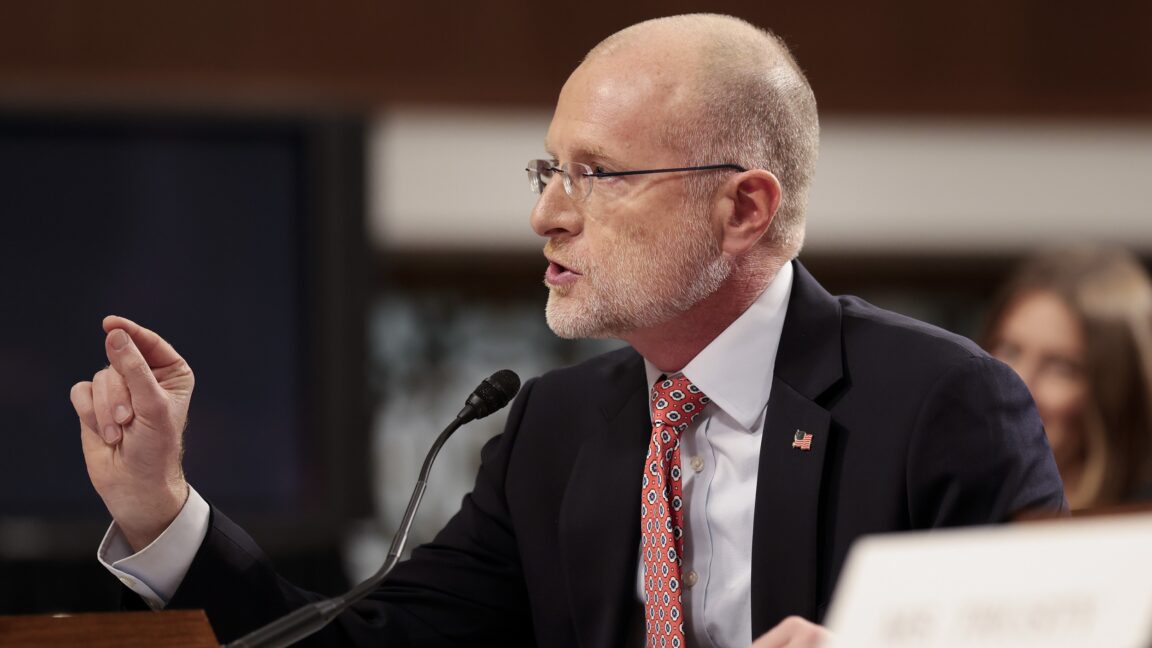
Commissioner Anna Gomez, the only Democrat on the three-member FCC, today called Carr’s plan an “unlawful effort to hand control of the public airwaves to billionaire buddies of this administration.” She said it “will destroy local newsrooms, silence community reporting, and drive up costs for the American families who depend on local stations for news and emergency alerts.” Without the 39 percent cap, “this FCC is now poised to allow local broadcasters to sell those airwaves off to the highest bidder,” Gomez said.
A press release issued by the FCC chairman’s office said that case-by-case reviews will allow mergers to exceed the 39 percent limit if the deal advances “localism, viewpoint diversity, and competition.” Carr wrote in his Breitbart op-ed that there has been “a steady decline in locally produced news” that would be fixed by letting companies own larger numbers of stations. The current rule prevents local broadcasters from achieving the scale in operations they need to challenge competitors, he argued.
“When it comes to broadcast news, our country could do with a little less Hollywood and a little more local reporting from communities across the country,” Carr wrote in Breitbart. “The FCC’s plan to switch from a national cap to a case-by-case review allows exactly that and shifts the focus back to the American people and the local communities they live in.”
Only Congress can change cap, critics say
The planned change, set to be voted on at the commission’s August 6 meeting, is certain to face legal challenges. Only Congress can change the ownership cap, Gomez and other critics of Carr say.
“Congress set the 39 percent national ownership cap in federal law, and only Congress has the authority to raise or eliminate it. The commission cannot waive away that limit simply because these corporate behemoths want to get out from under it,” Gomez said.
Gomez said the FCC tried and failed to change the cap over 20 years ago. “In 2003, the Commission raised the cap to 45 percent under its own authority,” she said. “Congress stepped in within months, rewrote the law to set the cap at 39 percent, and made clear the FCC did not have the authority to change it. An FCC vote to raise the cap now would be unlawful, as it would mean doing the exact thing Congress has already said the Commission cannot do.”
