


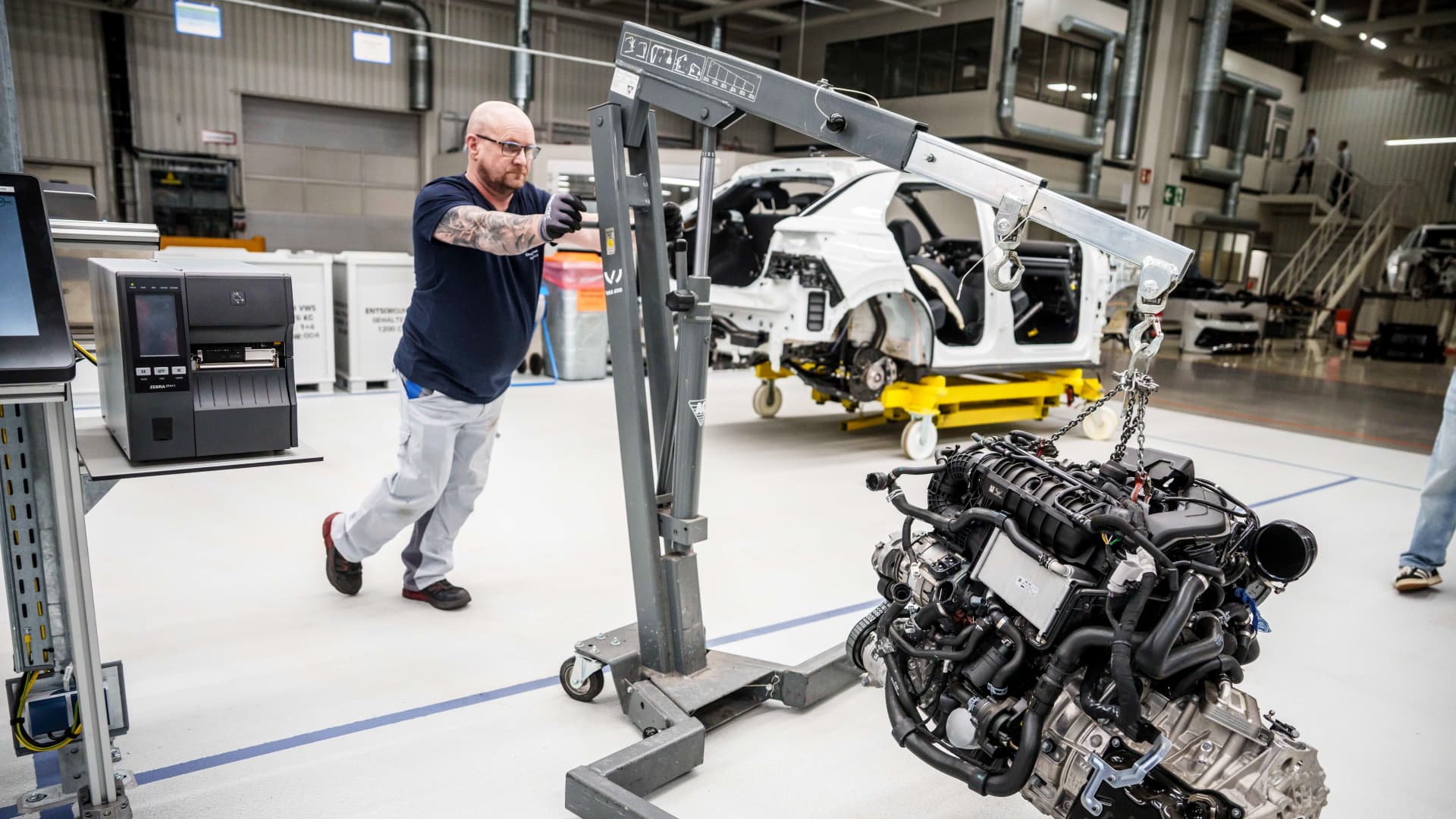
An employee moves an internal combustion engine (ICE) removed from a vehicle on a semi-industrial dismantling line of Volkswagen AG’s first circular economy hub at their plant in Zwickau, Germany, on Wednesday, Oct. 28, 2026.
Bloomberg | Bloomberg | Getty Images
Car parts maker Schaeffler said Tuesday it would cut 3,460 jobs and shutter five of its sites across Europe, as Germany’s once-dominant autos sector continues to struggle against economic headwinds, overseas competition and technological change.
Approximately 2,660 of the jobs and four of the five sites affected are in Germany, including Schaeffler’s plants in Dortmund and Morbach, which manufacture products for internal combustion engines. Operations will also be discontinued at its Berlin and Schwalbach sites, and toolmaking will cease at Höchstadt. Capacity will be adjusted in Haguenau and Toulouse, France, as well as Skalica and Kysuce in Slovakia.
Including earlier programs and 1,800 signed partial-retirement agreements, Schaeffler says about 18% of its German core workforce will be reduced by 2028. The company forecasts a roughly 300 million euros ($336 million) annual boost to earnings from 2030 as a result.
Schaeffler wants to eliminate overcapacity in production and make sweeping efficiencies as it grapples with weaker demand for combustion engine components and systems and a slower-than-expected ramp-up of EV adoption, an area in which it continues to lose money.
The group reported a 0.2% year-on-year fall in revenue to 5.8 billion euros in the third quarter, and a 7.2% fall in earnings before interest and taxes before special items to 245 million euros.
Its issues are being compounded by “above-average costs per employee in Germany” and “too many management levels,” it added.
European autos in ‘unprecedented transition’
Schaeffler’s challenges are far from isolated, with new car registrations in the European Union down from 15.3 million units in 2019 to 10.8 million units in 2025.
Germany’s Volkswagen is currently engaged in a massive strategic overhaul, set to result in around 100,000 job cuts and numerous plant closures as it tackles waning profitability and competition from Chinese car brands.
“The German industry finds itself in an unprecedented transition which can’t be stopped,” Rico Luman, senior sector economist for automotives and transport at ING, told CNBC by email.
The shift to EVs in Europe is accelerating, with battery electric vehicles accounting for 22.7% of new registrations in the European Union in the 12 months to September.
But Chinese brands are “gaining ground in this segment,” with parts suppliers facing particular difficulties, Luman said.
EVs are less complicated to build and have fewer components, leading to market contraction, while Europe is still unable to compete on cost for batteries, he said. New markets like robotics and defense products are “less mass markets and require less production workforce,” he added.
Luman also said the extent of Schaeffler’s reduction of its research and development workforce, which represents 30% of the fresh job cuts, with 50% in production and 20% in other roles, “surprises me a bit as there’s a lot of effort required to develop new products and markets.”
Schaeffler must play ‘defense and offense’
Schaeffler and other major players in Germany’s auto sector are confronting the industry’s challenges by trying to capture new opportunities in defense as Europe ramps up military spending.
CEO Klaus Rosenfeld told CNBC on Tuesday that Europe could restore its competitiveness in industrial production, but only if it plays “defense and offense at the same time.”
“We want to produce [in Germany], and we want to demonstrate that this is possible. But it’s only possible if we address the issues that we have, and that is a downturn in the automotive industry, overcapacity in our plants, it is too much research and development capacity that we have, too high personnel costs, and also a too complex organization,” Rosenfeld told CNBC’s “Squawk Box Europe.”
“We are basically rearranging here certain capacities to free up also capacity for the new things that are coming. They are not coming in the same synchronized manner as we would like to see it.”
“But it’s important that we not only adjust on the one hand, but that we look forward into the new opportunities like robotics, like defense, and others.”
Schaeffler set up a defense subsidiary at the end of 2025, and appointed a chief executive officer of “Defence & New Space” in June, as it looks to capitalize on higher European spending on the two sectors and tight regional production capacity.
The company also sees “ample opportunity to create efficiency” through robotics, automation and AI, Rosenfeld told CNBC.
