


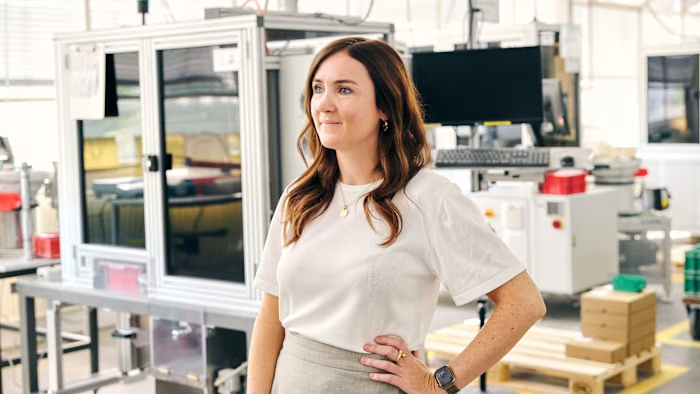
Sembach, a family-run ceramics company based in Bavaria, has been making parts for the auto industry since the 1970s, including sensors used in combustion engines.
But with an end to fossil fuel-powered cars coming into view and Europe’s car manufacturers under increasing pressure from Chinese electric-vehicle makers, Sembach is making a pivot from motors to medical tech.
“We’re currently witnessing a shift,” said Anna Sembach, the 35-year-old chief executive of the family business and its founder’s great-great-granddaughter. “You can really see that production volumes, especially in the European market, have dropped significantly.”
The company, based in Lauf an der Pegnitz near Nuremberg, manufactured on average about 600mn small parts a year for the auto industry until recently. Now the number is closer to 400mn.
With the company’s sales largely dependent on the struggling auto sector, Sembach made a dramatic change in 2023. The ceramics maker set itself a target of reducing the share of automotive revenues to 40 per cent from 80 per cent by 2033.
The stakes for Sembach are existential. “I don’t know if we’d still be around in 10 years’ time” without the new strategy, she said.
In Germany, the shift from the auto business into sectors with stronger growth prospects is gathering pace, with suppliers exploring areas such as medical technology, robotics and defence. With less work to do in auto factories, the carmakers are seeking to produce goods for other industries.
The pivot reflects pessimism about the prospects for the German auto industry, whose global success was synonymous with the country’s industrial prowess. The sector has shed tens of thousands of jobs since 2019 and is set to keep shrinking as Chinese rivals grow in strength.
The domestic automotive sector is set to shed another 125,000 jobs by 2035, according to the VDA, a German automotive industry lobby group, with the risk to suppliers particularly acute.
Three out of four German suppliers affected by the industry’s structural changes are already making the shift into other businesses, according to a survey by restructuring consultancy FTI-Andersch in November. The biggest interest is in the defence sector, where rising spending commitments by European governments have raised expectations of a boom.
The auto business “doesn’t offer significant growth anymore”, chief executive Klaus Rosenfeld of Schaeffler Group told the FT. Schaeffler, a stalwart of the German automotive industry, has restyled itself as a motion-technology company and is setting its sights on new industries such as space, robotics and defence.

Schaeffler is now adapting gears and sensors it made for the auto industry for use in humanoid robots. For the space industry, Schaeffler executives believe they can produce bearings, reaction wheels and power electronics.
The company estimates it can generate 10 per cent of its revenues from defence, robotics and space by 2035.
“This is not going to replace the auto business, but it’s going to give extra growth,” Rosenfeld said, adding that the shift “will give people some optimism that a company can reinvent [itself]”.
Bosch, the world’s largest auto supplier, is looking to diversify. The company has announced plans to cut 22,000 jobs worldwide as its traditional auto business struggles. But it recently said it was expanding into robotics, which executives said could eventually turn into a multibillion-euro business. The Stuttgart-based company reported €91bn in revenues last year.
Even Volkswagen, the world’s second-largest carmaker by volume, is looking to link up with defence companies to offload factories the carmaker no longer needs for auto production. VW has held talks with the maker of Israel’s Iron Dome about using its plant in Osnabrück.
Mercedes-Benz recently signed a memorandum of understanding with drone start-up Tytan to deliver vehicles for mobile air defence units, with chief executive Ola Källenius signalling openness to expanding the carmaker’s military business.
But even fast growth in the defence industry was not enough to make up for the rapid loss of automotive production, said Simon Schnurrer, an auto consultant at Oliver Wyman. Switching industries could offer a way to replace lost volumes for a select number of automotive companies “but it is not sufficient for a large part of the supplier population”, he said.
For Sembach, the experience of meeting the strict specifications of the auto industry made it well suited to making parts for pacemakers and endoscopy technology. But adapting to the medical industry’s smaller volumes meant production at the company’s factories in Bavaria needed to be adjusted. Fewer staff were needed on the production line.
The shift also offered an escape from the relentless price competition and tight margins of the auto industry. “In the automotive sector, every cent is a battleground, whereas that’s not really the case in the medical sector,” Sembach said.
The move away from Germany’s auto industry towards medical equipment had borne some fruit for the company, which recorded record revenues of €23mn last year, Sembach said.
While the market for its products in automotive had shrunk, the medical industry was a “rapidly growing market, simply because people are living longer”, she said. “That isn’t going away.”
