
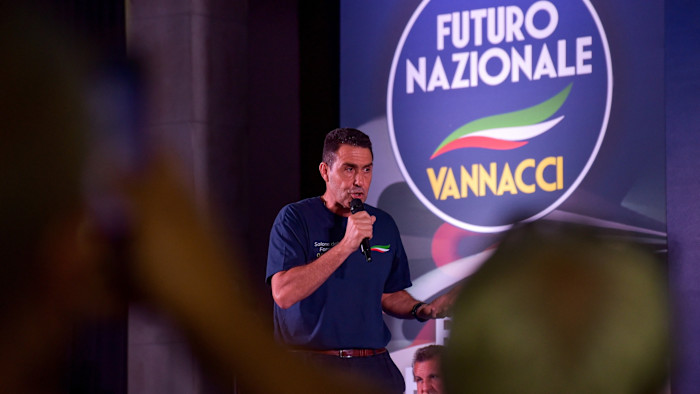
A former Italian paratrooper known for his xenophobic and pro-Russian views is creating fresh headaches for Prime Minister Giorgia Meloni, as his fledgling far-right party poaches coalition lawmakers and attracts her voters ahead of next year’s election.
General Roberto Vannacci, a former Italian military attaché in Moscow and controversial far-right ideologue, founded his Futuro Nazionale party in February after breaking from deputy prime minister Matteo Salvini’s far-right League.
Since then, Futuro Nazionale has gained traction. An opinion poll released on Monday put the party at 5.3 per cent of prospective voters, on par with the League — a trend described by some commentators as “a political earthquake”. Eight sitting MPs from Meloni’s coalition have also joined Vannacci’s fold.
Vannacci’s momentum poses a significant challenge to Meloni, whose own political roots lie in Italy’s postwar neo-fascist movement, and who spent years in opposition as an anti-EU firebrand, but has moderated her tone and broadened her appeal as prime minister. That has left some of her Brothers of Italy party base disgruntled.
“He is definitely becoming a problem for the rightwing coalition: he is stealing voters from the League and Brothers of Italy,” said Lorenzo Castellani, a political scientist at Rome’s Luiss University.
Vannacci’s growing support was “a red alert” for the prime minister, Castellani said. “The message in this case from the electorate is that ‘you, Meloni, changed and we don’t like this change’.”
At a rally launching Futuro Nazionale last weekend, Vannacci and his allies took direct aim at Meloni, accusing her coalition of betraying its ideals.
The event was tinged with fascist nostalgia, as speakers called the crowd “camerati” — the term dictator Benito Mussolini used to address his own supporters. The speakers evoked Mussolini’s old slogan “Dio, Patria e Famiglia” (God, Fatherland and Family) and paid homage to his surviving political allies, who founded Italy’s neo-fascist movement to further his ideals after the war.
Futuro Nazionale’s proposals include expelling foreign nationals to bring them to 4 per cent of Italy’s population, down from the current 12 per cent, a security crackdown to “restore order” in Italian cities, ending support for Ukraine, and resuming the purchase of Russian oil.
“With us, Italy will once again be the home of Italians,” declared Vannacci, who was hailed by one announcer as a new Julius Caesar, and greeted with chants of “generale, generale, generale” by his enthusiastic supporters. “We are the hope of Italy.”
Vannacci first stormed on to Italy’s political stage in 2023 with his best-selling book, The World Upside Down, which extolled the charms of Vladimir Putin’s Russia. In the book, he lambasted western liberalism, which he said had led to “normal people” being marginalised by vocal minorities such as feminists, who he deemed “modern witches,” and members of the LGBTQ community, who he called “abnormal”.
The army suspended Vannacci from service over the book, but Salvini fatefully invited the high-profile firebrand to lead his League party’s 2024 European parliamentary campaign.
In a TV interview last week, Vannacci, now an MEP in the same political group with Alternative for Germany, said Italy had experienced a “drift” during Meloni’s time in office. “Many of the things that were promised were not achieved,” he said. “The right has lost its way.”
His supporters agree. “Meloni was too soft — she didn’t stick to her plans,” far-right activist Luigi Cupaiolo, 54, said at the Futuro Nazionale assembly. “The general doesn’t intend to go to parliament to secure a seat, but rather to . . . implement the ideals of the right.”
Daniele Albertazzi, author of several books on Europe’s radical right, said that with his homophobic, misogynistic views and his calls for a return to “cultural homogeneity”, Vannacci was outflanking Meloni on the right. His rise was chipping away at her ability to maintain support both from centrist conservatives and “people who still look back at neo-fascist ideas with some nostalgia”, he said.
“Vannacci’s selling point is being the purifier,” Albertazzi said. “What he is telling the voters is that I am going to go back to a more pure version of what you were promised originally — which is not compromised by the needs of being in government or of making agreements with the EU.”
Regardless of whether Vannacci’s popularity will ultimately plateau, analysts say Meloni will face a strategic dilemma in the run-up to the next general election.

If she allows Futuro Nazionale to join her coalition, Meloni could alienate moderate voters and undermine her own successful repositioning as a more mainstream conservative. “It’s a very risky move,” Albertazzi said, adding that Vannacci could “destroy” Meloni’s hard-won reputation as “a reasonable” leader.
But if she excludes Vannacci, the governing coalition could struggle to find a parliamentary majority. “The 4 or 5 per cent of the voters that Vannacci could control are very very important to prevail in this race,” said Castellani.
In a testy exchange in parliament last week, she lashed out at a former Brothers of Italy MP, accusing him and other Vannacci-supporting lawmakers of “serving the left” by fracturing her coalition and opposing her government’s continuing support to Ukraine.
“Please don’t talk to me about the true right, because the true right never favours the left,” she snapped.
Futuro Nazionale’s rise is proving even more dangerous to the survival of Salvini’s League. It was the vice-premier who defied his party to promote Vannacci, and in some League strongholds banners have now appeared calling for Salvini to step down.
“He tried to exploit the fame of Vannacci, but it was obvious from the beginning that Vannacci would not be happy playing second-fiddle for very long,” said Albertazzi. Salvini “has ended up with a major crisis of his own doing”.
Additional reporting by Giuliana Ricozzi
