


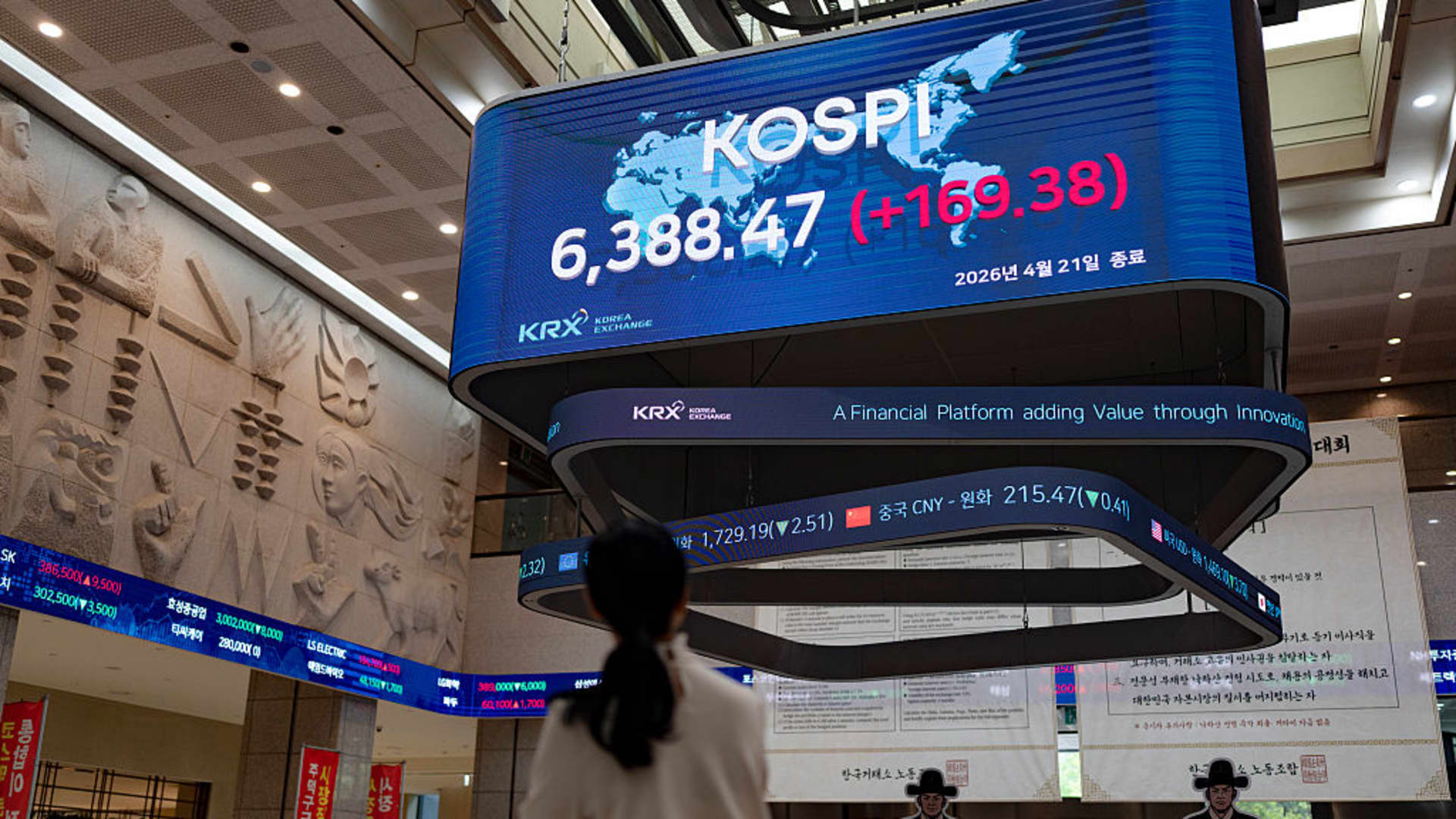
An employee smiles while looking at her mobile phone in front of a digital board showing the Korea Composite Stock Price Index (KOSPI) at the Korea Exchange (KRX) in Seoul, South Korea, on April 21, 2026.
Chris Jung | Nurphoto | Getty Images
North Asian markets are outperforming those in the south of the continent, thanks to tougher insulation from energy shocks, stronger fiscal ability and AI developments, according to a senior Goldman Sachs strategist.
North Asian markets have “greater buffer stocks” and can afford to pay a higher price for oil and gas, compared to South Asia, which has “much fewer buffers and doesn’t have the ability fiscally to offset the pass-through of higher energy prices to the economy,” said Tim Moe, Chief Asia Pacific regional equity strategist and co-head of macro research in Asia at Goldman Sachs Research.
Moe described some North Asian markets as seeing a “massive outperformance” compared to South Asia, according to a transcript of Goldman Sachs’ “Exchanges” podcast seen by CNBC.
Meanwhile, “[Markets in] Indonesia, South Asia — no tech and lots of energy vulnerability — is down 25%,” Moe said.
Investors are focusing on AI developments in the north of Asia, particularly in Taiwan, South Korea and Japan, where tech-oriented stocks make up around 80%, 60% and 30% of their indexes, respectively, Moe noted. The best-performing markets are South Korea and Taiwan, with South Korea up by more than 80% year-to-date, he added.
South Korea’s Kospi index.
But Moe cautioned that Korean semiconductor stocks such as Samsung Electronics and SK Hynix are trading at about five to six times this year’s earnings and about four times next year’s. “That implicitly says that the market really doesn’t believe that that profitability can last for very long,” he noted.
Moe was also optimistic about the Japanese market, citing the country’s measure of political stability following the election of Prime Minister Sanae Takaichi, “decent” earnings growth and AI robotics.
Chinese performance
In China, Moe sees A-shares — traded in yuan on the Chinese mainland and up 10% year-to-date — “meaningfully” outperforming H-shares, mainland stocks traded in Hong Kong. He said he sees a “very clear policy support” for the structural strategic development of China’s equity market.
“This really is a reflection that China’s come out of over three years of deflation measured by the PPI, the producer price index, and that’s gone positive for two consecutive months, the most recent reading being 2.8%, which is above consensus,” Moe added.
China’s H-shares are not doing as well due to weak earnings from heavyweight stocks. “H-shares are more dominated by the internet application area that [is on] the softer end of the spectrum of the AI trade,” Moe said. “And that is something which has been languishing partly because the attention’s been more on upstream hardware,” he added.
Asked for his takeaways on last week’s meeting between Chinese President Xi Jinping and U.S. President Donald Trump, Moe said “no harm was done.”
“Against a background of tension geopolitically, globally, and concern over U.S. and China friction, just having calm in the relationship I think was appreciated and desired by both sides,” he added.
Moe also warned of a “rude awakening” when the energy supply shock “really” hits.
“I think we could be set up for some kind of correction in the summer months. So, that is definitely something which we’re watching carefully,” Moe said.
