


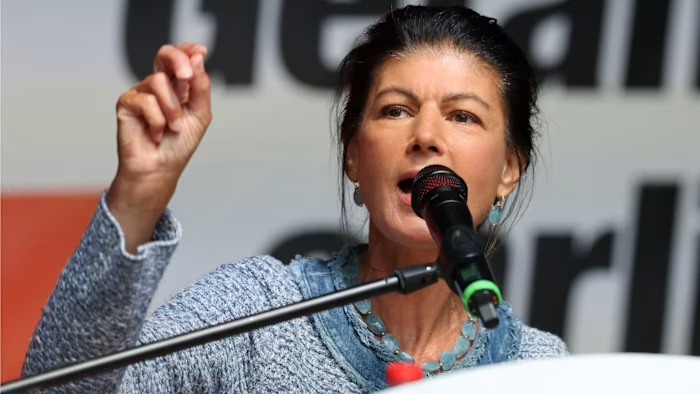
A hard-left, pro-Russian party set up just three years ago has emerged as the unlikely kingmaker that could usher in Germany’s first postwar far-right state premier.
The Bündnis Sahra Wagenknecht (BSW) bears the name of its steely founder whose dominance over the party and strict control of its members has led prominent critics to refer to the party as “Ich AG” — “Me Inc”.
BSW squeaked into Saxony-Anhalt’s state parliament in Sunday’s election with 5.3 per cent of the vote. It now holds unusual leverage as the only party willing to entertain working with the far-right Alternative for Germany (AfD) — potentially allowing the AfD’s lead candidate, Ulrich Siegmund, to form a government.
Like the AfD, the leftist party opposes the Brandmauer, the so-called firewall erected by other parties to keep the far right from power. But that barrier is under growing strain after the AfD surged to become the biggest political force in Saxony-Anhalt, winning a record 44 per cent of the vote.
In the days since the vote, Wagenknecht has railed against “firewall idiocy” after what she called a “crushing defeat of the established parties”. She said BSW would be willing to “build majorities in the Saxony-Anhalt parliament for sensible policies”.
With 39 seats, the AfD fell just short of the 42 needed for an absolute majority in the regional parliament. BSW has five.
That means the party could help former room-fragrance salesman Siegmund through the thorny process of becoming state premier. BSW has said it would be willing to abstain in the critical third round of voting, when a simple majority — more yes votes than no votes — would be enough to elect him. In that scenario, the AfD would need just one defection or abstention from the other parties in parliament, which together hold 39 seats. The ballot is secret.
If Siegmund cleared that hurdle, the two parties could continue to co-operate. Senior BSW figures say they do not want to form a coalition with the AfD, but they could lend their five votes to the far-right party on an ad hoc basis.
Siegmund, however, has shown little appetite for working with the often tumultuous BSW. Speaking shortly after Sunday night’s result, he described the party as “not part of the solution, but rather part of the problem”.
He pointed to the upheaval BSW has experienced in two neighbouring eastern German states. In Brandenburg, a coalition involving the party collapsed at the start of this year because of infighting. In Thuringia, a bitter, high-profile spat with Wagenknecht last week prompted 13 of its 15 elected officials to quit and found a new movement.
Wagenknecht, 57, quit the far-left Die Linke in 2023 to form her own party. She stepped down as BSW leader last year but remains its most dominant and best-known figure, recognisable by her trademark swept-back black bun and dangly earrings.
“She wants control over the party,” said Philipp Thomeczek, a political scientist at the University of Potsdam. “It’s a very tightly organised party, with less inner-party democracy compared to others.”
Despite being at opposite ends of the political spectrum, the AfD and the BSW overlap on some policies, most notably in their Russia-friendly stance and their fierce opposition to providing military support to Ukraine.
When a German satirical news site published a story saying that the parties would hold discussions about their potential co-operation in Moscow, Ukraine’s ambassador to Berlin wrote on X: “Took me a moment to realise that it’s satire. Or is it?”
The AfD and BSW differ on social and education policy. On migration, the leftwing party takes a less radical position than the far right.
Despite those differences, figures around Siegmund, both in the party leadership and locally, have pressed him to soften his opposition to working with BSW as they push for the AfD to take power for the first time.
One senior party official from Saxony-Anhalt said that he doubted that they could draw enough defectors from Chancellor Friedrich Merz’s Christian Democrats, leaving the BSW as the only realistic option.
AfD regional chair Oliver Kirchner met Claudia Wittig, one of BSW’s two lead candidates, at an event run by a far-right magazine in August and concluded that the two parties could work together, the person added.
Wittig, a former academic who wrote her PhD thesis on the moral education of western European nobility in the Middle Ages, told the FT that her party was “walking a thin line” as it tried to navigate the result. She said that they wanted to stop short of fully supporting a minority government but could co-operate with the AfD on a case-by-case basis.
She said there were stark policy differences, including on schooling.
Senior BSW officials have given mixed signals on the crucial question of whether the party would help Siegmund pass a budget. But Wittig said: “We would be willing to discuss what our most important projects would be and just see if we can get together and agree on something.”
The day after the result, as the reality that he could not govern alone sank in, Siegmund made clear that he would at least consider BSW as an option. He maintained that he wanted a “stable majority” in Saxony-Anhalt, but said “the hand is extended” to all groups and members of the regional parliament.
Fabio De Masi, BSW’s national co-leader, said there was little risk of internal disputes akin to those it had experienced with other regional branches. “I think we have a much better common understanding of topics,” he told the FT.
But Thomeczek, the political scientist, said any tie-up between the AfD and BSW would be fraught with peril, given how dependent Siegmund would be on the leftwing party. He said: “It would be on extremely thin ice.”
