


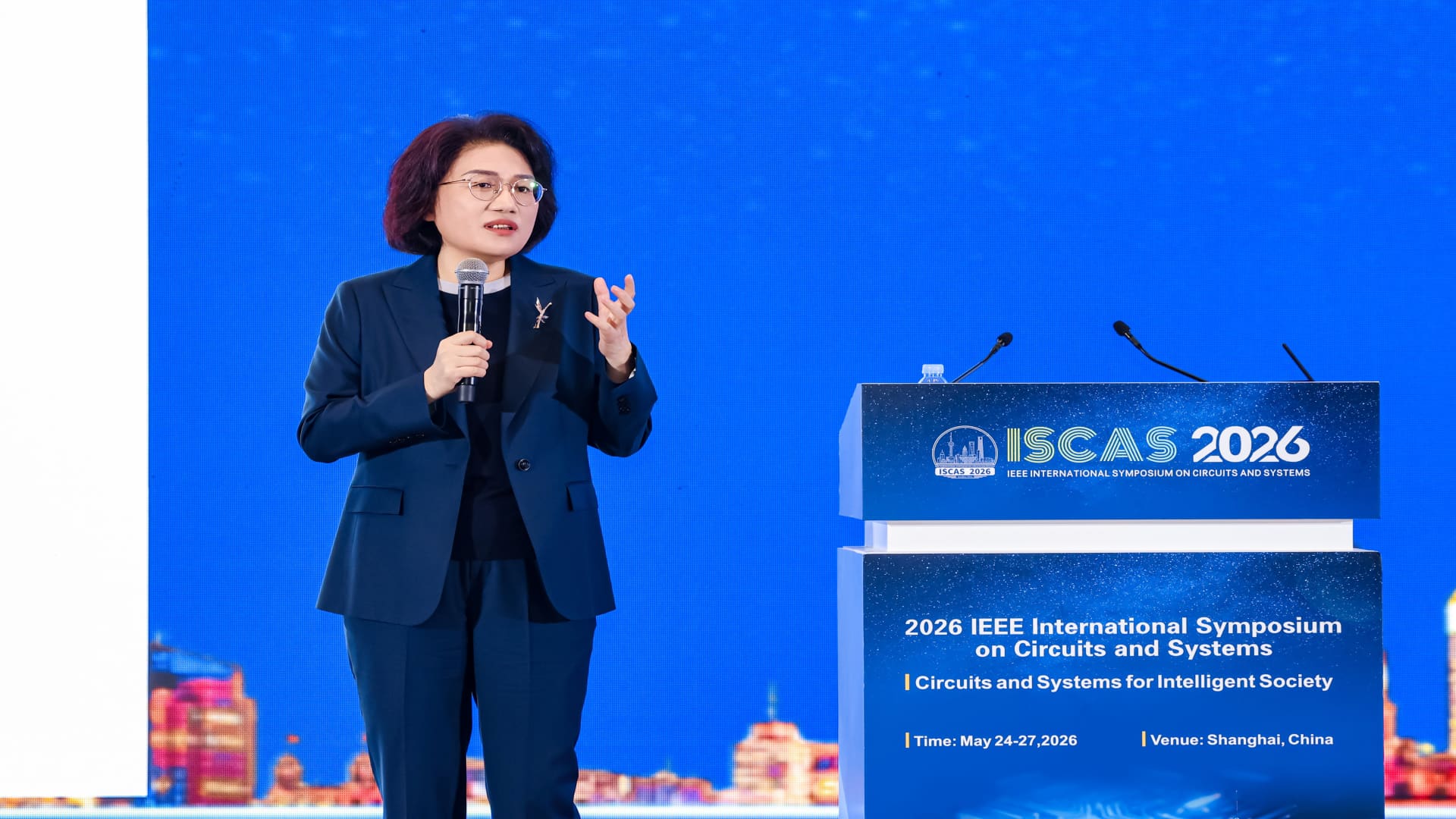
Tingbo He, president of Huawei semiconductor, presents at an industry conference in Shanghai on May 25, 2026.
Huawei
SHANGHAI — Chinese tech giant Huawei on Monday touted a new approach to developing advanced semiconductors despite U.S. sanctions, as Nvidia struggles to sell its high-end chips in China.
Huawei said it developed a new engineering approach called “LogicFolding” to manufacture its Kirin smartphone chips this fall.
That breakthrough comes as Nvidia faces U.S. export restrictions in China and Apple contends with renewed competition from Huawei in the world’s second-largest consumer economy.
Huawei’s Mate 60 smartphone, launched in 2023, included 5G connectivity powered by an advanced chip that helped the company regain market share from Apple.
While U.S. restrictions have kept Nvidia from selling its most advanced chips to China in recent years, Beijing has pushed to support homegrown technology instead. Last week, Nvidia CEO Jensen Huang told CNBC the U.S. chipmaker had “conceded” the Chinese market to Huawei.
“For Nvidia, this means the window to sell advanced chips such as the H200 into China is narrowing,” said George Chen, partner and co-chair of digital practice at The Asia Group.
“This trajectory will likely heighten concerns in Washington, where Huawei remains emblematic of U.S. export restrictions,” he said.
Huawei said that by 2031, its new chip technology could deliver capabilities equivalent to 1.4-nanometer process technology — while global chip leader TSMC has begun volume production of 2-nanometer chips.
Nanometer processes refer to chip manufacturing technology, with smaller nodes typically enabling faster and more efficient semiconductors.
Paul Triolo, head of technology, Asia and Americas, at DGA Group, was skeptical of Huawei’s 1.4-nanometer claim.
“A stacked/folded design can produce effective density gains, but it does not mean Huawei has solved the full process, yield, power, thermal, and device-performance problems associated with true 1.4 nm-class manufacturing,” he said.
Blocked from assessing advanced extreme ultraviolet, or EUV, lithography machines from Dutch chip equipment maker ASML, Huawei has been forced to pursue alternatives to chip development as it seeks to remain competitive in AI, said Neil Shah, vice president of research at Counterpoint Research.
“However, this parallel semiconductor path is still unproven at scale. This approach can introduce tough thermal constraints and packaging complexities that can hit the manufacturing yields,” Shah said.
Huawei’s efforts to deploy the technology in its flagship Mate 90 smartphone series this fall would mark an engineering feat, but scaling it to AI datacenters would serve as the “ultimate litmus test for China’s creative workaround to Western sanctions,” he added.
Academic ambitions
Huawei is also seeking greater academic recognition for its semiconductor research. On Monday, the company described its findings as the “Law of Tau,” or “τ scaling,” and claimed it addresses challenges faced by the semiconductor industry.
Huawei said it has designed and mass-produced 381 chips based on the “τ Scaling Law” over the last six years.
Semiconductor development has, for decades, relied on “Moore’s Law,” an observation that the number of transistors would double roughly every two years — delivering more computing power while lowering costs. However, even Nvidia’s Huang has said Moore’s Law is no longer applicable to future chip development.
“Huawei is turning an engineering strategy into a quasi-‘law,'” Triolo said.
The new principle “is more a systems-level optimization doctrine: shorten wires, stack logic, improve memory semantics, and co-design chips, packages, software, and clusters,” he said.
Still, challenges remain around heat management and manufacturing at scale, Triolo said.
Huawei’s new chip architecture expands the layout from one layer to two, significantly increasing power efficiency, according to Tingbo He, president of Huawei’s semiconductor business.
This structure allows transistors to interact with each other at more points, He, who is also a director of the company’s scientist committee, said at the Institute of Electrical and Electronics Engineers’ International Symposium on Circuits and Systems.
However, she acknowledged that challenges remain, as Huawei is only just beginning a decade-long development path for the new technology.

