
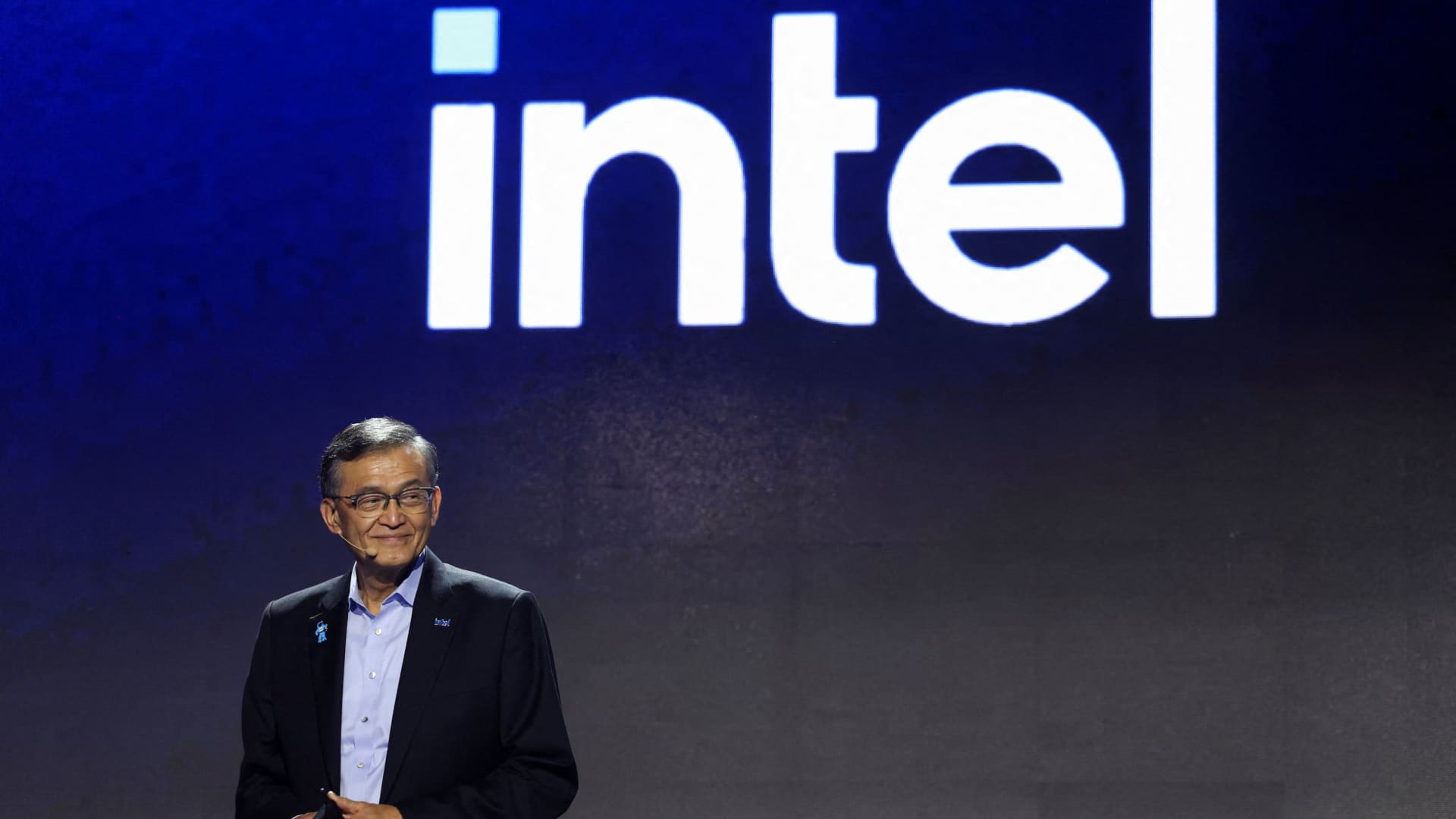
Intel CEO Lip-Bu Tan attends the annual Computex trade show in Taipei, Taiwan, June 2, 2026.
Tsai Hsin-han | Reuters
Intel has begun production of its most-advanced chip node, bringing the company one step closer to a possible deal to make some chips for Apple devices.
Intel announced it’s making the new chip node, 18A-P, at the VLSI Symposium in Honolulu, Hawaii, on Tuesday.
“This is a journey, and while we have more work ahead, we appreciate the opportunity to share the progress we are making,” Intel foundry head Naga Chandrasekaran said in a statement. Chandrasekaran called the development a “signal to Intel Foundry customers and partners that we are fully committed to leading edge process innovation over the long term.”
First announced last year, 18A-P is now in what’s known as “risk production,” an early production stage with data indicating it will meet customer requirements upon final qualification. After years of missteps and low yields, Intel touted 18A as key to a turnaround that would finally convert the company into a competitive chip manufacturer for non-Intel products.
Intel brought 18A to PC chips in January, but the company has yet to secure a major outside customer. Analysts say 18A-P may be a more likely proving point.
Intel said 18A-P can deliver 9% higher performance or use 18% less power than 18A, which the company has been making at volume at its chip plant in Arizona since December. The chip is at least 20% more heat resistant and is fully compatible with existing 18A buildouts, the company said.
“Yield rate is the number one criteria here,” said chip analyst Neil Shah of Counterpoint Research. “If they can commit to more than 90% yield rate in the first month, I think they can attract a few more customers.”
Wall Street has been anticipating a massive rebound in the business, sending Intel shares up over 200% this year after the stock soared 84% in 2025. A major catalyst for the move came in August, when the U.S. government took a 10% stake in the company, followed by Nvidia’s $5 billion investment in September.
Intel CEO Lip-Bu Tan told CNBC in May that he expects commitments from multiple foundry customers in the second half of 2026.
Shares popped nearly 14% that month on reports that Intel reached a preliminary deal to make chips for Apple. Chip analyst Ben Bajarin told CNBC that Apple is likely to wait to make chips on 18A-P.
One big roadblock, Shah said, is that Intel primarily manufactures chips on the traditional x86 instruction sets, while custom chips from Apple, Google, Amazon and others are made on rival Arm architecture.
“Building Arm chips is something that they have not done,” Shah said. Taiwan Semiconductor Manufacturing, the market leader, “has mastered that,” he said.
TSMC is expanding its own $165 billion chipmaking campus just 50 miles North of Intel’s Arizona plant.
Intel may be more likely to first secure a major customer for its leading advanced packaging technology, a lesser-known step of the chipmaking process that involves individual chip dies being connected to larger systems with increasingly complex methods. Intel’s EMIB packaging — embedded multi-die interconnect bridge — rivals TSMC’s leading CoWoS packaging technology.
“There is a lot of packaging bottlenecks at TSMC,” Shah said. “That is a big opportunity right now, very low hanging opportunity for Intel.”
WATCH: Can Intels’ Arizona chip fab bring it back from the brink?
