


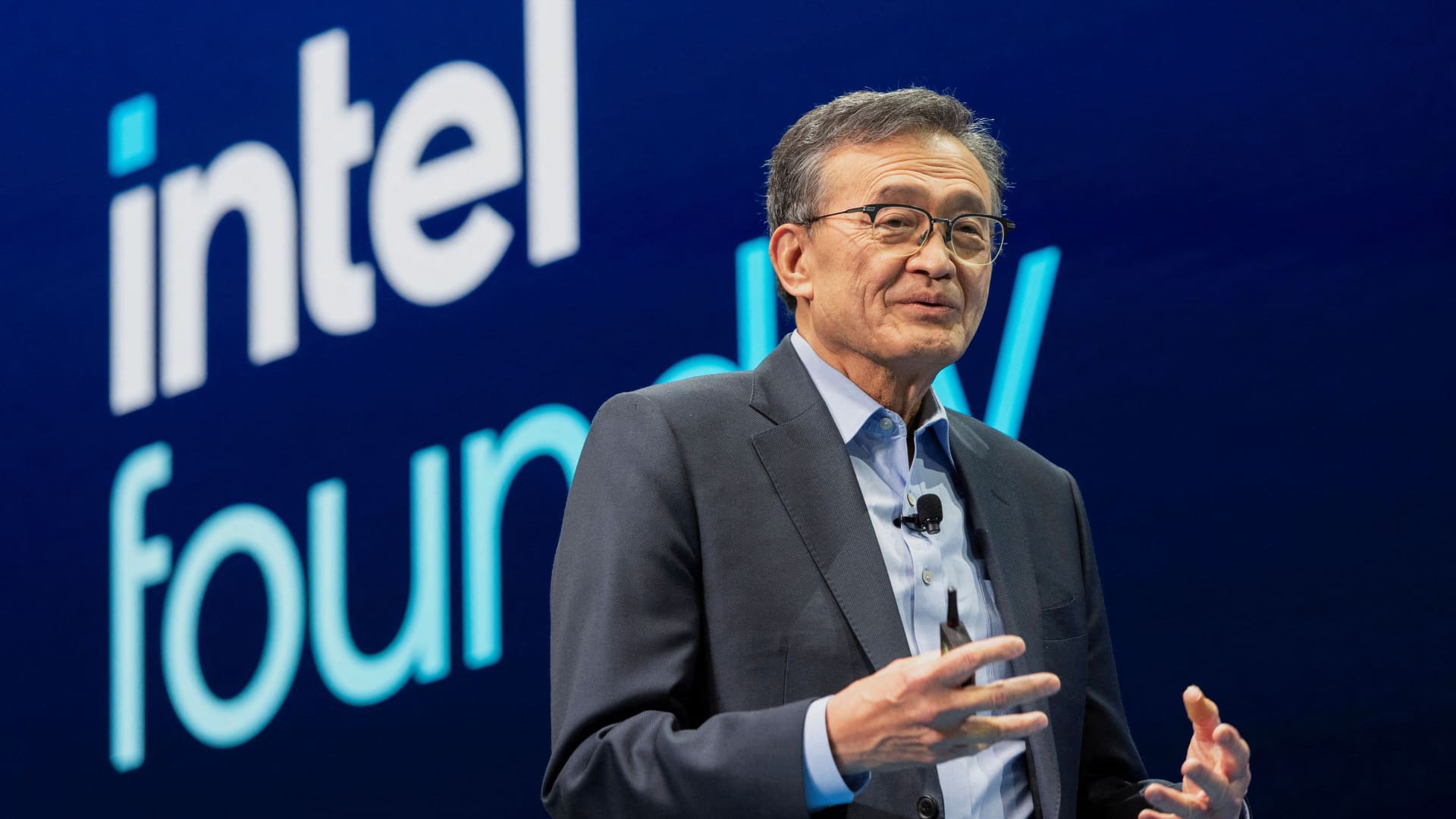
Intel CEO Lip-Bu Tan said Monday that the company’s external manufacturing business is gaining traction, emerging as a key piece of the chipmaker’s turnaround.
“Foundry is very important,” Tan told Jim Cramer on CNBC’s “Mad Money.” “It’s one of the key national treasures.”
Intel’s manufacturing business, known as foundry, is of the most expensive and crucial parts of the company’s revitalization strategy. It is designed to manufacture semiconductors for outside customers while helping rebuild advanced chip production capacity in the U.S. after years of overseas dominance. Historically, Intel’s factories only produced its own chips used in personal computers and data center servers. Tan’s predecessor, Pat Gelsinger, championed the pricey external foundry strategy.
Shares of Intel have surged more than 300% since Tan was appointed CEO in March 2025, as investors bet the longtime semiconductor executive would stabilize the struggling chipmaker after years of setbacks. One of the big questions was whether Tan would be able to make good on Intel’s foundry ambitions by getting its manufacturing capabilities competitive with the likes of Taiwan Semiconductor Manufacturing Co..
Tan said the company is beginning to make tangible progress on that goal.
In particular, Tan pointed to improvements in Intel’s advanced 18A manufacturing process, which has been closely watched by investors as a key test of the turnaround. He said when he took over, the 18A process was “not good.”
“Now I’m seeing it,” said Tan, who led chip design software maker Cadence Design Systems from 2009 to 2021 and had a two-year stint on Intel’s board that ended in 2024.
Manufacturing yield, the percentage of usable chips produced from each wafer, is a critical metric for profitability and customer confidence in the foundry business. Tan said Intel’s progress has exceeded expectations.
“The best practice is to see 7% or 8% yield improvement per month, and now I’m seeing it,” he said.
The improvements are beginning to draw customer interest, according to Tan. As Intel’s manufacturing performance has progressed, he said more prospective customers have approached the company about using its foundry business.
On May 8, the Wall Street Journal reported that Intel and Apple had reached a preliminary deal to have Intel produce some of Apple’s chips, which are currently produced by TSMC. When Cramer asked Tan about those reports, the CEO declined to discuss customers by name.
However, Tan said Intel expects commitments from multiple foundry customers in the second half of the year. “Multiple customers, they are working with us,” he said. “We are looking forward to serve them.”
The comments align with what Intel executives previously told investors. On the company’s April earnings call, CFO David Zinsner said Intel expected signals from external foundry customers to become “more concrete” in the second half of the year and into early 2027.
Beyond Intel’s turnaround, Tan framed the foundry business as strategically important for the U.S. semiconductor supply chain. Intel has built a new plant in Arizona, where it uses the 18A process, while a separate project in Ohio has faced major delays and isn’t set to start production until at least 2030.
“90 plus percent of the most advanced processor is manufacturing outside the country,” he said. “So, I think it’s important to bring some of them back.”
Looking further ahead, Tan said Intel’s next-generation 14A process could eventually compete with TSMC, widely considered the leading third-party chipmaker.
“It will be the same time as TSMC,” he said. “That is a major, major breakthrough.”
