


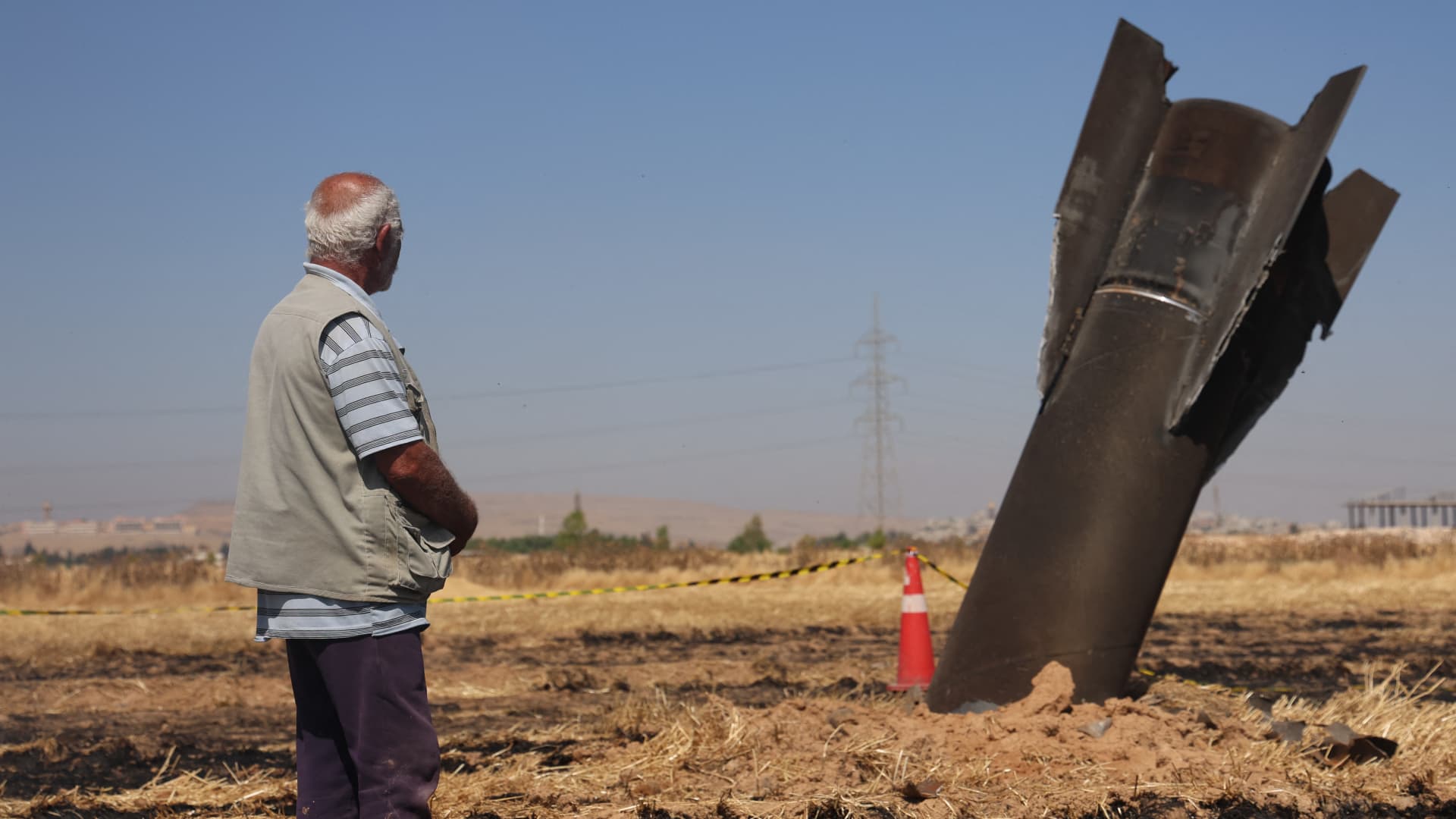
A Syrian farmer looks at an Iranian missile that fell into an agricultural land in the area of Najha, in the countryside of the Syrian capital after being intercepted by Israeli air defense systems on June 8, 2026.
Bakr Alkasem | Afp | Getty Images
It’s been 10 days since U.S. President Donald Trump declared the ceasefire with Iran “over,” with both sides launching military strikes and renewing geopolitical uncertainty.
U.S. Central Command has pounded Iran with 10 straight nights of strikes, saying that the attacks are to “degrade Iranian capabilities used to attack commercial shipping in the Strait of Hormuz.”
Here are some things to note:
Plunge in Strait of Hormuz traffic
Shipping through the critical waterway has fallen since the resumption of hostilities, with ships transiting the strait with their transponders turned off, according to Lloyd’s team of analysts.
Over the weekend, just 30 ships transited the strait, according to trade intelligence firm Kpler. More than 100 ships transited Hormuz daily before the U.S. and Israel attacked Iran on Feb. 28.
However, the Trump administration has said the Strait remains open and millions of barrels of oil are being shipped out daily under U.S. military protection.
Oil prices surge
The renewed hostilities have sent oil prices surging, with international benchmark Brent breaking above the $90 mark on July 20 for the first time in over a month, with U.S. crude futures also reaching their highest point in a month on the same day.
The Strait of Hormuz is a critical energy chokepoint, with around 20.3 million barrels of petroleum and crude oil passing through the Strait of Hormuz daily, according to the U.S. Energy Information Administration.
This accounts for roughly 25% of the world’s seaborne oil trade. Nearly 90% of these oil flows are exported to Asian markets, with China and India being the primary destinations.
Amrita Sen, founder and director of market intelligence at Energy Aspects told CNBC’s “Access Middle East” Monday that with inventory buffers heavily depleted, continued disruption into August could force Gulf production lower and send crude prices back into triple digits.
Iran’s ability to retaliate
For its part, Iran still has the power to cause damage to U.S., its allies, and assets in the region.
Its strikes on commercial shipping have caused concern, with a vessel operated by Greek shipping firm Dynacom reportedly the latest victim. Israeli media said the ship caught fire after it was struck by an unknown projectile in the Strait of Hormuz.
Despite the U.S. strikes, Tehran is also still able to launch missiles and drones, with its attacks on countries hosting American bases have killed an additional three U.S. servicemen recently.
U.S president Donald Trump has vowed that Tehran “will pay” for the deaths “many times over,” adding that the strait was open to all except Iran.
‘No good options’ for an off-ramp
On Monday, Axios, citing sources familiar with the matter, reported that regional mediators like Qatar and Pakistan presented the U.S. and Iran with a proposal for a 10-day ceasefire, although Washington is also gearing up for the possibility of the talks to fail.
Axios also reported that Israel is preparing for a possible expansion of the war into a full-scale, coordinated campaign within days.
Last week, Clemens Chay, senior fellow for geopolitics at the Observer Research Foundation described the situation to CNBC as a contained but widening escalatory cycle.
In his view, Washington had “no good options.” The U.S. has to either endure an Iranian war of attrition, escalate despite regional opposition, or offer concessions.
He said Iran retained Hormuz leverage “like a switch that it can flip on and off,” and warned that simultaneous disruption of Hormuz and the Bab el-Mandeb Strait would be catastrophic for the global economy.
Relief valve under threat
On Monday night, Houthi militants declared a maritime embargo against Saudi Arabia effective immediately, threatening to exacerbate the oil supply disruption triggered by Iran’s attacks on tankers in the Strait of Hormuz.
The Houthis have repeatedly threatened to close the Bab el-Mandeb Strait during the U.S.-Iran war. The strait is a choke point for commercial ship traffic, as well as oil exports from Saudi Arabia.
Since the closure of the Strait of Hormuz, Saudi Arabia has diverted million of barrels of oil per day through a pipeline to an export terminal on the Red Sea. Those exports have acted as a crucial relief valve for global oil markets during the conflict.
A closure of Bab el-Mandeb would block in those barrels, exacerbating the disruption triggered by Iran’s attacks on tankers in Hormuz.
— CNBC’s Spencer Kimball contributed to this report.
