
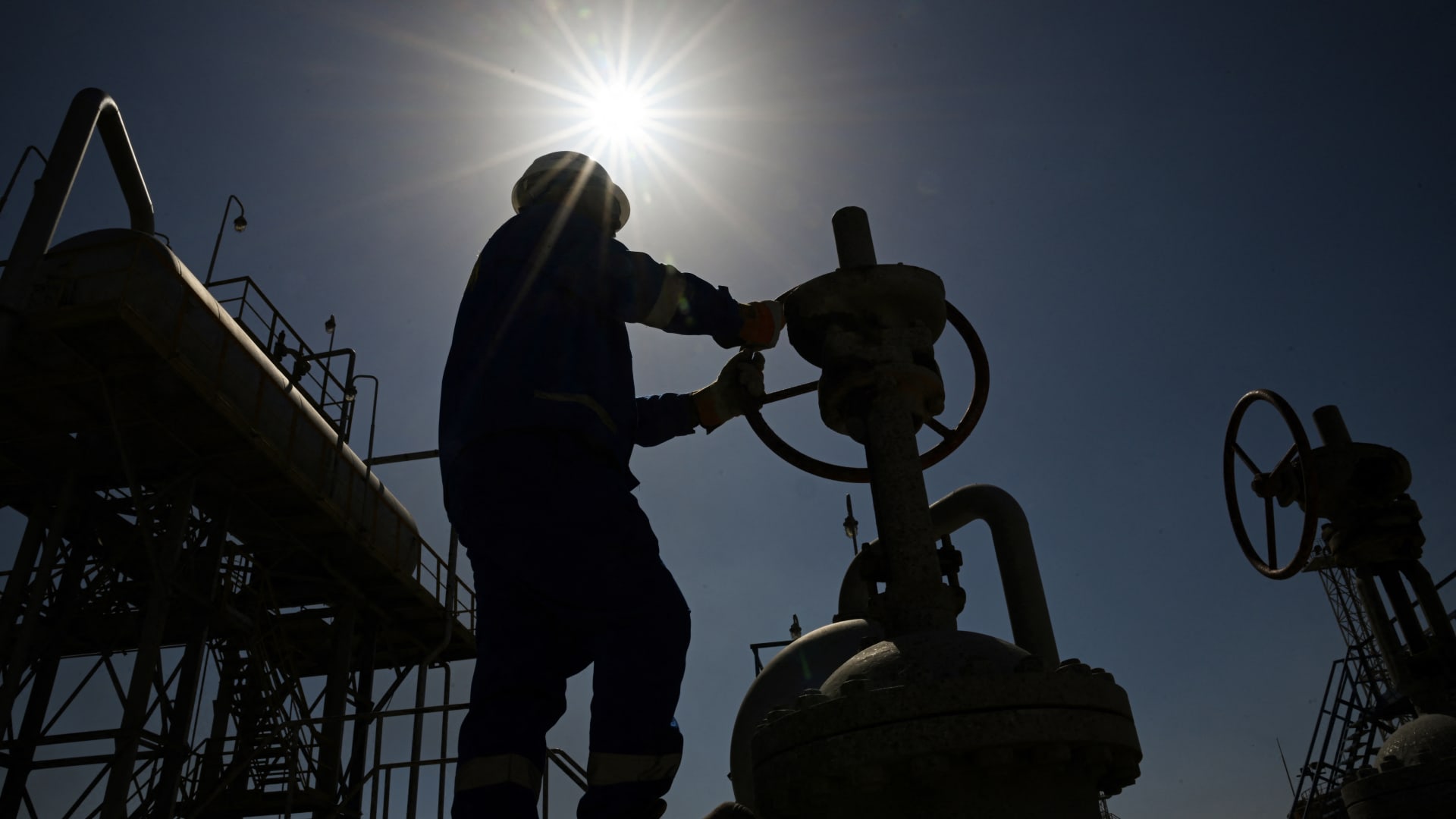
An employee of Basra Oil Company, works at the Nahr Bin Umar Oil and Gas Field on the outskirts of the southern Iraqi city of Basra on April 29, 2026.
Hussein Faleh | Afp | Getty Images
Iraq and the United Arab Emirates are fast-tracking plans to expand oil pipelines to replace the capacity lost by the closure of the Strait of Hormuz, as new data reveals their stark dependency on the Persian Gulf.
Last week, the Iraqi cabinet approved plans to accelerate crude exports through the Kurdistan-Turkey pipeline network, which would more than triple its existing shipments from 220,000 barrels per day to 770,000.
The route offers an alternative passage through Kurdistan to Turkey’s Mediterranean port of Ceyhan. When operating at full capacity, it should provide relief to the oil-dependent Iraqi economy, which contributed 53% to its real GDP in 2025, according to the World Bank.
Exclusive data shown to CNBC by economic intelligence provider QuantCube Technology reveals that Iraq’s overall exports have virtually dried up since the war began, as a result of its geographical dependence on Hormuz.
QuantCube’s indicator measures the volume of deadweight tonnage leaving Iraqi and UAE ports, which provides an estimate of the cargo weight the ships are carrying.
“Iraq is in a much more complicated situation because we know that most, if not all of its oil, transits through Hormuz,” Alan Lemangnen, senior economist at QuantCube, told CNBC in an interview.
Iraq announced in a press conference on May 16 that it had exported 10 million barrels of oil through the Strait of Hormuz in April, down from 93 million barrels before the war.
Meanwhile, Abu Dhabi is fast-tracking construction of the new West-East pipeline to Fujairah as it also looks to expand its oil export capacity and bypass the Strait of Hormuz chokepoint.
The project, expected to come online in 2027, will double the Abu Dhabi National Oil Company’s (ADNOC) export capacity.
Abu Dhabi Crown Prince Sheikh Khaled bin Mohamed bin Zayed Al Nahyan on May 15 called for faster delivery of the pipeline to meet rising global energy demand.
The UAE can still export oil through other terminals, easing the impact of the Hormuz closure.
“It’s clear that Iraq, because of its location and its inability to reroute, is in a much more complicated situation than the UAE or KSA,” Lemangnen added.
“The UAE still has the Fujairah terminal. Even if it has been damaged during the war, it still, in theory, has the infrastructure and vessels to export a large amount of oil.”
But even existing alternatives are at risk. Saudi’s East-West pipeline was attacked by Iran in April, while Fujairah has also come under attack from Iranian drones, disrupting oil loading operations at its crude export terminal.
The East-West pipeline, linking processing facilities near the Persian Gulf to an export hub on the Red Sea, and the UAE pipeline to the port of Fujairah, have a combined estimated 3.5 to 5.5 million barrels per day (mb/d) of available capacity, the IEA notes, although Saudi Arabia said in March its pipeline is pumping 7 mb/d.
But flows remain well short of the roughly 20 million barrels of oil and petroleum products that transited through the Strait of Hormuz every day before the war.
Developing alternative export routes involves not only massive investment in infrastructure, but also time. Often transnational agreements are necessary if pipelines pass through several territories.
Ship transits through Hormuz remain significantly below prewar levels. Traffic through the sea lane fell to the lowest point of the Iran war in May, according to Lloyd’s List.
Vessels stuck in the Gulf risk attack by Iranian forces unless they receive Tehran’s approval to transit a designated route through Hormuz. They also risk U.S. sanctions if they cooperate with Iran.
— CNBC’s Emma Graham, Holly Ellyatt and Spencer Kimball also contributed to this report.
