


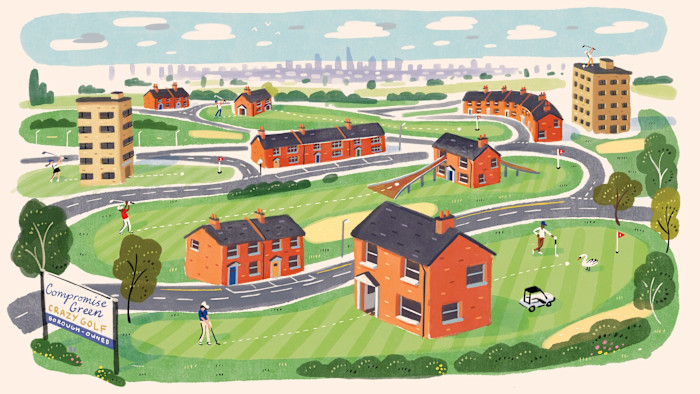
Crowlands Heath Golf Club features nine holes, two swans and, at £950, one of the cheaper annual membership fees in London. In the coming years, it might instead have close to 1,300 homes, if a recent proposal to redevelop the course moves forward.
The golf course and its 78 members have landed in the unlikely foreground of a citywide debate over housing and its chronic undersupply. As the UK’s Labour government struggles to meet its election promises to deliver homes, some are pointing to underused golf courses as a means of helping achieve that goal.
Housebuilding is proceeding at sclerotic rates throughout England. But London has proved particularly challenging. The aim here is to build 88,000 new homes a year, part of Labour’s pledge to deliver 1.5mn new homes over the course of this parliament. Yet construction starts in London have fallen more than 80 per cent over the past decade, according to housing research company Molior, with work beginning on just 5,589 homes last year. There were 2,103 starts in the first quarter of this year, a fraction of the 22,000 needed to meet the yearly goal.
Rising construction and financing costs, coupled with more stringent building safety regulations introduced after the 2017 Grenfell disaster, have forced some developers to stay on the sidelines. At the start of 2027, 15,000-20,000 new homes will be under construction in the capital, down from 60,000-65,000 at any given time between 2015 and 2020.
The morass is prompting local authorities and cities to hunt for creative ways to meet their targets, including by lowering affordable housing quotas, loosening planning rules and potentially weakening restrictions on tracts of land that have so far been protected from development.
Last month, Mete Coban, deputy mayor of London for environment and energy, said that golf courses are a target in some of these efforts, which will also scrutinise old industrial sites and others. London’s 93 or so golf courses equate to the size of the borough of Brent, or some 4,325 hectares. “We know so many young Londoners are struggling to grow up in the place that they call home,” he said.
It will ultimately be up to the boroughs to decide how to apportion greenbelt land for redevelopment.
The idea to convert golf courses into housing developments unspooled from a proposal put forth five years ago by Russell Curtis, an architect surprised by the number of golf courses he encountered on his daily walks in the capital during lockdown. Routes that were cut off by the sites spurred him to create a map of golf courses across the city. He then suggested converting a site in Enfield from 18 holes to nine and building 650 homes upon it.
The plans were half serious, more of a “provocation”, he says. But while nothing happened at Enfield, his maverick ideas surfaced last year in the mayor’s consultation on the next London growth plan.

“Given the challenging housing target, there may be some very specific circumstances where certain [Metropolitan Open Land], such as golf courses, could be considered for release for housing,” the paper said. “These are often not publicly accessible and offer limited biodiversity value.”
Metropolitan Open Land is a designation given to green spaces in a built-up area in London that protects them from development; it’s different from the greenbelt that encircles the capital, which is designed to thwart suburban sprawl. The city is also looking at locations where greenbelt land might be released as part of a strategy to support housing growth.
Forty-one of London’s courses are publicly owned. “In a city that is suffering from such profound housing inequality and an inability to build homes for people who need them, it’s a lot of space to be taken up for a leisure activity enjoyed by a relatively small few,” argues Curtis, director of architecture firm RCKa.
Building homes on only the MOL golf courses (about 40 in total) would yield around 50,000 homes, he estimates. Building on both MOL and greenbelt within 800 metres of a station would result in 85,000 homes. (Land that falls outside the 800-metre radius on courses could be left for golfing, he adds.)
The next version of the mayor’s plan is expected to be unveiled this summer and put in place by next year. A spokesperson for the mayoral office declined to comment.

Sam Dumitriu, head of policy at pro-building campaign Britain Remade, sees golf courses as an opportunity “to try and close some of the housing gap . . . We really need to come up with ways of bringing housing costs down, and the way to do that is by building more homes, fundamentally.”
A 2024 paper he co-wrote with Ben Hopkinson, head of housing and infrastructure at the right-leaning Centre for Policy Studies, called for redevelopment on golf courses located near public transit in London — and that they be used not just for housing, but also public green spaces.
Though not complication-free, golf courses can be easier to convert than other sites, says Nicole Guler, director and chartered town planner at London-based Urbanist Architecture. “In many cases they already have access roads, drainage and some utility infrastructure in place, so you are not always starting from zero. The land is also often less problematic than old industrial sites, because it is usually stable and less likely to have serious contamination.”
Not everyone is on board with the plan. Not least, those disagreeing about the environmental impacts both from golf courses themselves and any development attached to them.

“It’s completely false” to say that golf courses have little biodiversity, says Alice Roberts, campaigns director at CPRE London, a charity that works to protect green spaces. She cites Purley Downs in Croydon and Langley Park in Bromley as just two of at least two dozen habitat-rich sites in London, and also points to those designated as Sites of Importance for Nature Conservation for their wildlife (about a third of courses had this designation as of 2017, according to Greenspace Information for Greater London CIC). Courses in London are home to ring-necked parakeets, pheasants, stag beetles, deer, bats, heron and butterflies, among other species.

“Unless someone can show me that building these houses will tackle affordability in London . . . then no, we can’t support building on green space,” Roberts says. She wants the government to focus building on areas that already have planning permission, but on which no homes have been built yet, as well as on so-called brownfield, or previously developed, sites.
“Golf courses are often assumed to be environmentally damaging or to offer limited biodiversity value”, but they “can deliver a range of environmental benefits”, adds a spokesperson from England Golf, the national governing body. Not only does the preservation of large green spaces maintain habitats like grassland and woodland that can support biodiversity and carbon sequestration, it also helps with natural drainage, flood mitigation and urban cooling, they say.
Proponents of golf and access to green space chafe at the depiction of the sport as an elitist enterprise. They praise the physical, mental and social health benefits and, in the case of Crowlands, affordable membership fees, which have widened access to the game. CPRE contends that golf functions like any other recreational sport that operates on a paid-for basis.

“Why destroy something that gives back to the community?” asks Kevin Bowtell, who has played at Crowlands for 20 years. He has started a Facebook group to save the club that counts nearly 200 members. “Why don’t you build on something nobody uses? It’s more than just golf, it’s a community.”
On a recent Monday morning, Bowtell pointed to outdoor picnic tables, which he says attract 30 to 40 people on a weekend evening. On the last Guy Fawkes Night, at least 800 people turned out.
Ian Hoskins, who has epilepsy, plays at Crowlands five days a week; he says other clubs are too expensive and he appreciates how it caters for his disability. “It mucks up my life completely if this closes,” he says. He notes that adults and children with disabilities are welcomed, and that elderly patrons frequent the clubhouse to dine — and don’t always play.
CPRE’s Roberts also objects to building more housing to solve the crisis, which she contends is a result of high rents and a failure to tackle the lack of social housing.
In the case of Crowlands Heath Golf Club, which abuts the training facility for West Ham United FC, social housing is, in fact, built into the proposals. Developer Marc Pennick of Homes4Life put in an offer to acquire the club’s leasehold in 2024, subject to securing planning permission. His scheme of nearly 1,300 apartments and houses has around 60 per cent social housing — with the rest allocated to key workers, including those in healthcare. He is also planning on retaining outdoor public space.

The club and Barking and Dagenham Council have approved the sale. Pennick expects to submit the planning application in May and if it is successful, he hopes to be on site by November.
A separate proposal by the government for a “new town” in Chase Park and Crews Hill in Enfield includes affordable housing. It has proposed converting land including a golf course into a site that can accommodate 21,000 homes, with at least 40 per cent of them to be designated as affordable. A decision is expected later this year after a consultation and an environmental assessment.
Other cities are also considering golf courses for redevelopment. In Singapore, two courses have been earmarked for residential use when their leases expire in 2030.
Las Vegas-based StoneCreek Partners LLC, which advises on golf course construction, is tracking more than 130 redevelopment projects across the US, including repurposing for housing. “In the US, it’s been a big subject for some years now,” says Donald Bredberg, managing director. Last year New York City mayoral candidate Brad Lander suggested building neighbourhoods on four of the capital’s 12 municipal golf courses to alleviate housing pressure.
Such housing development proposals come at a perilous time for London’s golf clubs. Consultancy Custodian Golf estimates one in five clubs in Great Britain is at risk of closing owing to financial difficulties, and 37 in London.
Crowlands Heath has faced financial hurdles due to underuse, compared with the costs of running the club, says Iain Baillie, a minority shareholder. He says the site is surrounded by a number of other golf facilities in the immediate area and that memberships, which were never very high, have been trending downward. He declined to comment on specific figures, but said the club has lost a small amount of money on average for the past six years.
“We felt it was struggling financially and there was no reason to suppose it wouldn’t continue to struggle,” says Baillie. He declined to comment on the size of Pennick’s bid.
House & Home Unlocked

Don’t miss our weekly newsletter, an inspiring, informative edit of the news and trends in global property, interiors, architecture and gardens. Sign up here.
Pennick says that on average, 16 people play at the club each weekday, the number rising to 25 on weekends. Bowtell disputes those figures, saying the club doesn’t actually track the members who play, so he believes the figures provided only reflect those who have paid to play that day.
Pennick says he is funding the venture with money from a UK pension fund, which he declined to name. He is willing to accept a lower return on the investment because he sees less risk. By delivering affordable housing, he says he removes risks found in private development. “There is no exposure to housing market cycles, absorption rates or price volatility, and demand is deep… the homes are let quickly from long waiting lists, income is highly predictable and rents are set within a clear regulatory framework”.
Viddy Persaud, a councillor for Rush Green and Crowlands, an electoral ward in the borough of Havering, is readying to submit a petition against the development with “hundreds” of signatures once the planning submission goes in. “We’ve already got Romford, which is within walking distance — they’ve got thousands of flats or living spaces that are going through the planning process. If we start to build on green space, it will never end.”
Elsewhere in the UK, other developers are seeking a middle ground. Joel Cadbury, who co-founded the luxury Beaverbrook hotel in Surrey, has bought four “unloved” golf courses in the countryside with an eye towards a revamp.
“Golf needs to be younger, quicker, more relaxed, more inclusive and more female-friendly,” he says. He is shaving the number of holes from 18 or 27 to 12, and adding pickleball, padel tennis and eco-cabins. One of the sites is currently operating; another opens in June.
Trimming the courses will leave him with an extra 30 to 50 acres of land, on which he hopes to build housing in five to 10 years’ time, if the land is suitable. He is in early conversations with local authorities.
“Rather than having an ongoing clash between developers and local residents, you’ve got to find a more palatable solution for both,” he adds. “We want to do it in a thoughtful way such that we don’t need to cram as many houses on every square foot, and also approach it with a sustainable ethos.
“Maybe you don’t have to take something away, just to add housing.”
Julie Steinberg is the FT’s property correspondent
Find out about our latest stories first — follow @ft_houseandhome on Instagram
