


From her grandmother’s beautifully restored home in a medieval Italian village, Monica Tommasi, president of Friends of the Earth Italy, is battling wind turbines — literally.
German renewable energy group RWE has secured permission to erect seven 200-metre wind turbines in the countryside around Tommasi’s home not far from the picturesque Umbrian town of Orvieto. Along with other local property owners, Tommasi, a transportation engineer, is now fighting to stop a project she says will scar a precious landscape while delivering little reliable power.
Though she says she once believed in “the energy fairy tale” of renewables cutting dependence on imported fossil fuels, Tommasi is now convinced the answer to Italy’s energy woes lies in nuclear power, which the country once generated — until Rome shut down all its reactors decades ago amid a fierce public backlash.
“We realised achieving these renewable energy targets meant filling the country with wind turbines and solar panels, distorting the landscape and our identity,” said Tommasi. “If we need to decarbonise, we need to use the best technology, and one of the best technologies is nuclear. It’s no longer the world of the ‘70s and ‘80s — the world has changed. This technology — nuclear power — has changed.”
She is not alone in her belief. As Italian businesses and households face power bills around 30 per cent higher than the European average — due partly to the country’s heavy reliance on gas imports, Prime Minister Giorgia Meloni’s rightwing coalition government is betting big on a nuclear power revival to offer long-term relief.

Two energy crises in less than five years have forced a rethink in many European countries about how to reduce their exposure to imported fossil fuels, which in Italy still account for about half of total electricity generation, according to the Energy Institute.
Inspired by her erstwhile ideological ally US President Donald Trump, Meloni has called Italy’s potential resumption of nuclear power production — with as yet untested next-generation small modular reactors — “a great prospect, a great vision, a great dream” that could provide the country with low-carbon, affordable and domestically generated electricity.
Meloni’s government took a big step towards that goal in June, when Parliament’s lower house approved a new framework law empowering Rome to draft new rules for domestic nuclear power production through small modular reactors.
Once the senate gives its assent to the law, expected next week, Rome will have 12 months to draft the rules and procedures to establish a nuclear energy regulator and rules on nuclear waste disposal. After that, the review of specific proposed projects and the issue of licences could commence.

Italian physicist Stefano Buono, chief executive of Newcleo, a Franco-Italian nuclear start-up, says he has already received enquiries from Italian industrialists eager for nuclear reactors to power their own energy-intensive businesses such as steelmaking and cement.
Some Italian businesses have invested in Newcleo, contributing to the $780mn it has raised so far to develop and commercialise its lead-cooled, small reactors fuelled by recycled nuclear waste.
“As soon as we have the regulation, we can file the request for a nuclear power plant,” Buono told the FT.
Not all are convinced. Many climate change activists and renewables companies see Rome’s nuclear obsession as a tool to distract Italians from the severity of the climate and energy crisis — and the simplest, quickest solutions for decarbonisation. For all the hype around the SMRs and their potential, many designs are still unproven commercially, while the International Energy Agency has called solar power, in the right locations, “the cheapest source of electricity in history”.
Italy’s powerful industry association, Confindustria, has argued businesses cannot afford to wait another decade for a nuclear revival. It has pleaded with Meloni’s government to authorise an emergency increase in renewables production to bring quick relief to industries struggling with high electricity costs.


About 130 gigawatts of proposed photovoltaic and wind projects are pending, awaiting official clearance, as policymakers debate over suitable locations.
RWE argues that its Orvieto-area wind farm — whose 42MW capacity could power 40,000 homes — “balances” cultural heritage preservation with renewables development, as the turbines will not be visible from the town’s historic centre but will make a “tangible contribution” to Italy’s energy security.
But Gilberto Pichetto Fratin, the minister of environment and energy security, says Italy’s topography makes a large rollout of renewables tough. The country’s installed capacity of solar and wind was about 60 gigawatts at the start of 2026, far less than Germany or Spain.
“Italy is a country that is two-thirds hilly and mountainous, largely cultivated and has a world-class tourist value,” Pichetto Fratin, a longtime atomic energy advocate, told a recent nuclear conference. “We can’t plaster it with solar panels and wind turbines.”

That’s a sentiment shared by other Italian nuclear advocates — many of whom were themselves once fiercely opposed to the technology but now consider wind turbines or solar panels a bigger blight.
“Nuclear power is for sure something that has much less impact on the environment,” said campaigner Francesco Pratesi, president of the Tuscany branch of the environmental group Italia Nostra (Our Italy). “It doesn’t spoil the landscape . . . [or] agriculture . . . and you can produce the same energy in a small area as acres and acres of solar and wind.”


Italy has had a fraught relationship with nuclear energy. In the 1960s and 1970s, it was an early adopter of civil nuclear power — with four large reactors in operation and ambitious plans for capacity expansion.
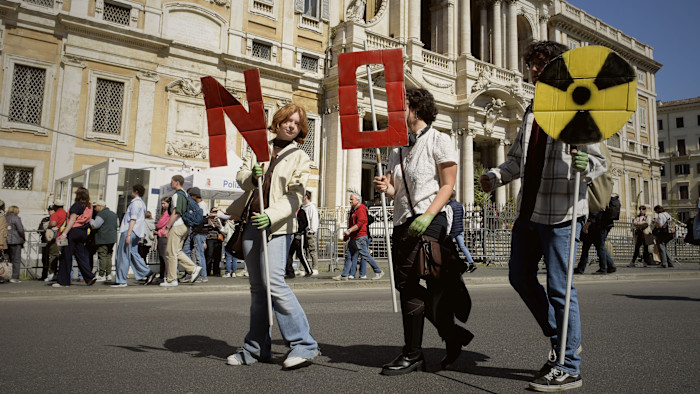
But as capacity expanded, so too did anti-nuclear sentiment. In 1987, after the Soviet Union’s Chernobyl disaster, Italians voted overwhelmingly against nuclear energy in a national referendum, leading to the shutdown of all atomic power stations by 1990.
Former Prime Minister Silvio Berlusconi later tried to revive the industry, passing new laws and developing new contracts. But in a second referendum months after Japan’s 2011 Fukushima nuclear accident, some 90 per cent of voters rejected Berlusconi’s plan.
Alessandra Fenizzi, Pratesi’s wife, who is also active in the fight against wind turbines, admits she once voted against nuclear power but now says: “We were wrong.”
British-born artist James P Graham, who has campaigned fiercely against the proposed RWE project, which threatens to tower over his villa, says it is “hypocritical and wrong” that Italians happily import nuclear-generated electricity from France while opposing production at home.


“Nuclear is the only constant source of energy we have right now,” Graham said.
Polls suggest Italians are far more open to domestic nuclear power production than in the past. A June YouTrend poll found that 57 per cent of respondents were positive about Meloni’s attempted nuclear revival, while 31 per cent viewed it negatively.
For all the current enthusiasm, Newcleo’s Buono says public support could waver when it comes to finding future sites for a new generation of small reactors. Members of Meloni’s coalition admit that another referendum cannot be ruled out either.
“Italians don’t like any power installation — wind turbines, solar power plants or nuclear reactors,” Buono said. When it comes to it, “we will be having the same problems as everyone else”.
Additional reporting by Giuliana Ricozzi
