
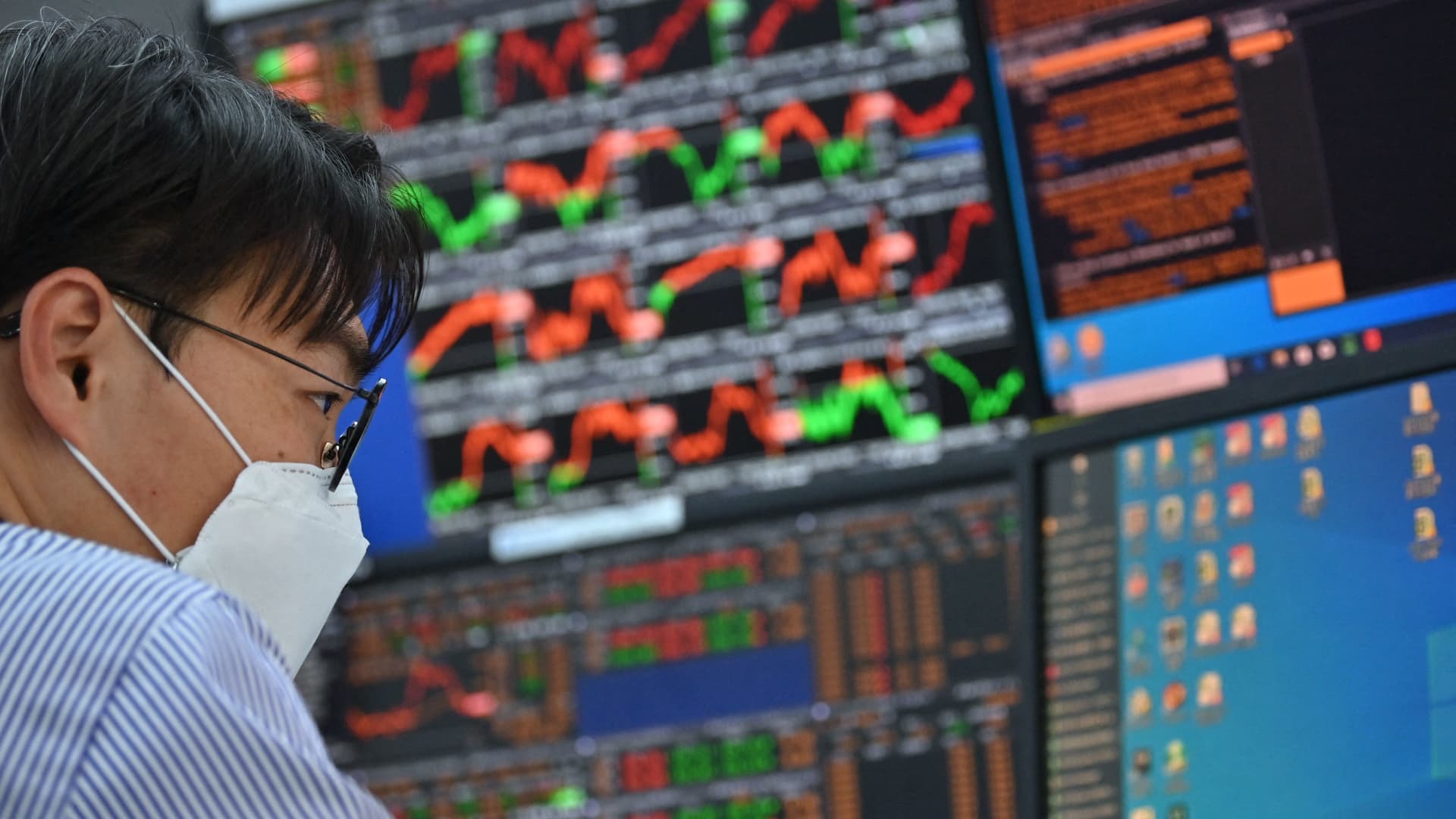
A currency dealer monitors exchange rates in a trading room at KEB Hana Bank in Seoul on June 21, 2021.
JUNG YEON-JE | AFP via Getty Images
Foreign investors have dumped billions of dollars’ worth of South Korean stocks this year, even as the Kospi has emerged as one of the world’s standout performers thus far, with record year-to-date gains.
On Monday, overseas investors had unloaded a net 1.24 trillion won (about $801 million) worth of Kospi-listed shares as of 11am Singapore time (11p.m. ET Sunday), according to Korea Exchange data.
“Foreign investors continued to sell the Kospi market, driven by outflows for Kospi Tech and Auto,” Goldman Sachs analysts wrote in a June 5 note.
The Kospi was down more than 8% at the open.
Yet many investors and strategists say foreign selling has less to do with deteriorating fundamentals and more to do with the market’s own success.
“This is essentially forced selling that we are seeing from our investors and clients,” said Chetan Seth, Nomura‘s Asia-Pacific equity strategist.
As Korean stocks have surged, their weightings in global and emerging-market benchmarks have increased sharply, forcing many active fund managers to trim positions to stay within portfolio and risk limits, investors told CNBC.
The selling pressure has been evident for months. Goldman estimated net foreign outflows from the Kospi had reached roughly $62 billion as of late May.
‘Structural pressures’
The phenomenon mirrors what happened in India in recent years, according to Nomura, where surging domestic retail participation increasingly crowded out foreign investors.
“I think the same dynamic might play out in Korea as well,” Seth added, noting that foreign investors may wait for better entry points after a pullback.
Nick Wilcox, head of Asian equities at Man Group, echoed that view, noting that Korea’s rapid ascent in emerging-market indices has created structural pressures for international investors.
The Kospi index
He added that some investors are also bumping up against regulatory restrictions on how much they can own of individual companies after Korea’s largest stocks surged.
“A lot of the selling is forced selling because investors are coming up against active limits.”
Yet foreign selling has been more than offset by a wave of domestic buying.
“The outflow from foreigners has been more than made up for by domestic investors,” Wilcox said, pointing to an estimated $70 billion of retail inflows this year and a sharp increase in brokerage account openings.
The selling also reflects growing concerns over risk concentration, as Korea’s rally has become increasingly dependent on Samsung Electronics and SK Hynix.
However, in spite of the offloading, market veterans maintained that the fundamentals of Korean equities remained robust.
“I don’t get a sense that investors are taking foreign investors are taking a negative view on Korea, right? So … I think it’s mechanical right now,” said Nomura’s Seth.
Similarly, Goldman Sachs remained bullish on Korean equities, raising its 12-month Kospi target to 12,000 and forecasting a further 37% upside in a note published Friday.
