
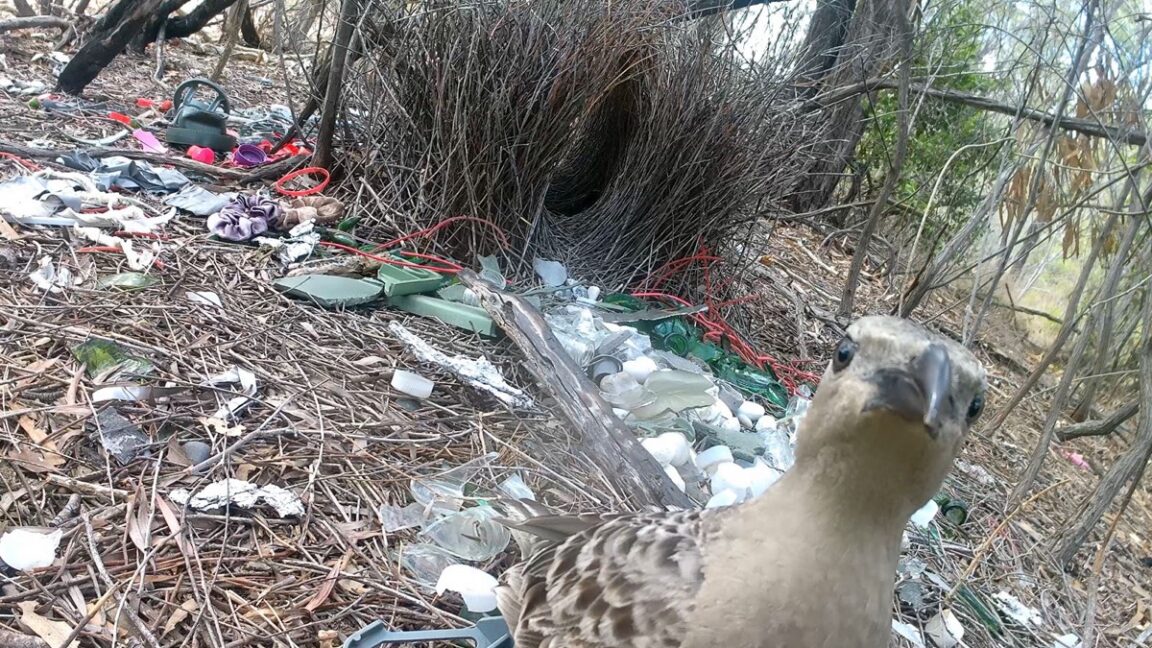
When the team returned to the sites, they determined which decorations had been selected from the slush pile and moved to a bower, and whether it came from an urban or rural source. After recording the data, all the original decorations were returned to their bowers.
Green glass and red wire
A male great bowerbird in a rural environment displaying to a female great bowerbird. Credit: Caitlin Evans
The subsequent analysis revealed that rural bowerbirds most often used green glass and green leaves or seeds for decoration, while urban birds preferred green glass and red wire. Plastic items were also popular, although “we also found items including a pair of handcuffs, medicine jars at bowers near a hospital, and fluorescent mouth guards from a site near an Australian Rules football ground,” said University of Exeter co-author Caitlin Evans.
Urban bower decorations were more than 10 times more likely to be human-made than those of rural bowers, which had more natural items, such as fruit, seeds, leaves, and sticks. Urban bowers also had nearly five times as many decorations as rural ones, averaging 90 items per bower compared to 20 for the rural birds. One overachieving urban male gathered 300 items to decorate his bower. Both urban and rural male bowerbirds showed a strong preference for human items when given a choice of items sourced from each environment. And red decorations in urban bowers were more vivid, and the green items duller, than in rural bowers.
