


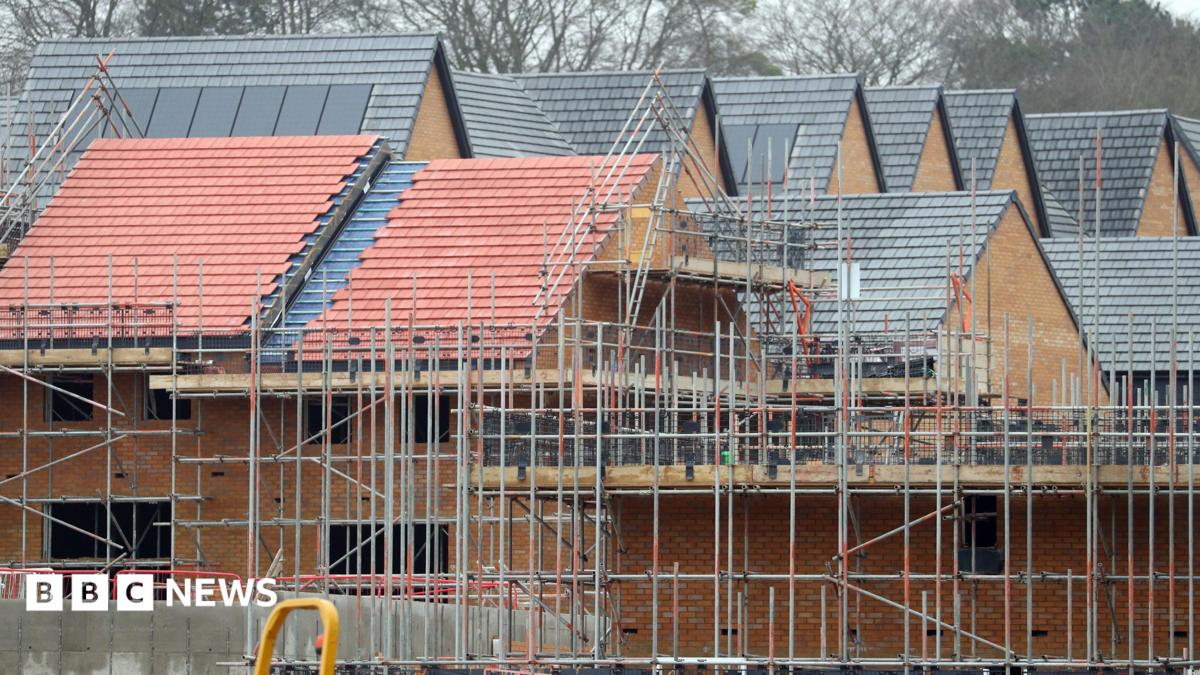
Mayors across England will be given new powers to overrule local councils on some planning decisions.
The change would apply to proposals with more than 150 homes, more than 15,000 square metres of commercial space or buildings over 30 metres.
Mayors in 13 areas including Manchester, Liverpool, the West of England and the West Midlands will gain similar powers to Sir Sadiq Khan in London, who is already able to “call in” planning decisions.
Housing minister Matthew Pennycook said the powers were an “essential part of the toolkit that mayors need to effectively deliver new homes and regeneration”.
The Conservatives questioned whether it was right for councils to lose the “ability to make planning decisions in their own communities”.
The powers will also be available to mayors in the Combined Authorities in North East England, South Yorkshire, West Yorkshire, York and North Yorkshire, Hull and East Yorkshire, Greater Lincolnshire, Cambridgeshire and Peterborough, East Midlands, and Tees Valley.
Housebuilding has fallen in London in recent years, but Pennycook insisted the “call in” powers had helped the mayor “unblock strategic growth sites” in the capital.
In the 2024 general election, the Labour government promised to build 1.5 million homes in England by the end of the decade but housebuilders have warned the target could be missed.
Pennycook said the government was “absolutely determined to stick with that ambition”.
He acknowledged the target was “really stretching” but said nearly 180,000 children were in temporary accommodation and “any smaller target wouldn’t be commensurate with the scale of the challenge”.
In addition to gaining the new “call-in” powers, mayors are set to be able to grant “up-front permission”, which the government says will allow building to begin “without a developer having to apply”.
A consultation on how the powers will work is due to be published next week.
The government has sought to stress that local councils will continue to decide the majority of applications and that all decisions must still follow planning rules.
It has also said mayors will get a “bigger say” over how housing funding is spent in their area, with the government directing national agency Homes England to focus on local mayors’ priorities.
New Prime Minister Andy Burnham, who served as mayor for Greater Manchester for nearly a decade, has repeatedly expressed his desire to transfer more powers to local mayors.
“Challenge does need to be made to local decision-making and actually it cuts both ways,” he told the Sunday Times.
“Sometimes it’s the other way round. It’s the local authority putting forward something that’s unacceptable in terms of the impact on the community. It’s a two-way street.”
Last month, Burnham promised to give all mayors a share of income tax revenue, saying he wanted to “bring power home” to “every postcode”.
Earlier this week, he announced a secondment programme to send high-performing civil servants to work in mayoral offices.
The approach has faced criticism from some in his own party and the Liberal Democrats, who fear it could create a “two-tier system” that discriminates against those areas that do not have an elected mayor.
