
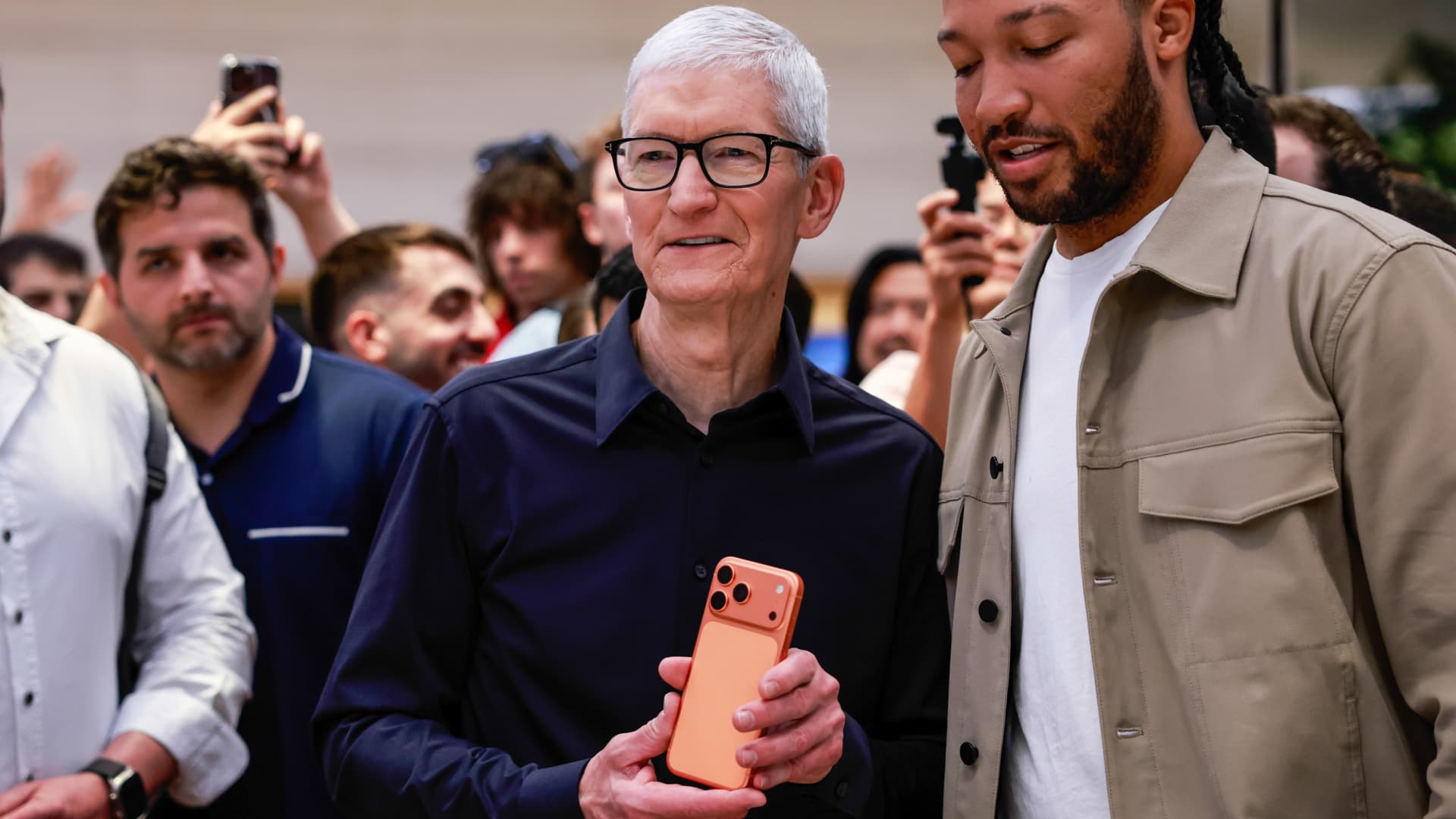
Apple CEO Tim Cook and Jalen Brunson, basketball player for the New York Knicks, during the first day of in-store sales of Apple’s latest products at Apple’s Fifth Avenue store in New York, Sept. 19, 2025.
Bloomberg | Bloomberg | Getty Images
For the past few years, consumers have been swarming to AI chatbots and agents, taking advantage of powerful new artificial intelligence models that are transforming how we live and work. They’re now paying for it, but not in the way they probably expected.
The AI boom has led to unconstrained demand for memory, creating a worldwide shortage that’s leading to increased prices. It’s a big enough problem that Apple is finally telling consumers to get ready to open their wallets.
Apple CEO Tim Cook told the Wall Street Journal, in an interview published on Wednesday, that the company plans price increases on its products due to the ongoing memory shortages. He called the hikes “unavoidable” and the memory situation “unsustainable.”
“The world is being disrupted by AI and, at the same time, even before we start reaping the benefits of AI in our devices, we are already paying the bill,” said Francisco Jeronimo, an analyst at IDC, in an interview.
AI chips, largely made by Nvidia, are taking all the memory and storage that a handful of vendors can produce. Smartphone, PC, and other device makers have to get in line, or pay more for expedited access. But Apple’s surprising disclosure, less than three months before Cook steps down as CEO, underscores the widespread impact of the shortage. To date, the iPhone maker has been viewed as particularly insulated from price increases due to its market power.
“It tells you the depth of the problem,” said Ranjit Atwal, an analyst at Gartner. “Even Apple can’t be safe, as much as they have all the expertise and long-term planning, and everything else. This is beyond their capacity to limit the impact.”
Cook declined to say in the interview when price increases would go into effect and on which devices and models. An Apple spokesperson declined to comment to CNBC.
One possibility is that Apple will reserve the price hikes for its premium devices, such as the Pro-series phones, because higher-end customers are more likely to be able absorb the hit. IDC’s Jeronimo expects Apple to boost the price on the $999 iPhone Pro and $1,199 iPhone Pro Max by $100, and to leave lower-end devices alone.
Analysts at BofA Securities, in a note on Thursday, agreed with that assessment, and said they’re also expecting price increases for most Mac and iPad models.
But there’s another potential approach, one that involves taking advantage of the situation to capture more market share.
Apple has in recent months been targeting budget-conscious consumers with recent launches of the $599 MacBook Neo and $599 iPhone 16e. Some analysts expect Apple could benefit as manufacturers of Android devices cut specs or raise prices. Average smartphone prices are expected to increase by 20% this year, according to IDC.
“This could be an amazing opportunity where Apple could say Android is going to face a real challenge with the price of chip increases,” said Simon Bryant, an analyst at research firm CCS Insight. “And maybe Apple could really use this to squeeze a lot of market share from Android.”
Typically a price increase from Apple comes with new features. For example, the company lifted the starting price of the Mac Mini desktop computer to $799 from $599 in May while adding storage.
For on-device AI, Apple is currently packing more RAM into each phone. Upgrades like a new custom Siri voice and dictation feature expected to launch this fall will be limited to a small number of newer iPhones, iPads, and Macs because the older and lesser-expensive ones can’t handle the memory-hungry options.
In the Journal interview, Cook talked about the kinds of memory Apple needs, namely DRAM, which is used for short-term data storage, and NAND, which is often referred to as a solid state drive and is used for long-term data storage.
AI chips for data centers use high-bandwidth memory, which is faster and requires more power than smartphone memory. One Nvidia Blackwell B200 chip has 192GB of high-bandwidth memory. Eight of them can go into a single server, and over 2,000 servers can be arranged into a single cluster.
An Apple iPhone, by contrast, comes with 8GB or 12GB of DRAM.
The problem is that all of it requires production capacity from three primary suppliers: Micron, SK Hynix, and Samsung. When a supplier like Micron makes one unit of HBM memory, it has to forgo making three units of more conventional smartphone memory, CNBC previously reported.
Memory suppliers are building new factories, called fabs, but much of the additional capacity could still go to the more profitable HBM memory, and the capacity is expected to take years to come online.
Cook told the Journal that Apple could use its cash reserves to help increase supply.
“We’re willing to use our balance sheet to help be a part of the solution,” he said.
WATCH: Apple flexes pricing power as memory costs surge

