
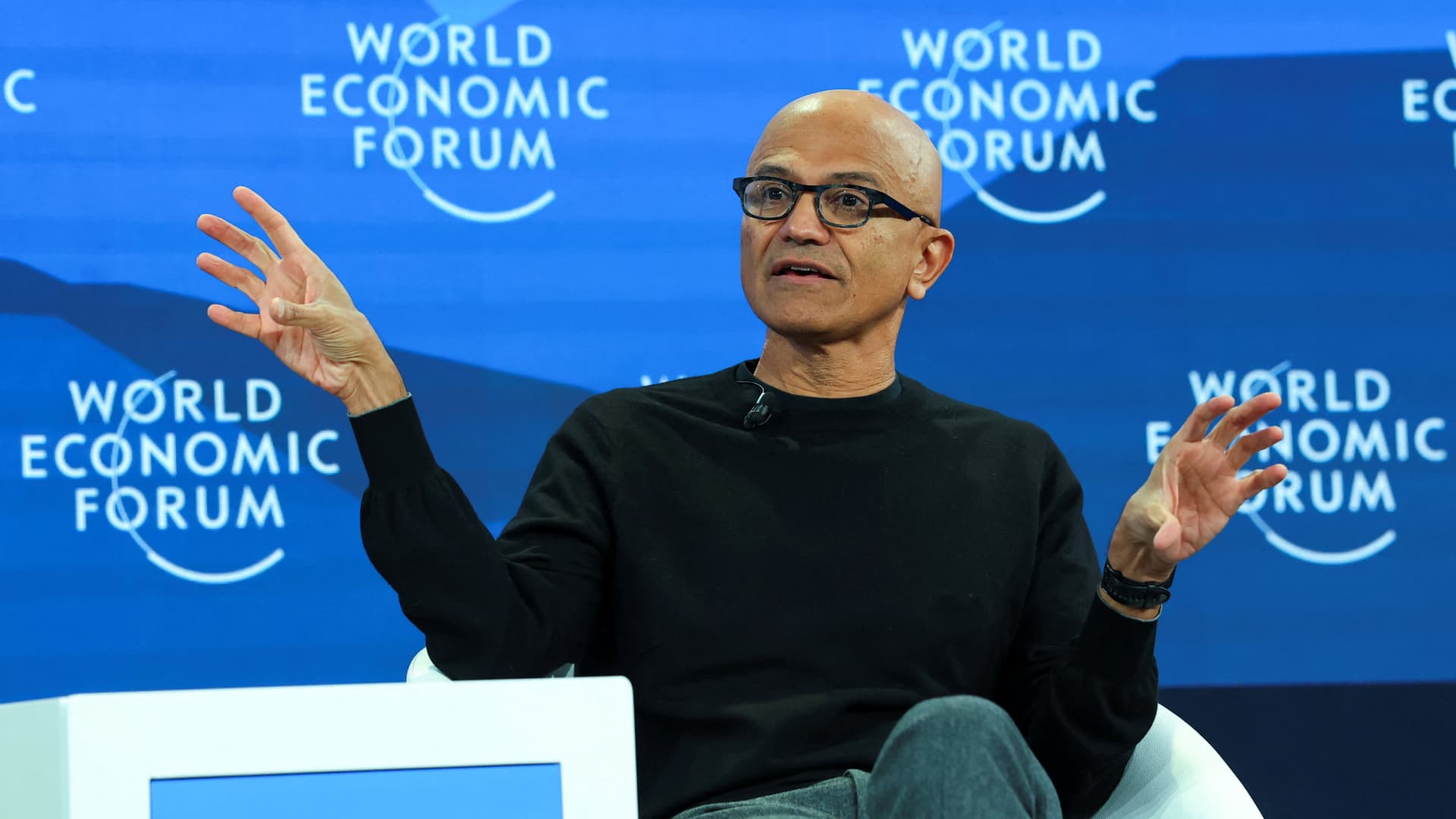
Microsoft CEO Satya Nadella attends the World Economic Forum meeting in Davos, Switzerland, on Jan. 20, 2026.
Denis Balibouse | Reuters
Microsoft has been a major player in the artificial intelligence boom, providing key cloud infrastructure and services and taking multibillion-dollar equity stakes in OpenAI and Anthropic. Now the company is making a concerted effort to compete with proprietary models.
At its Build developer conference in San Francisco on Tuesday, Microsoft announced MAI-Code-1-Flash, its inaugural model that takes written descriptions from people and spits out source code for applications and websites. The AI coding market, or vibe coding, has taken off of late, with developers and people without technical backgrounds using text-based prompts to produce sophisticated software.
For Microsoft, there are economic benefits to providing its own models that can be passed onto developers as costs jump for using the leading models. Microsoft can run its models on its own Azure cloud infrastructure and avoid paying third parties such as OpenAI. In May, Google announced the Gemini 3.5 Flash model that can code and carry out other tasks, running in the search company’s data centers.
In addition to MAI-Code-1-Flash, Microsoft is introducing MAI-Thinking, a reasoning model, and is playing up the efficiency for both offerings.
The reasoning model is medium-sized and “built for high efficiency and performance, but importantly, at a low-token cost,” Kyle Daigle, Microsoft’s developer marketing chief and GitHub operating chief, wrote in a blog post. Tokens are used by developers to pay for model use.
Microsoft is attempting to play at more layers of the AI stack as OpenAI and Anthropic continue to record historic growth and push toward the public market. Anthropic said on Monday that it confidentially filed for an IPO, and OpenAI is also pursuing an offering potentially this year. Microsoft has invested $13 billion in OpenAI and $5 billion in Anthropic, while making their models available through Azure.
MAI-Thinking-1 is available in a private preview through Microsoft Foundry, a service for integrating models into applications. Customers can express interest in testing the model before it becomes broadly available.
Customers will be able to increase the accuracy of the reasoning model by incorporating their own data.
“What you just saw is a pretty significant shift,” Microsoft CEO Satya Nadella said onstage. “We believe the time has come for every company to just move from consuming a frontier model to fully participating at the frontier in the frontier ecosystem.
After refining its models for the needs of consulting firm McKinsey, Microsoft was able to outperform OpenAI’s GPT 5-5, with 10 times better cost efficiency, said Mustafa Suleyman, CEO of Microsoft AI.
The coding model is “inference ultra-efficient,” Daigle wrote, and is available in the GitHub Copilot AI coding service and the Visual Studio Code text editor.
Also on Tuesday, Microsoft is revealing updated cloud-based models for speech recognition, synthetic voice generation and image generation, as well as small Aion models that can run on Windows PCs.
WATCH: Charles Lamanna, Microsoft EVP Copilot, Agents and Platform: A Fortt Knox Deep Dive
