
Stay informed with free updates
Simply sign up to the War in Ukraine myFT Digest — delivered directly to your inbox.
Russian shadow fleet ships have started to circumvent British and French waters after the two countries stepped up interceptions of the sanctioned vessels.
Five sanctioned tankers that had called at Primorsk, Russia’s largest oil-loading port, on Friday were making their way around the UK through the north Atlantic rather than taking the much shorter English Channel route, according to ship tracking data.
A further two close to the Portuguese coast had also taken the long route around the UK.
The diversions, which involve more than a day of extra sailing for each ship, come after 13 tankers were intercepted by French, British and Swedish militaries this year.
One of the enabling factors in two recent seizures by French and UK armed forces was a decision by Cameroon — under pressure from western governments — to eject 39 sanctioned vessels from its flag registry. That allowed European navies to intercept ships on the basis that they are sailing without a flag.
“Russian ships are doing everything they can to avoid their territorial waters,” said one EU security official, who declined to be named.
Territorial waters extend for 12 nautical miles or around 22km off the coast. Ships passing through the English Channel must pass through UK or French waters.
Since February 2022, Moscow has been gradually building a shadow fleet of more than 700 oil tankers to evade international sanctions imposed on its exports of fossil fuels, a major plank of the Russian economy.
Normally shadow fleet ships carry Russian oil from ports in the Baltic or Black Sea through the Mediterranean and on to Asia where it is often delivered to China’s independent, or ‘teapot’, refineries.
But the crackdown by European governments has pushed the vessels to take more circuitous routes to avoid being held up by western authorities.
More European countries including Ireland and Belgium are legislating to allow their armed forces to intercept and board sanctioned vessels.
States are not allowed to board or stop a ship that is properly flagged — meaning that another state has accepted responsibility for it. A vessel, however, can be boarded where there are reasonable grounds to suspect the vessel is without nationality.
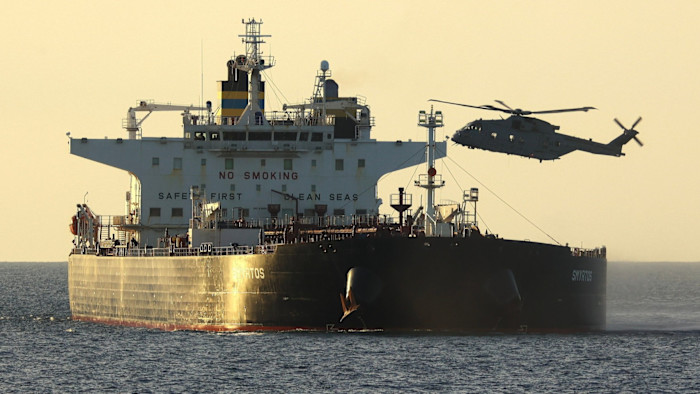
The UK seized the Smyrtos, one of those cut from the Cameroon registry, on June 14 while the French intercepted the Deliver, another previously Cameroon-flagged ship, off Sicily on June 23.
Of the five ships sailing around the UK on Friday, four were signalling to either Port Said or the Suez Canal suggesting that they would take the shorter route through the canal to Asia through the Mediterranean. One, the Nevah, listed its destination port as Singapore. The Nevah is Cameroon-flagged but has not been removed from its registry.
Another Cameroon-flagged ship that was among those removed, the Invicta, made the highly unusual decision on June 29 not to sail through the Mediterranean but instead to take a route around the Cape of Good Hope, adding 10 days or more to its voyage following France’s interception of the Deliver.
Around 21 flag registries are being used by the current shadow fleet, which includes hundreds more tankers carrying Iranian and Venezuelan oil, according to data from maritime intelligence platform Windward. The number of ships switching flags, either because there was a crackdown from a registry or to further obscure the ship’s identity, more than doubled last year, Windward found.
Avoiding the English Channel could require each ship to use as much as 100 tonnes of additional shipping fuel — known as bunker. Bunker fuel accounts for around 60 per cent of a ship’s voyage costs.
Map by Alan Smith
