
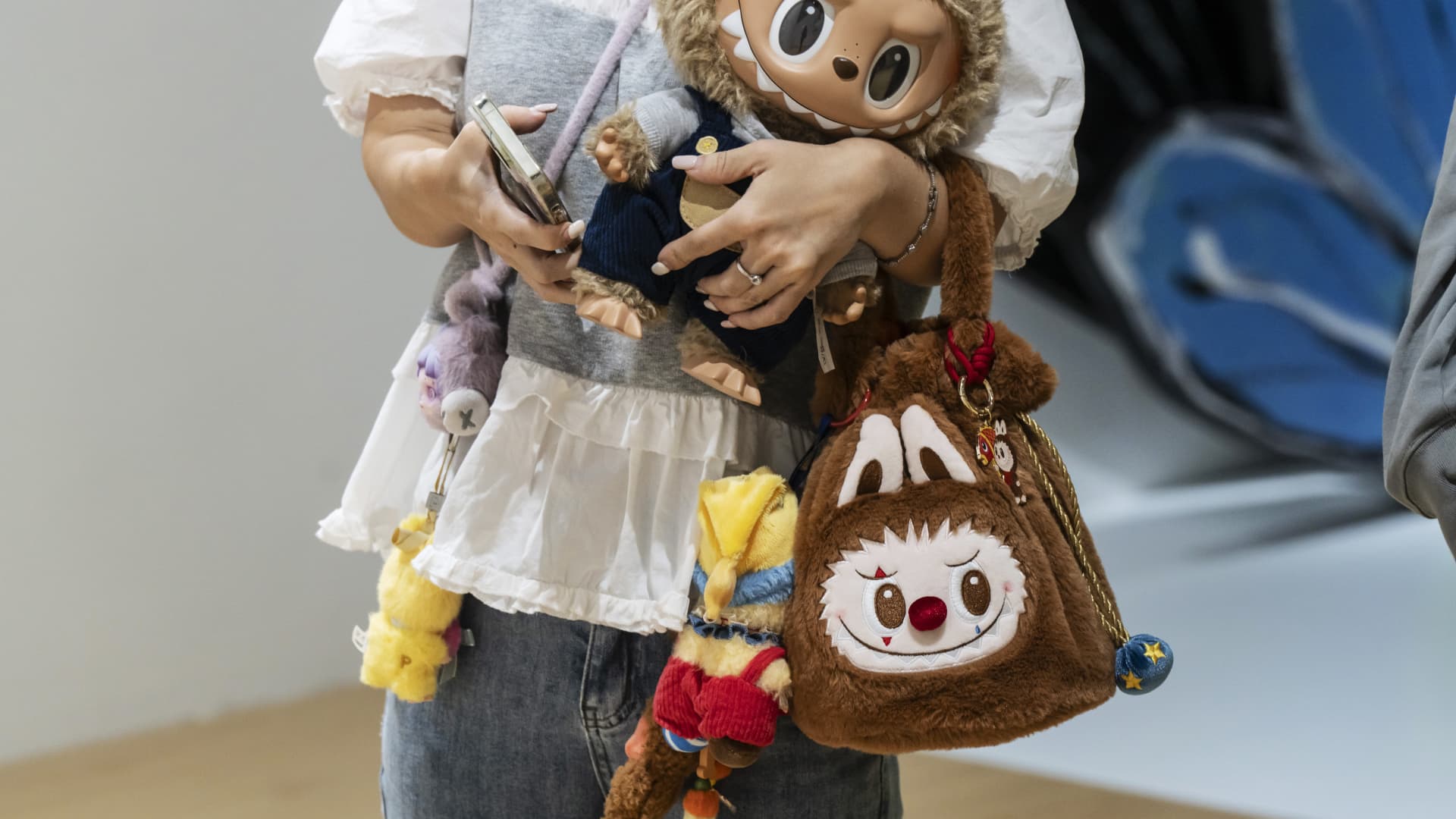
A visitor holds a Labubu doll at Pop Mart International Ltd.’s “Monsters by Monsters: Now and Then” ten year anniversary exhibition in Shanghai, China, on Wednesday, Oct. 15, 2025.
Qilai Shen | Bloomberg | Getty Images
Short sellers are doubling down on Pop Mart International even as a recent share price recovery makes their bearish bets on the Chinese toymaker look increasingly risky.
Short interest in Pop Mart climbed to 12.67% of shares outstanding as of Tuesday, up from 11.3% in April, according to S&P Global Market Intelligence data.
Pop Mart shares have more than halved from their peak in August last year to 153 Hong Kong dollars ($19.5), as of Tuesday. But the stock has recently recouped some ground, gaining 8% since its year-to-date low in April — leaving the Chinese toymaker as the only one of the 10 most-shorted stocks listed in Hong Kong where short sellers are currently losing ground, according to the market intelligence firm.
“Pop Mart stands out as the only stock on the list where shorts are losing money,” said Matt Chessum, executive director of equity and analytical products at S&P Global Market Intelligence, highlighting “resilient” consumer demand and the growing risk of a technical short squeeze as the stock rebounds off its April lows.
The persistent bearish bets reflect deepening tension between a sizable cohort of skeptical traders and the bulls. Bears have pointed to cooling demand signals in key overseas markets and question whether Pop Mart can sustain its breakneck growth, with concerns centered on waning appetite for the Labubu toy line — while bulls counter with new product launches and what they see as attractive valuations.
Citigroup’s director of equity research, Lydia Ling, retained a buy rating in June but trimmed her target price to 263 Hong Kong dollars, citing long-term growth potential anchored in Pop Mart’s IP development capability and overseas expansion, while flagging near-term overseas volatility as a headwind.
Melinda Hu, consumer equity research analyst at Bernstein, held on to an underperform rating with a target price of 181 Hong Kong dollars. The management’s tacit acknowledgment of “less accumulation” in teams, fan bases, and retail infrastructure in overseas markets compared to China validates underlying weakness, Hu said in her note, published after Pop Mart’s first-quarter results.
“Management’s ‘pit stop year’ framing, emphasis on quality over quantity, and organizational restructuring all signal decelerating growth,” Hu said. Pop Mart chairman and CEO Wang Ning used the pit stop analogy in the company’s 2025 annual report, describing the prior period of expansion as “F1-style” rapid acceleration and casting 2026 as a year of “pausing in the pit lane to refuel and replace tyres” as the company consolidates gains and pursues more sustainable growth.
The risks are ratcheting up on short sellers, with Pop Mart shares currently 92.4% utilized — meaning nearly all shares available for borrowing are already on loan — making it harder and more expensive for new bearish bets to enter positions, according to S&P Global.
“The execution of new shorts will become more challenging,” while fees remain high, Chessum said, adding that shorts’ profits will be limited by the cost to borrow.
— CNBC’s Justina Lee contributed to this report.
