
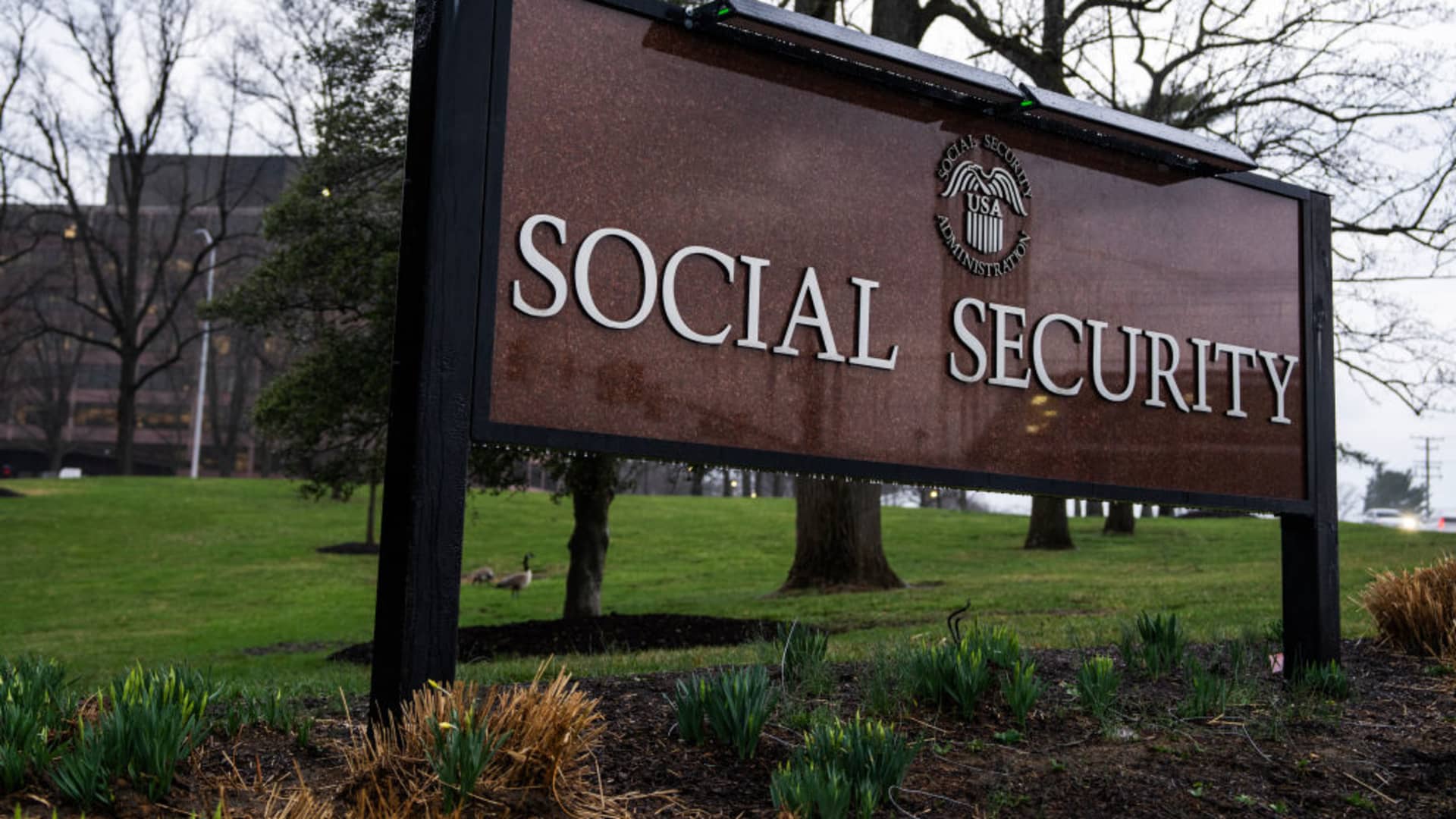
A sign for the U.S. Social Security Administration is seen outside its headquarters in Woodlawn, Md., on Thursday, March 20, 2025.
Tom Williams | Cq-roll Call, Inc. | Getty Images
The trust fund Social Security relies on to help pay retirement benefits may run out in 2032, at which point 78% of benefits will be payable, according to the Social Security Administration’s annual trustees report released on Tuesday.
That projected depletion date is one year sooner than had been estimated last spring.
The new projected depletion date follows the enactment of President Donald Trump’s “big beautiful” tax law, which Social Security’s chief actuary said in an August letter would have “material effects” on the financial status of the trust funds because it impacts income taxation of Social Security benefits. At that point, they estimated late 2032 for the retirement fund depletion date.
The OASI trust fund — formally known as Old Age and Survivors Insurance, or OASI — if combined with the disability insurance trust fund, may be able to pay full benefits until 2034, when 83% of benefits will be payable, according to the new report.
Social Security uses incoming revenue from payroll taxes to pay benefits. When benefit payments exceed that payroll tax income, the program relies on the trust funds to help make up the shortfall.
While current law prohibits combining the trust funds, Congress may authorize shifting money to cover benefit payments in the event of shortfalls. However, combining the trust funds would require taking money from beneficiaries with disabilities and putting it toward OASI beneficiaries, who include retirees, survivors and dependents, according to Shai Akabas, vice president of economic policy at the Bipartisan Policy Center, a Washington, D.C., think tank promoting bipartisanship.
“That solution is merely a band-aid,” Akabas said of combining the trust funds. “It’ll delay the point at which Congress would have to tackle the broader problem.”
The disability trust fund is projected to have a positive balance for the next 75 years, according to the new trustees’ report.
This is a developing story. Please refresh for updates.
