
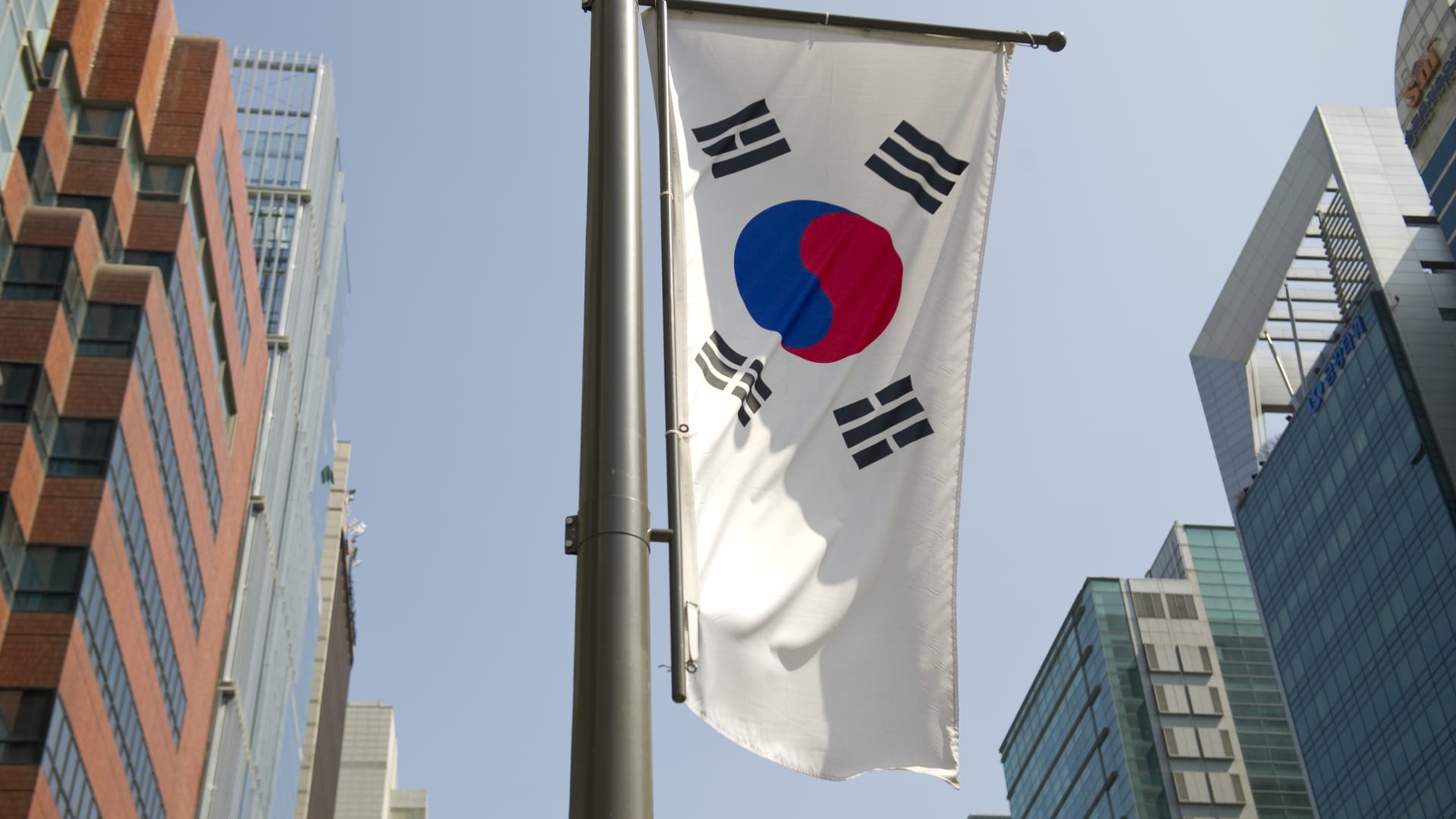
A South Korea flag is displayed against skyscrapers and businesses in Gangnam-gu, Seoul.
Ann Hermes | Christian Science Monitor | Getty Images
South Korea’s equity IPO activity has plummeted this year as efforts to boost corporate valuations run into trouble around governance reforms and the high amount Chaebols, or family-run conglomerates.
South Korea saw 15 new listings in the year to June 3, with proceeds totaling around $700 million, according to LSEG data. By comparison, new listings averaged 80 per year between 2020 and 2025, with around $8 billion, the data show. Malaysia’s new listings and proceeds almost double South Korea’s.
By contrast, the Kospi is the top-performing major index worldwide, more than doubling in value in the year to Monday.
Chaebols, which were once central to South Korea’s industrial development, are now “more of a hindrance than a help for creating new, independently listed champions,” according to Polka Mishra, partner at Javelin Wealth Management in Singapore. South Korea’s inheritance tax of 50% for amounts exceeding 3 billion won ($2 million) gives conglomerates an incentive to keep valuations and free float low, she said.
At issue: In 2024, South Korea launched the “Corporate value-up initiative” to end the so-called “Korea discount,” in which shares trade at lower levels than overseas peers. The country made three rounds of amendments to the Commercial Act to improve minority shareholder protection and corporate governance.
The five largest conglomerates – Samsung, SK, Hyundai Motor, LG, and HD Hyundai – accounted for around 70% of South Korea’s equity market cap as of Monday, according to Korea Exchange data
Parent-subsidiary listings, which refer to a unit pursuing its own listing, will “be prohibited as a general principle,” Korea Exchange CEO Jeong Eun-bo told CNBC on June 11. They can be seen as diluting the parent company’s value at the expense of minority shareholders while letting controlling families retain control of the newly listed subsidiary.
Measured by the value of cross-held shares between listed companies, these accounted for around 11% of South Korea’s total market cap as of last year, according to the Financial Services Commission, compared with about 4% in Japan and 3% in Taiwan.
South Korea’s market operator plans to direct capital to new companies by delisting around 300 companies by next year, Korea Exchange’s Jeong said.
The Korea Exchange is encouraging new listings while swiftly removing insolvent companies from the market, Jeong said. Ultimately, “so that we can cut off unfair trading practices and expand access for new ventures seeking to list.”
While the decline in numbers has raised parent companies’ valuations, the slowdown has dampened the fundraising and exit environment for venture capital funds, said Lee Hyo-seob, senior research fellow at the think tank Korea Capital Market Institute in Seoul.
The IPO slowdown suggests the market is “evolving into a more selective, quality-driven market, with capital increasingly concentrated in a narrower set of sectors and issuers,” said Jungik Park, IPO leader for South Korea at EY.
South Korea already has a “high number” of listed companies, totaling around 2,700, Park said. That’s roughly half the number in the U.S., even though South Korea’s equity market cap is only a fraction of that of the U.S.
The limited IPO activity in South Korea is a double-edged sword for the broader capital market, said Lee Hyo-seob, senior research fellow at the think tank Korea Capital Market Institute in Seoul.
While fewer parent-subsidiary listings have raised parent companies’ valuations, the slowdown has dampened the fundraising and exit environment for venture capital funds, Lee said.
Still, Jeong of Korea Exchange said the drop in IPOs reflected a transitional phase in the country’s efforts to boost corporate valuations.
“Once the government issues clearer guidelines on parent-subsidiary listings, I expect companies to move forward more actively with their listing processes,” he said.
AI IPO prospects
Going forward, analysts expect AI infrastructure companies to make up the bulk of South Korea’s IPO pipeline, reflecting the country’s stronghold in the chip sector led by Samsung Electronics and SK Hynix.
“Semiconductor and AI data centers require enormous capital expenditure and long-term capital deployment, meaning there are limits to what private capital alone can do,” Kang Jin-hyuk, a senior analyst at Shinhan Securities, said in a report published on May 22.
“Ultimately, the role of public funding and industrial financial support becomes even more important for the growth of Korea’s AI industry,” Kang said. He cited the example of the state-led National Growth Fund’s investments of around $130 million in each of the AI chip startups Rebellions and FuriosaAI.
