
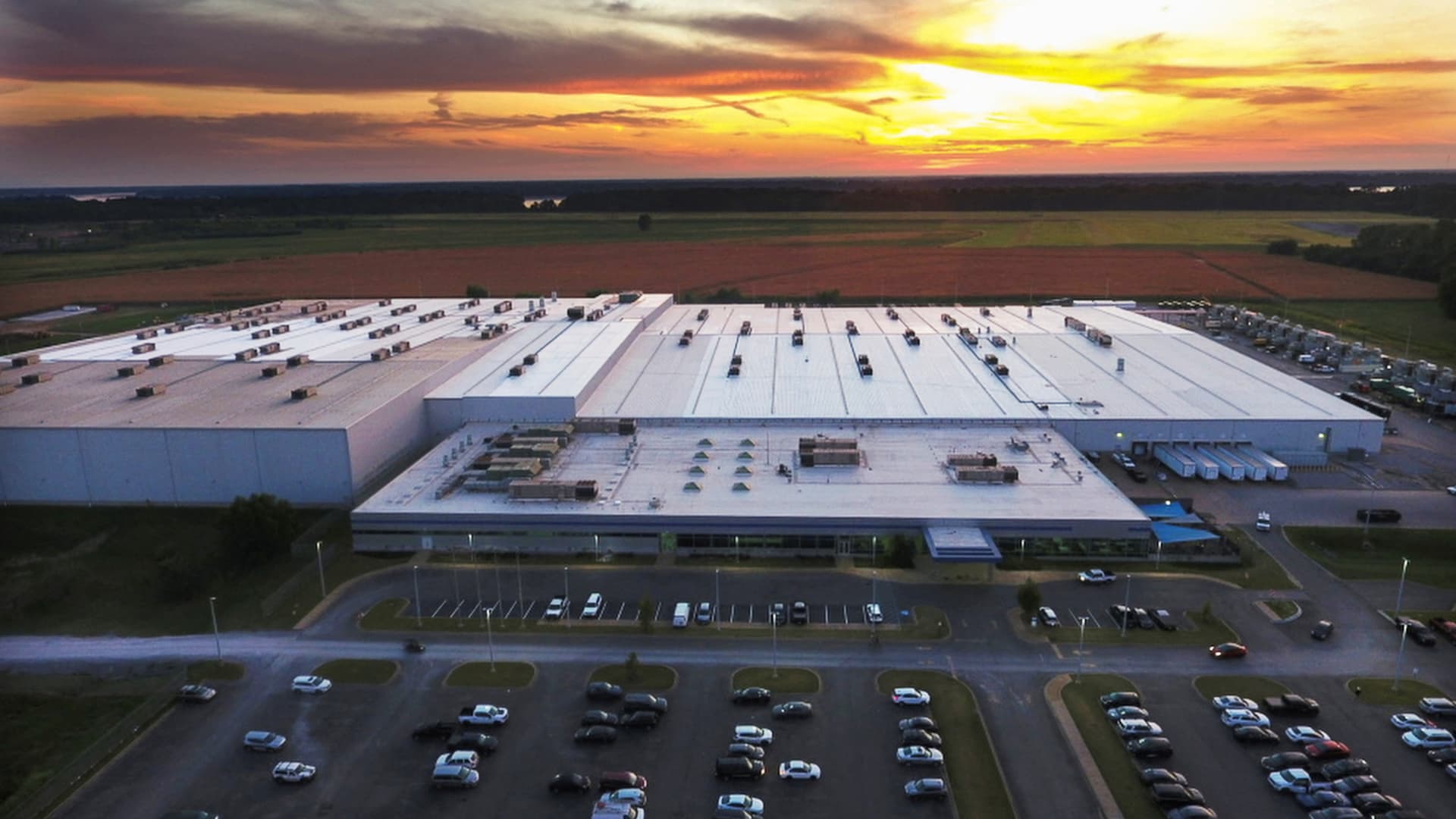
Elon Musk’s supercomputer Project Colossus, which he’s termed a “gigafactory of compute”, is seen in Memphis, Tennessee, U.S. August 22, 2024.
Karen Pulfer Focht | Reuters
SpaceX has signed a major computing power agreement with Reflection AI, making the open-source artificial intelligence startup the latest outside company to tap Elon Musk’s Colossus infrastructure.
Under the agreement, Reflection will get immediate access to Nvidia GB300s, top-of-the-line AI chips used to train and run advanced models, and has agreed to pay SpaceX $150 million per month beginning July 1, 2026, through 2029, according to materials viewed by CNBC.
The payments would total about $6.3 billion if the agreement runs through the end of its term.
Either company can end the contract with 90 days’ notice after the first three months.
The deal shows how SpaceX is using its massive data center build-out after its record initial public offering. The company built Colossus in part to power Grok, Musk’s AI chatbot and rival to ChatGPT. Now, SpaceX is also using that infrastructure to sell computing power capacity to outside AI companies.
SpaceX has already struck computing power-related deals with Anthropic, Google and Cursor, and Musk’s company is now acquiring Cursor. Reflection adds another customer to that roster, and a strategically different one: an AI lab focused on open-source models at a moment when governments and enterprises are reassessing dependence on closed AI systems.
The timing is notable. Open-source AI has gained momentum after Anthropic cut off access to Fable and Mythos, raising questions about the risks of relying on closed-model providers for critical work. The episode has given open-model companies a stronger argument that customers should be able to inspect, customize and run models with more control.
Reflection has leaned directly into that pitch as the startup, last valued at $25 billion, is trying to build American open-source AI models that can compete with frontier systems from OpenAI, Anthropic and Google, while offering governments and enterprises more flexibility than closed systems.
“Recent events highlight how important open source is to the AI ecosystem, with more nations and enterprises recognizing the risks and costs associated with exclusively depending on closed models,” a Reflection spokesperson said in a statement.
Reflection said the agreement gives it additional computing power, or compute, capacity to accelerate what it calls “American open intelligence.”
The startup has not yet released a public frontier open-source model, but it has been building momentum with government and national security customers. The company is working with the Department of Energy’s Genesis Mission and has been part of broader Pentagon AI efforts.
For SpaceX, the deal is another sign that compute itself has become strategic currency in the AI race. Access to advanced Nvidia chips remains one of the biggest constraints for companies trying to train and serve frontier models. By opening Colossus to outside customers, the company is positioning itself alongside cloud providers and AI infrastructure companies that are racing to sell scarce graphics processing unit capacity.
It also gives SpaceX another way to justify its growing AI infrastructure narrative.
Investors have been watching whether SpaceX can expand beyond rockets and Starlink into AI, data centers and compute services.
