
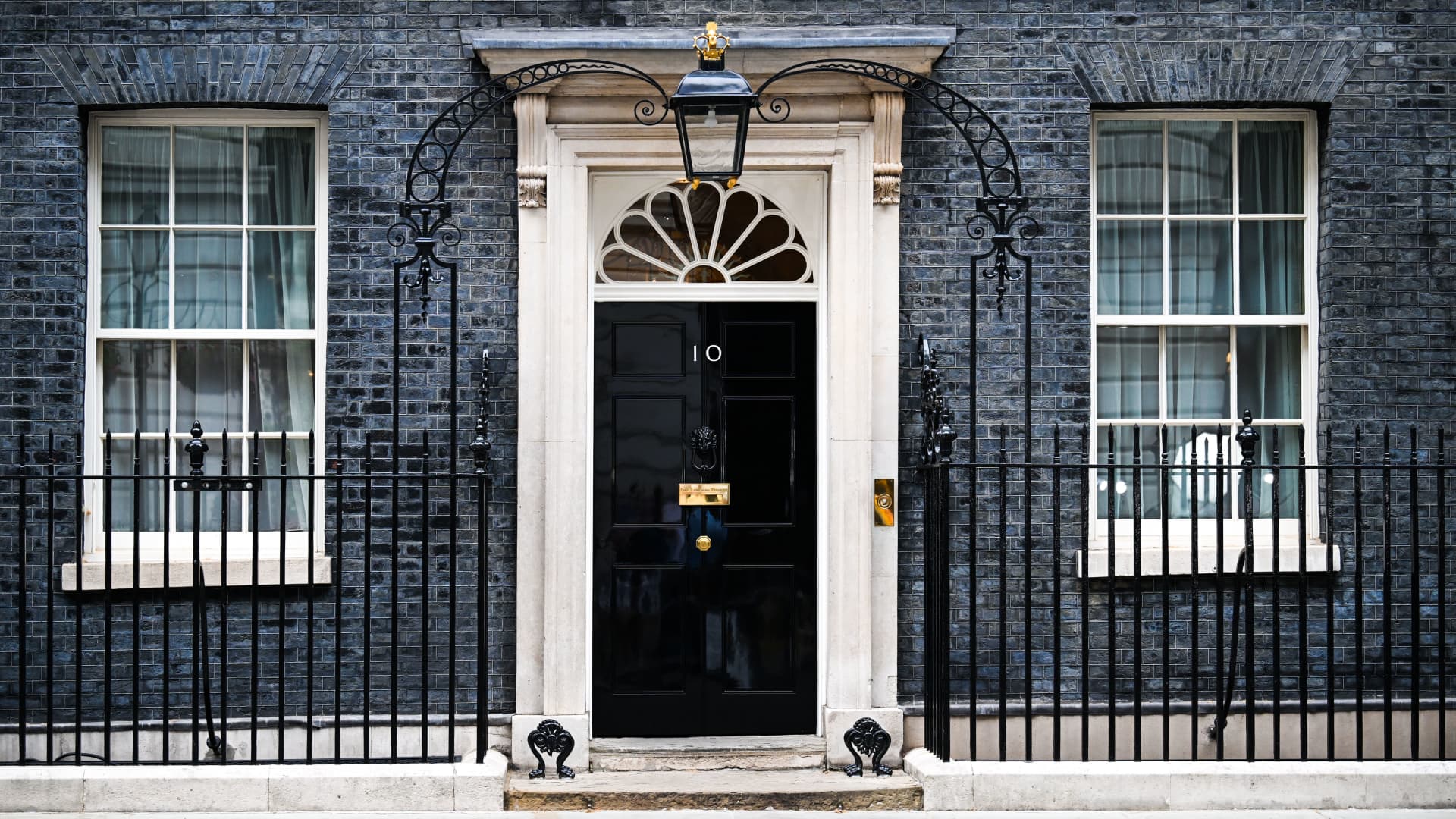
Number 10 Downing Street on June 22, 2026 in London, England.
Ben Montgomery | Getty Images News | Getty Images
This report is from this week’s CNBC’s UK Exchange newsletter. Like what you see? You can subscribe here.
The dispatch
The U.K. is facing its seventh prime minister in a decade after Keir Starmer announced on Monday that he will stand down.
That is two more than Italy — often cited in the U.K. as an example of how not to do things — has had over the same period.
As striking is that of the last five — Theresa May, Boris Johnson, Liz Truss, Rishi Sunak and Starmer — just one, Sunak, was ejected by voters in a general election. The rest were forced out by their own party.
It creates a sense that a country once renowned for political stability is now ungovernable.
However, while voters are restive and angry, this ungovernability cannot all be blamed on them.
As Luke Tryl, an influential pollster, points out, May demonstrated her lack of prime ministerial qualities by calling an unnecessary election in 2017, during which she threw away a parliamentary majority inherited from David Cameron. Johnson was undone by revelations of his conduct during Covid lockdowns and Truss by the adverse market reaction to her 2022 mini-Budget.
Now Starmer is going due to unpopularity, largely self-inflicted, after policy errors including scrapping the pensioners’ winter fuel allowance, hitting small farmers with inheritance tax increases and appointing a close friend of the late paedophile Jeffrey Epstein as ambassador to Washington.
So how did Britain get like this?
The chaos dates back to the defenestration of Margaret Thatcher, viewed by many as Britain’s greatest post-war prime minister, in 1990.
It was the first time in living memory a sitting prime minister had been forced from office by their own MPs, as opposed to losing a general election or standing aside of their own volition.
They were rewarded for their regicide when Thatcher’s successor, John Major, unexpectedly won the following election in 1992.
Conservative MPs have subsequently replaced leaders whenever they have concluded someone else would keep them in government — an approach validated when, after ditching May, they won the 2019 election under Johnson.
Starmer’s party, Labour, learned from this.
Tony Blair, the most successful post-Thatcher prime minister, was forced out in 2007 in favor of his Chancellor (or Finance Minister) Gordon Brown.
Now, Starmer is out after his MPs identified an alternative — then mayor of Greater Manchester, Andy Burnham — deemed more likely to save their jobs.
Some will say voters are too short-termist, too easily swayed by the media, too accepting of politicians promising European standards of public services and benefits funded by U.S. levels of taxation.
That has arguably made governing harder.
The U.K. has endured two decades of stagnating productivity and living standards following the global financial crisis, exacerbated by the Brexit vote a decade ago, the pandemic and two energy price shocks.
But poor policymaking, in areas such as energy and healthcare, undoubtedly hampered Britain’s ability to bounce back from these episodes. So too, in an era of constrained public finances, has a refusal to make hard decisions.
Starmer’s attempt to tackle Britain’s spiralling benefits bill was thwarted by his own MPs.
Ruling out tax increases for average earners, who remain more lightly taxed than they have been in 60 years, has left the Treasury dangerously dependent on the top 1% of earners, who pay around 26% of all income tax, while forcing Starmer’s government into other tax-raising options that hit growth.
The portents for change are not encouraging.
Burnham looks set to succeed Starmer unopposed despite failing to say what he would do in the job. He has an unfortunate reputation for telling people what they want to hear while avoiding tough decisions.
However, when politicians have squared with them, British voters have in the past volunteered for harsh medicine.
For example, in 2010, when Cameron told them the public finances required repair.
They did in 1979, when Thatcher told them inflation and the unions needed taming.
Burnham, assuming he succeeds Starmer, will get off to a strong start if he does the same — not least in being rewarded by the bond markets he has previously criticised.
But don’t count on it happening.
— Ian King
Need to know
Brexit 10 years later: How the UK economy and politics changed, in charts
CNBC breaks down the political and economic changes the country has seen since the vote.
Who is Andy Burnham? And 4 other things investors should know about the UK right now
A change in leadership does not automatically translate to a change in the country’s economic fortunes, strategists warned.
Bank of England holds interest rates at 3.75% amid Iran war peace prospects
The hold, which was in line with the expectations of economists polled by Reuters, was backed by seven of the nine monetary policy committee members in the BOE’s May meeting.
— Katrina Bishop
Coming Up
JUNE 29: Mortgage approvals; Lending data
JUNE 30: Q1 GDP
