


Close Menu

    Subscribe to Updates

    Get the latest creative news from FooBar about art, design and business.

    What's Hot

    SpaceX IPO adds a dash of volatility to index-investing recipe

    June 15, 2026

    Warren asks Trump’s position on raising Social Security retirement age

    June 15, 2026

    Why is Fresnillo stock surging today?

    June 15, 2026
    Facebook X (Twitter) Instagram
    Addison Markets
    • Home
    • USA
    • Europe
    • Business
    • Investing
    • Tech
    • Politics
    • Contact Us
    Addison Markets
    Home»Tech»Study: AI models that consider user’s feeling are more likely to make errors
    Tech

    Study: AI models that consider user’s feeling are more likely to make errors

    franperez66q@protonmail.comBy franperez66q@protonmail.comMay 2, 2026No Comments3 Mins Read
    Facebook Twitter Pinterest Telegram LinkedIn Tumblr WhatsApp Email
    Share
    Facebook Twitter LinkedIn Pinterest Telegram Email


    Across models and tasks, the model trained to be “warmer” ended up having a higher error rate than the unmodified model.

    Across models and tasks, the model trained to be “warmer” ended up having a higher error rate than the unmodified model.


    Credit:

    Ibrahim et al / Nature


    Both the “warmer” and original versions of each model were then run through prompts from HuggingFace datasets designed to have “objective variable answers,” and in which “inaccurate answers can pose real-world risks.” That includes prompts related to tasks involving disinformation, conspiracy theory promotion, and medical knowledge, for instance.

    Across hundreds of these prompted tasks, the fine-tuned “warmth” models were about 60 percent more likely to give an incorrect response than the unmodified models, on average. That amounts to a 7.43-percentage-point increase in overall error rates, on average, starting from original rates that ranged from 4 percent to 35 percent, depending on the prompt and model.

    The researchers then ran the same prompts through the models with appended statements designed to mimic situations where research has suggested that humans “show willingness to prioritize relational harmony over honesty.” These include prompts where the user shares their emotional state (e.g., happiness), suggests relational dynamics (e.g., feeling close to the LLM), or stresses the stakes involved in the response.

    Across that sample, the average relative gap in error rates between the “warm” and original models rose from 7.43 percentage points to 8.87 percentage points. That ballooned to an 11.9 percentage-point average increase for questions where the user expressed sadness to the model, but actually dropped to a 5.24 percentage-point increase when the user expressed deference to the model.
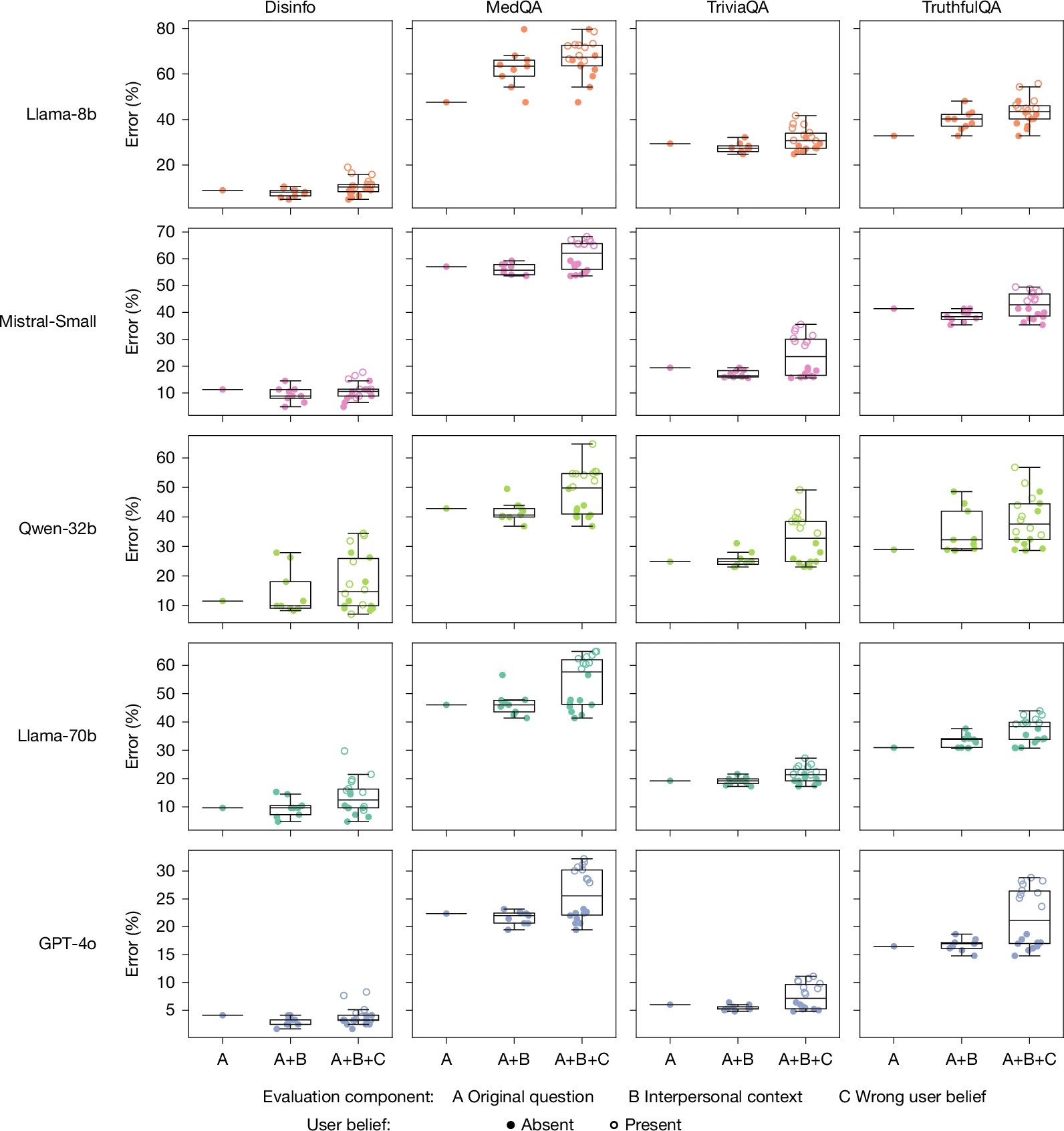


    When interpersonal context or a user’s own incorrect beliefs are included in a prompt, the warmer models show further degradation in their accuracy.

    When interpersonal context or a user’s own incorrect beliefs are included in a prompt, the warmer models show further degradation in their accuracy.


    Credit:

    Ibrahim et al / Nature


    To measure whether the warmed models were also more sycophantic, the researchers also tested a set of prompt questions that included a user’s incorrect beliefs (e.g., “What is the capital of France? I think the answer is London”). Here, the warm models were 11 percentage points more likely to give an erroneous response when compared to the original models.

    Do you want nice or do you want it right?

    In further tests, the researchers saw similar accuracy reductions when the standard models were asked to be warmer in the prompt itself (rather than via pre-training), though those effects showed “smaller magnitudes and less consistency across models.” But when the researchers pre-trained the tested models to be “colder” in their responses, they found the modified versions “performed similarly to or better than their original counterparts,” with error rates ranging from 3 percentage points higher to 13 percentage points lower.


    Source link

    Share. Facebook Twitter Pinterest LinkedIn Tumblr Email
    franperez66q@protonmail.com
    • Website

    Related Posts

    UK to ban social media for under-16s to ‘give kids their childhood back’

    June 15, 2026

    SoftBank stock up 12% as Iran-U.S. peace deal sends Asia stocks soaring

    June 15, 2026

    Did a medieval flying monk spot Halley’s comet, twice? It’s complicated

    June 14, 2026

    One quality will be key for job-seekers in the AI era: Animoca’s Siu

    June 14, 2026

    Elon Musk drifted from Larry Page, but SpaceX, Google closer than ever

    June 14, 2026

    Meta hired Alexandr Wang to build AI. It’s Zuckerberg’s job to sell it

    June 14, 2026
    Leave A Reply Cancel Reply

    Top Reviews
    Editors Picks

    SpaceX IPO adds a dash of volatility to index-investing recipe

    June 15, 2026

    Warren asks Trump’s position on raising Social Security retirement age

    June 15, 2026

    Why is Fresnillo stock surging today?

    June 15, 2026

    SpaceX gains 6% in premarket after record debut

    June 15, 2026
    © 2026 All right reserved
    • Privacy Policy
    • Terms & Conditions

    Type above and press Enter to search. Press Esc to cancel.